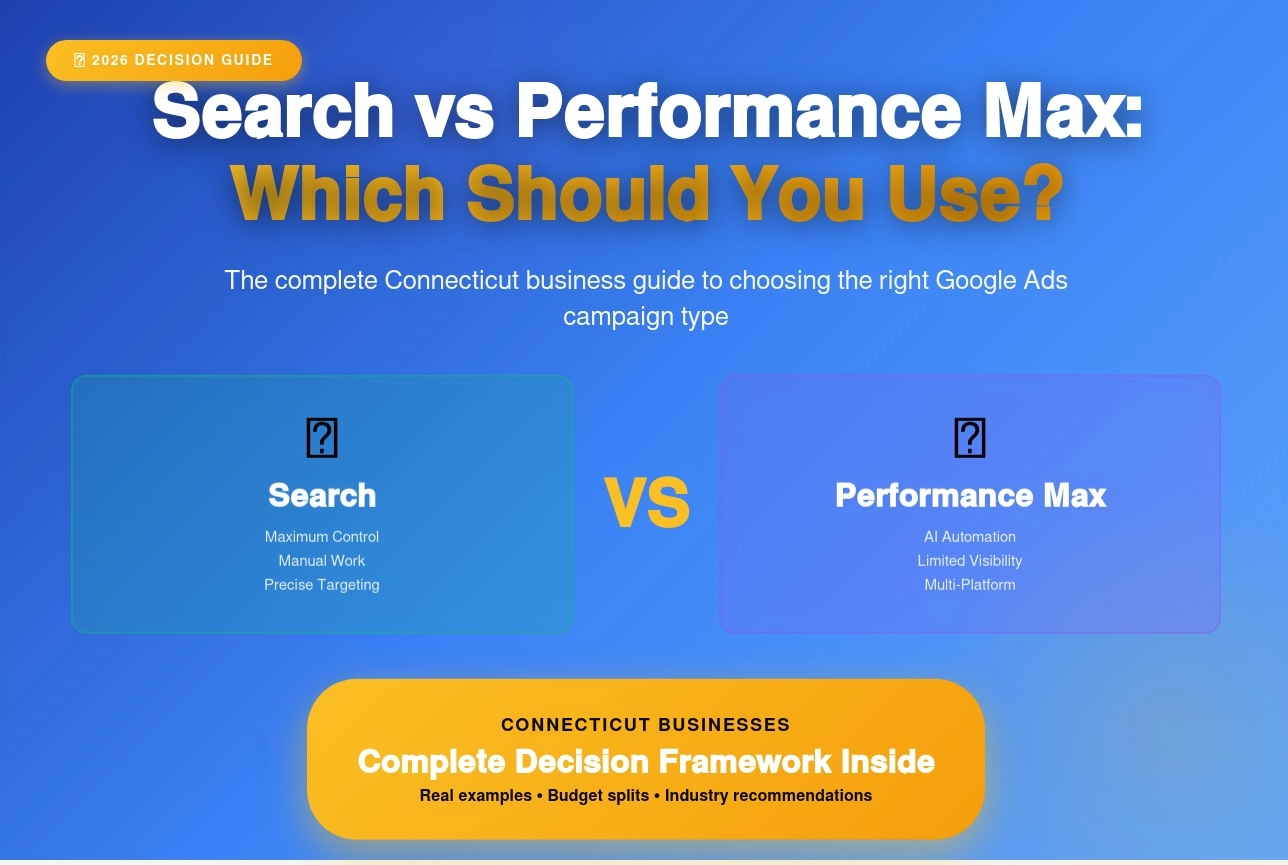
Google Ads Search vs Performance Max in 2026: When to Use Each
Renzo Orellana
January 13, 2026
If you're running Google Ads in 2026, you've probably noticed that Google keeps pushing Performance Max campaigns. Your agency might be recommending it. Your competitor might be using it. But here's what nobody's telling you: Performance Max isn't always the right choice, and Search campaigns aren't dead.
Google Ads Search vs Performance Max in 2026: When to Use Each
Most Connecticut businesses are asking the wrong question about Google Ads.
It's not "Should I use Search or Performance Max?" It's "When should I use each—and how do I know?"
If you're running Google Ads in 2026, you've probably noticed that Google keeps pushing Performance Max campaigns. Your agency might be recommending it. Your competitor might be using it. But here's what nobody's telling you: Performance Max isn't always the right choice, and Search campaigns aren't dead.
I run RDC Group, a digital consulting firm that helps Connecticut businesses own their marketing automation instead of paying agencies forever. Over the past year, we've managed both Search and Performance Max campaigns for businesses spending $3,000 to $50,000 monthly on Google Ads. We've seen which works when, and more importantly, why.
In this guide, you'll learn:
The real differences between Search and Performance Max (beyond what Google tells you)
When to use Search campaigns vs Performance Max based on your industry and goals
How Connecticut businesses are running hybrid strategies to get the best of both
A decision framework you can use today to choose the right campaign type
Real examples from dental practices, ecommerce stores, and service businesses in Connecticut
Let's start with what actually matters.
What Search and Performance Max Actually Do (The Truth)
Google's marketing materials make both campaign types sound amazing. But after managing millions in ad spend across Connecticut businesses, here's what each actually delivers.
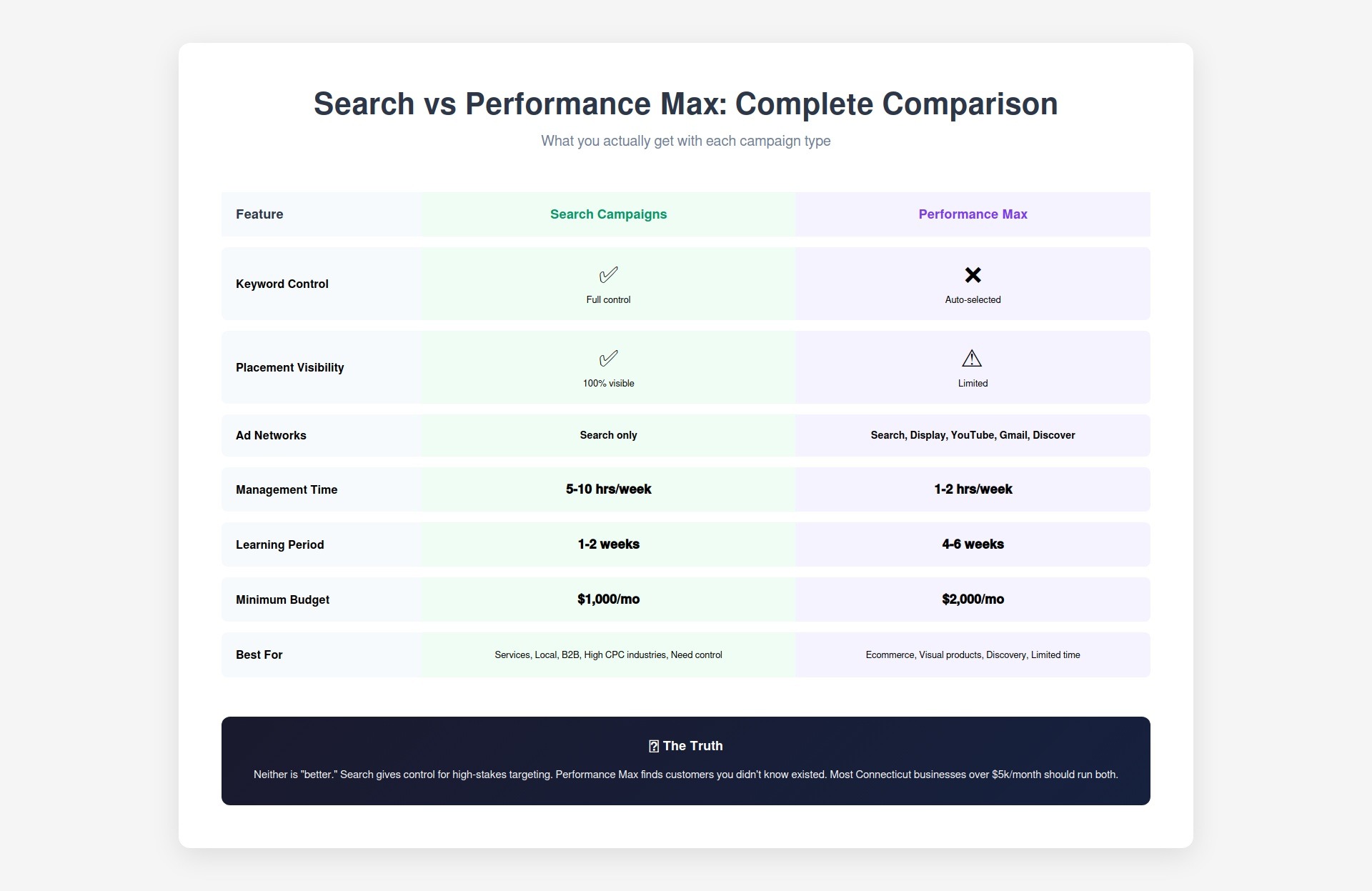
Search Campaigns: Maximum Control, Manual Work
Search campaigns show your ads when people search specific keywords on Google Search.
What you control:
Exact keywords you bid on
Individual keyword bids
Ad copy for each ad group
Landing pages for each keyword
Geographic targeting
Audience layers
Budget allocation
Bid strategies
What you see:
Which keywords triggered ads
Exact search terms people used
Cost per keyword
Quality Score per keyword
Conversion rates by keyword
Hour-by-hour performance
The reality: You know exactly what's happening, but you need to actively manage it. If you (or your agency) ignore the account for two weeks, performance drops.
Connecticut businesses that succeed with Search campaigns typically:
Have someone checking the account 2-3 times per week minimum
Are comfortable analyzing data and making bid adjustments
Want to control exactly which searches trigger their ads
Need to exclude specific search terms or competitors
Have clear keyword intent (people searching for exactly what they offer)
Performance Max: Automation Over Everything, Limited Visibility
Performance Max campaigns use Google's AI to show ads across Search, Display, YouTube, Gmail, and Discover—all in one campaign.
What you control:
Overall budget
Conversion goals
Asset groups (images, headlines, descriptions, videos)
Audience signals (suggestions, not targeting)
Geographic boundaries
Final URLs
What you DON'T control:
Where your ads actually show
Which headlines/images are used together
Bid amounts for different placements
Search terms that trigger your ads (mostly hidden)
How budget splits across placements
What you see:
Total performance (impressions, clicks, conversions, cost)
The reality: Google's AI runs your campaign. You provide assets and goals, then hope it works. You can't see what's actually happening under the hood.
Performance Max works well for Connecticut businesses that:
Have clear conversion tracking set up correctly
Can provide quality assets (10+ images, 5+ headlines, videos)
Are willing to let Google's algorithm learn for 2-4 weeks
Trust automation over manual control
Want to test multiple placements simultaneously
According to Google's Performance Max documentation, the algorithm optimizes toward your conversion goals across all Google properties. But that optimization requires data—and time.
The Connecticut Context: What We've Learned Managing Both
Here's what we've seen managing both campaign types for Connecticut businesses across different industries and budgets.
Search Campaigns Work When:
1. You know exactly what people search for
A Stamford-based personal injury law firm we work with spends $8,000/month on Search campaigns targeting keywords like:
"car accident lawyer Stamford CT"
"workers compensation attorney Connecticut"
"slip and fall lawyer near me"
These searches have clear intent. Someone searching these terms needs a lawyer right now. Search campaigns capture that exact moment.
Performance Max would waste budget showing these ads on YouTube or Gmail to people not actively looking for a lawyer.
2. You need to exclude competitors or specific terms
A Hartford dental practice was getting clicks from people searching "dental school Hartford" and "dental assistant jobs Connecticut"—zero conversion intent.
With Search campaigns, we added negative keywords immediately. Performance Max doesn't give you that control. You'd waste budget for weeks while the algorithm "learns" those searches don't convert.
3. Your industry has high cost-per-click
Legal, dental, and home services in Connecticut often see $20-150 per click. At those prices, you need to control exactly which searches trigger ads.
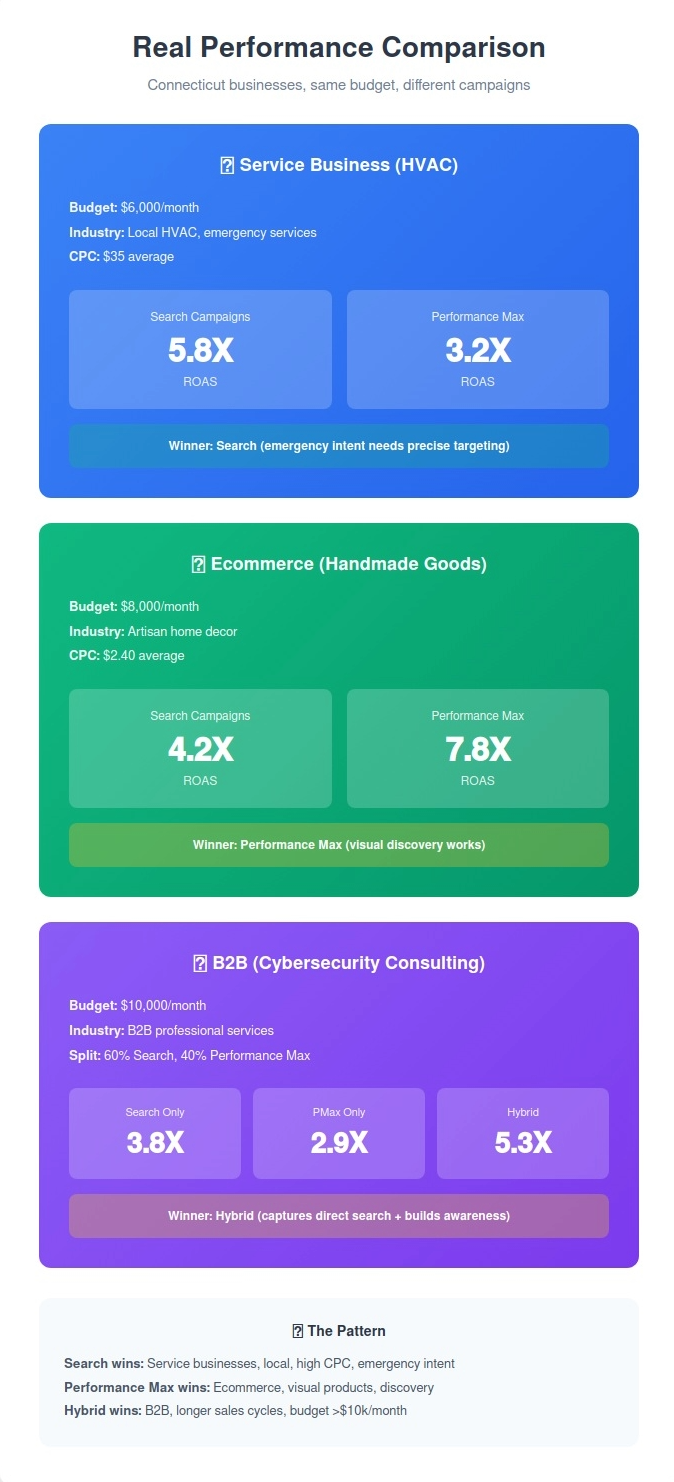
A New Haven HVAC company paying $45 per click can't afford to let Google's algorithm "experiment" with their budget across Display and YouTube placements that might never convert.
4. You have local service area restrictions
Many Connecticut service businesses serve specific towns or counties. A plumber in Fairfield County doesn't want calls from New London County—it's 90 minutes away.
Search campaigns let you set exact geographic boundaries. Performance Max geographic targeting is less precise, especially when your ads show on YouTube or Display networks where location signals are weaker.
Performance Max Works When:
1. You sell products online (ecommerce)
An ecommerce brand selling handcrafted home goods saw Performance Max outperform their Search campaigns by 140% ROAS.
Why? Performance Max could show:
Search ads to people actively looking
Display ads on home decor blogs
YouTube ads on DIY channels
Shopping ads with product images
Discovery ads to people browsing gift ideas
The algorithm found customers they didn't know existed. Their Search campaigns only captured people searching "handmade wooden bowls"—Performance Max found people who didn't know they wanted wooden bowls yet.
This aligns with what we covered in our ChatGPT Shopping article—ecommerce needs to capture intent at multiple touchpoints, not just direct searches.
2. You have limited time to manage campaigns
A Westport-based consultant spending $3,000/month didn't want to check Google Ads daily. Performance Max requires 2-3 hours of setup, then mostly runs itself.
We check it weekly for major issues, adjust budget monthly, and refresh assets quarterly. That's it. A Search campaign would need daily keyword bid adjustments to maintain performance.
3. You want to test new customer segments
A Norwalk fitness studio thought their customers were primarily 25-35-year-old women. Performance Max revealed their best converters were actually 40-55-year-old women and 30-40-year-old men—segments they'd never targeted.
The algorithm found these audiences by testing ads across Display, YouTube, and Discovery. A Search campaign would have missed them entirely because they weren't searching "personal training Norwalk CT."
4. Your business has strong visual appeal
A boutique hotel in Mystic uses Performance Max because their property photographs beautifully. The algorithm shows these images across:
Display network on travel blogs
YouTube on Connecticut tourism videos
Discovery feed for people researching New England getaways
Search for direct "boutique hotels Connecticut" queries
Search campaigns would only show text ads. Performance Max leverages their visual assets everywhere.
The Decision Framework: Which Should You Use?
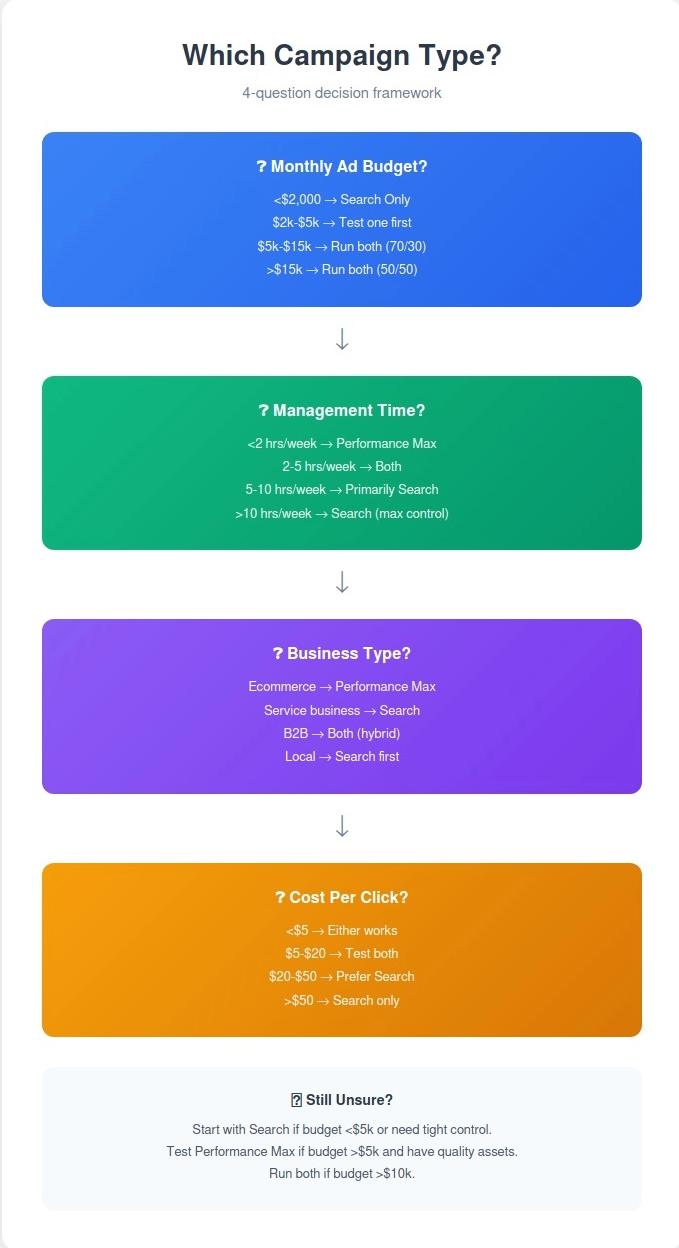
Here's the framework we use with Connecticut clients to decide between Search, Performance Max, or both.
Start with These Four Questions:
Question 1: Do you know exactly what your customers search for?
YES → Strong case for Search campaigns
NO → Lean toward Performance Max
If you can list 20+ high-intent keywords that your customers definitely search, Search campaigns work well. If you're guessing at keywords or your product/service doesn't have clear search intent, Performance Max will find customers you didn't know existed.
Question 2: What's your monthly ad budget?
Under $2,000/month → Search campaigns only (Performance Max needs data to learn)
$2,000-$5,000/month → Test Performance Max OR run Search
$5,000-$15,000/month → Run both (70% Search, 30% Performance Max to start)
Over $15,000/month → Definitely run both, potentially 50/50 split
Performance Max algorithms need volume to optimize. Under $2,000/month, you won't generate enough conversions for the algorithm to learn effectively.
Question 3: How much time can you dedicate to management?
Less than 2 hours/week → Performance Max (minimal management needed)
2-5 hours/week → Performance Max with some Search testing
5-10 hours/week → Balanced Search and Performance Max
10+ hours/week → Primarily Search (maximum control and optimization)
Be honest here. If you or your team can't check campaigns 2-3 times weekly, Search campaigns will underperform. Performance Max requires far less active management.
Question 4: Is your business visual or service-based?
Visual products (ecommerce, hotels, restaurants, retail) → Performance Max advantage
If you can showcase your product/service in compelling images or videos, Performance Max will leverage those assets everywhere. If you're selling services where visuals don't matter much, Search campaigns' text ads work fine.
The Hybrid Strategy: When to Run Both
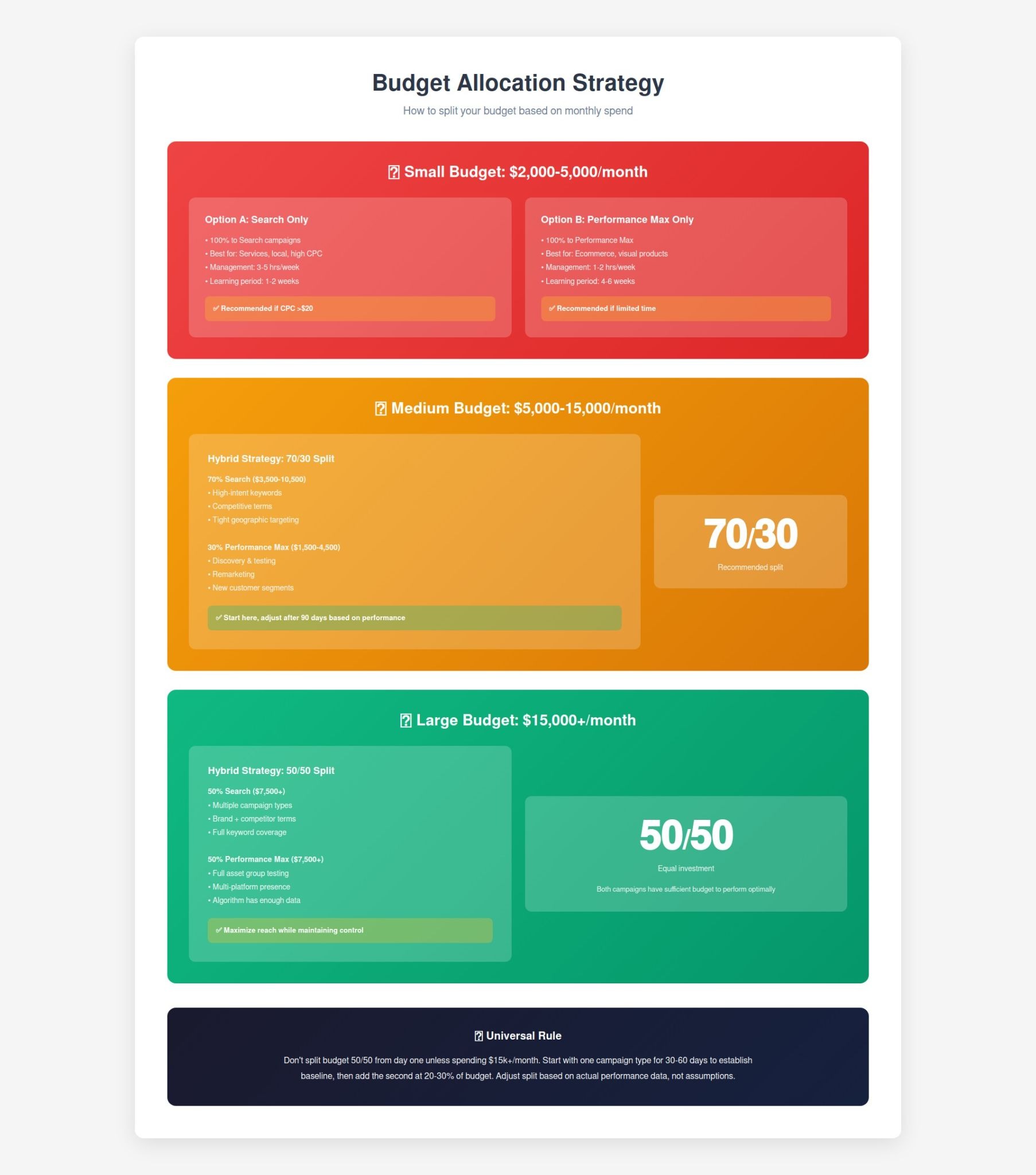
Many Connecticut businesses get the best results running both campaign types. Here's when that makes sense and how to structure it.
Best candidates for hybrid strategy:
Monthly ad spend over $5,000
Both high-intent keywords AND discovery potential
Someone managing campaigns 3-5 hours per week
Want to maximize reach without losing control
How we structure hybrid campaigns:
For a $10,000/month budget:
$7,000 to Search campaigns (70%)
Target high-intent keywords with proven conversion history
Maintain tight control over cost-per-click
Quickly adjust for market changes or seasonality
Use for competitive terms where you want guaranteed visibility
$3,000 to Performance Max (30%)
Test new customer segments
Expand reach beyond search
Let algorithm find unexpected conversion opportunities
Use for remarketing and discovery
As Performance Max proves itself (typically 60-90 days), we might shift to 60/40 or even 50/50.
Real Example - Hartford Marketing Agency:
Client: B2B marketing agency spending $12,000/month on Google Ads
What we did:
Month 1-2: 100% Search campaigns to establish baseline performance
Result: 3.2X ROAS, $3,750 cost per client acquisition
Month 3: Launched Performance Max with $2,500/month (21% of budget)
Let it run without touching it for 45 days
Month 4-5: Performance Max found new customer segment (enterprise clients vs small business)
Result: 4.8X ROAS on Performance Max, $2,800 cost per client acquisition
Month 6: Adjusted to 60% Search ($7,200), 40% Performance Max ($4,800)
Combined result: 4.1X ROAS, $3,100 average cost per client acquisition
22% more clients than Search-only approach
The hybrid strategy gave them the control of Search campaigns plus the discovery power of Performance Max.
Industry-Specific Recommendations for Connecticut Businesses
Every industry has different needs. Here's what we recommend based on what we've seen work (and fail) in Connecticut.
Dental Practices, Medical Offices, Healthcare
Recommendation: Start with Search, add Performance Max after 90 days
Why Search first:
Patients search specific terms: "dentist near me," "emergency dental care Stamford," "cosmetic dentistry Connecticut"
High cost-per-click ($15-45) requires precise targeting
Local service area restrictions critical
Compliance concerns make tight control important
Example: A West Hartford dental practice started with $4,000/month on Search campaigns targeting 35 high-intent keywords. After three months of consistent performance (2.8X ROAS), we added $1,500/month Performance Max.
Performance Max discovered an unexpected audience: parents searching for "children's dentist" who then booked cleanings for themselves too. Search campaigns had only targeted adult dental services.
When to add Performance Max:
After 90 days of Search campaign data
If monthly budget exceeds $4,000
When you have quality office photos and team images
To capture family members of existing patients
HVAC, Plumbing, Electrical, Home Services
Recommendation: Primarily Search, test Performance Max seasonally
Why Search dominates:
Emergency intent ("furnace repair near me," "burst pipe plumber")
People search when they have immediate need
Local service area critical (30-minute service radius)
Seasonal spikes require fast budget adjustments
Example: A Fairfield County HVAC company runs $8,000/month in Search campaigns. During peak heating season (November-February), they add $2,000/month Performance Max with seasonal creative showcasing emergency heating repair.
Performance Max helped them capture homeowners researching "heating system replacement" on YouTube and Display network before the emergency happened—generating $45,000 in new system sales.
Budget split recommendation:
Off-season: 90% Search, 10% Performance Max
Peak season: 75% Search, 25% Performance Max
Law Firms, Legal Services
Recommendation: Search campaigns only (Performance Max rarely works)
Why Performance Max fails for legal:
Keywords are expensive ($50-200 per click)
Legal advertising has strict compliance rules
Need precise control over messaging
Practice area targeting requires exact keywords
Can't afford algorithm "learning period" waste
Example: A New Haven personal injury firm tried Performance Max with $5,000/month budget. After 60 days:
Wasted $3,200 on Display and YouTube placements with zero conversions
Average cost per consultation: $847 (vs $380 on Search campaigns)
Switched back to 100% Search, immediately improved performance
Exception: If you're running brand awareness campaigns with budgets over $20,000/month, Performance Max can work for top-of-funnel visibility while Search handles conversions.
Ecommerce, Retail, Product-Based Businesses
Recommendation: Start with Performance Max, add Search for branded terms
Why Performance Max wins:
Visual products benefit from Display/YouTube/Discovery placements
Algorithm finds customers across entire purchase journey
Can showcase product catalog effectively
Shopping ads integrated seamlessly
Example: A Connecticut-based artisan goods company switched from Search to Performance Max:
70% Performance Max (product discovery and general keywords)
30% Search (branded terms and high-intent product searches)
B2B Services, Consultants, Professional Services
Recommendation: Hybrid from day one (60/40 Search to Performance Max)
Why hybrid works:
Some prospects search specific services ("management consultant Hartford")
Others discover you while researching industry topics
Longer sales cycles mean multiple touchpoints matter
LinkedIn + Gmail placements in Performance Max can reach decision-makers
Example: A Stamford-based cybersecurity consultant struggled with Search-only campaigns. Decision-makers weren't searching "cybersecurity consultant"—they were researching specific problems.
Hybrid approach:
Search ($3,600/month): Captured immediate-need prospects searching specific services
Performance Max ($2,400/month): Found CTOs and IT directors reading cybersecurity articles, watching compliance webinars on YouTube, researching vendor alternatives
Result: 3.5X more qualified leads, 40% lower cost per lead.
Budget split recommendation:
60% Search (capture active searchers)
40% Performance Max (build awareness and capture researchers)
Common Mistakes Connecticut Businesses Make
After managing both campaign types across dozens of Connecticut businesses, here are the mistakes we see repeatedly.
Mistake #1: Running Performance Max Without Proper Conversion Tracking
Performance Max optimizes toward conversions. If your conversion tracking is broken or tracking the wrong things, the algorithm optimizes toward garbage.
We took over a Norwalk ecommerce account spending $6,000/month on Performance Max with terrible results. The problem? Conversion tracking was counting every page view as a "conversion" instead of actual purchases.
The algorithm had optimized for clicks, not sales. Once we fixed tracking, performance improved 4X within 30 days.
How to avoid this: Before launching Performance Max, verify that:
Purchase/lead conversions are tracking correctly
Values are assigned to conversions (if applicable)
Google Tag Manager or Google Analytics 4 is configured properly
Test conversions fire correctly before spending money
5 unique headlines (focus on benefits, not features)
4 descriptions with specific value propositions
At least 1 video (even a simple 15-second clip works)
Brand logo in multiple formats
If you don't have good creative, stick with Search campaigns until you do.
Mistake #3: Giving Up on Performance Max After 2 Weeks
We get calls from frustrated business owners: "We tried Performance Max for two weeks and it's not working!"
Performance Max algorithms need 30-60 days to learn and optimize. Google states the learning period is typically 2-4 weeks minimum.
During the learning period:
Cost per conversion might be 2-3X higher than your goal
Impressions and clicks fluctuate wildly
Asset ratings change frequently
Performance looks worse than Search campaigns
How to avoid this:
Commit to 60 days minimum before evaluating
Set aside "learning budget" you're okay losing ($1,000-2,000)
Don't change anything during first 30 days
Compare performance after 60-90 days, not 2 weeks
Mistake #4: Not Using Negative Keywords in Search Campaigns
Search campaigns give you control—but only if you use it.
A Hartford home services company was getting 40+ clicks per day on Search campaigns with almost no conversions. We checked their search terms report and found:
"home services jobs Connecticut" (job seekers, not customers)
Don't be afraid to add broad negative keywords if they never convert
Mistake #5: Setting Identical Budgets for Search and Performance Max
Performance Max and Search campaigns have different learning curves and efficiency points.
A mistake we see: Splitting $6,000 budget exactly 50/50 ($3,000 each) from day one.
Better approach:
Start with 100% Search for 30 days (establish baseline)
Add Performance Max at 20-30% of budget
Let Performance Max run for 60 days
Adjust split based on actual performance, not assumptions
You can't know the right split until you have data from both campaign types running for at least 60 days.
How to Switch Campaign Types (Without Destroying Performance)
Switching from Search to Performance Max (or vice versa) isn't as simple as pausing one and launching the other. Here's how to transition properly.
Moving from Search to Performance Max
Don't: Pause all Search campaigns and launch Performance Max with full budget Do: Gradual 90-day transition
Month 1:
Keep Search at 100% of budget
Launch Performance Max with 20% additional budget (if possible) or carve out 20% from Search
Let both run without changes
Month 2:
Analyze Performance Max performance
If performing well, shift to 70% Search, 30% Performance Max
Identify Search keywords that Performance Max is also covering
Month 3:
Finalize split based on data (might be 50/50, might be 40/60)
Pause Search campaigns that Performance Max outperforms
Keep Search campaigns for high-control keywords
Example: A New Haven ecommerce store did this transition over 90 days, moving from 100% Search to 30% Search, 70% Performance Max. Revenue increased 42% during the transition because they maintained visibility throughout.
Moving from Performance Max to Search
This is less common, but happens when businesses want more control.
Month 1:
Launch Search campaigns with 30% of budget
Keep Performance Max at 70%
Use Performance Max insights to identify best-performing search themes
Month 2:
Analyze which placements in Performance Max drive conversions
Build Search campaigns around winning search themes
Shift to 50/50 split
Month 3:
Move to primarily Search (70-80%) if that's the goal
Keep small Performance Max campaign (20-30%) for discovery
Example: A Stamford law firm moved from Performance Max to Search when they realized 90% of conversions came from Search placements anyway. They kept 20% in Performance Max for brand awareness, focused 80% on Search with tight keyword control.
Connecticut-Specific Considerations
Running Google Ads in Connecticut has unique dynamics that affect campaign type decisions.
Geographic Competition Levels
Fairfield County (Stamford, Greenwich, Norwalk, Westport):
Highest CPCs in Connecticut
Extremely competitive for professional services, legal, financial
Search campaigns recommended for cost control
If running Performance Max, exclude expensive competitive terms
Hartford County:
Moderate competition
Good balance for hybrid approach
Insurance and healthcare very competitive (use Search)
Other industries can benefit from Performance Max discovery
New Haven County:
Lower CPCs than Fairfield/Hartford
Performance Max works well here with more room for algorithm learning
Education and healthcare sectors benefit from hybrid approach
Eastern Connecticut (New London, Windham Counties):
Lowest CPCs in state
Performance Max can work with smaller budgets ($2,000-3,000/month)
Less competitive Search landscape
Seasonal Factors for Connecticut Businesses
October-December (Holiday Season):
Ecommerce: Shift to 80% Performance Max (capture gift shoppers)
Service businesses: Maintain Search focus (people search when they need services)
Retail: Performance Max dominates during research phase
Fitness/wellness: Performance Max finds resolution-focused audiences
Home improvement: Search for "spring project" planning searches
April-September (Summer Season):
Tourism/hospitality: Performance Max for vacation planning
HVAC: Search for emergency cooling needs
Landscaping: Hybrid approach (Search for emergent needs, Performance Max for discovery)
Multi-Location Connecticut Businesses
If you operate in multiple Connecticut cities, campaign structure matters.
Option 1: Separate campaigns per location
Works well with Search campaigns (control bids by city)
Less effective with Performance Max (algorithm wants volume)
Option 2: Statewide campaigns with location assets
Better for Performance Max (more data for algorithm)
Use location extensions to show relevant office
Example: A 5-location dental practice tried separate Performance Max campaigns per office. Performance suffered because each campaign had insufficient conversion data. We consolidated to one statewide Performance Max campaign with location extensions—performance improved 3X.
The RDC Group Approach: Why We Don't Push One or The Other
Most agencies push whatever Google is promoting this quarter. In 2026, that means Performance Max.
But here's the truth: The right campaign type depends on your business, not what Google wants.
At RDC Group, we help Connecticut businesses:
Test both campaign types with controlled budgets
Measure actual performance over 90-day periods
Make data-driven decisions about which to use
Build automation systems so you don't need agencies forever
We covered our full automation approach in our comprehensive Google Ads automation guide, but the key principle is simple: You should own your marketing automation, not rent it from agencies.
When You Should Work with Us
You're a good fit for RDC Group if:
You're currently paying an agency $2,000-5,000/month for Google Ads management
You want to own your campaigns instead of renting agency access
You're spending $3,000+ monthly on Google Ads
You're willing to invest 2-3 hours weekly learning and managing campaigns
You want to cut costs by 40-70% while maintaining or improving results
You're NOT a good fit if:
You want someone to "just handle it" completely hands-off
You're spending under $2,000/month on ads
You don't want to learn any Google Ads fundamentals
You prefer traditional agency relationships
Our Process
Phase 1 (Week 1-2): Audit & Setup
Audit current campaigns (if running ads already)
Fix conversion tracking
Build proper campaign structure
Determine Search vs Performance Max vs Hybrid approach
Phase 2 (Week 3-12): Optimization & Training
Launch campaigns with proper monitoring
Weekly optimization sessions (we teach you what to look for)
Build automation for reporting and anomaly detection
Transfer complete control to you by Week 12
Phase 3 (Ongoing): Autonomous Management
You manage campaigns with AI-powered automation tools
We're available for strategic advice
No ongoing monthly retainers
You own everything
Cost: One-time setup fee ($3,000-5,000 depending on complexity), then optional quarterly strategy sessions ($500).
Compare that to agency fees: $2,000-5,000 every single month, forever.
Check placement reports (if available) to see where conversions come from
If 80%+ of conversions come from Search placements:
Consider launching dedicated Search campaigns for high-converting search themes
Move to hybrid approach (60% Search, 40% Performance Max)
If conversions come from multiple placements fairly evenly:
Stay with Performance Max
Focus on refreshing creative assets quarterly
Test new audience signals
If You're Not Running Google Ads Yet
This week:
Determine if your business has clear search intent (people searching for what you offer)
Set aside test budget: Minimum $2,000-3,000/month for 90 days
Get conversion tracking set up first (before launching any campaigns)
Start with:
Search campaigns if: Service-based business, local, high CPCs expected, need tight control
Performance Max if: Ecommerce, visual products, willing to wait 60 days for results
Hybrid approach if: Budget over $5,000/month, can dedicate 5+ hours weekly to management
If You're Working with an Agency Currently
This week:
Ask your agency: "What percentage of my budget is in Search vs Performance Max and why?"
Request a breakdown showing performance of each campaign type
Ask to see placement performance for Performance Max
Red flags:
Agency pushes Performance Max without explaining why it fits your business
Can't show you placement-level performance data
Refuses to test alternative approaches
Charges $3,000+/month but only checks your account weekly
If you see these red flags, book a free audit with us. We'll review your current setup and show you exactly what's working (and what's not).
The Bottom Line: Search vs Performance Max in 2026
There's no universal answer. The right choice depends on:
Your industry and business model
Monthly ad budget and management capacity
Whether you need control or automation
Your conversion tracking quality
Creative assets available
Most Connecticut businesses should:
Start with Search if spending under $5,000/month or need tight control
Test Performance Max if spending $5,000+/month with quality creative assets
Run hybrid approach if spending $10,000+/month with dedicated management time
Don't:
Let Google (or your agency) pressure you into Performance Max without understanding why
Assume one campaign type is always better than the other
Give up on Performance Max after 2 weeks
Run Performance Max without proper conversion tracking
Do:
Test both campaign types if your budget allows
Measure performance over 60-90 days minimum
Make decisions based on your actual data, not industry averages
Consider whether you want to own this process or pay agencies forever
If you're tired of paying agencies $2,000-5,000/month for work that can be automated, let's talk. We'll show you exactly how to take control of your Google Ads—whether that means Search, Performance Max, or both.
About RDC Group
We help Connecticut businesses cut marketing costs by 40-70% by owning their automation instead of renting agency access. Our clients typically save $24,000 - $60,000 annually while improving results.