ChatGPT's Instant Checkout feature (launched Sept 2025) lets 700M users buy products in chat. Learn the EFS Formula to optimize for AI recommendations + dominate Connecticut ecommerce in 2026.
ChatGPT Just Became a Shopping Mall: What This Means for Your Ecommerce Business in 2026
ChatGPT's Instant Checkout feature (launched Sept 2025) lets 700M users buy products in chat. Learn the EFS Formula to optimize for AI recommendations + dominate Connecticut ecommerce in 2026.
If you're running an ecommerce business in Connecticut and you haven't heard about ChatGPT's shopping feature, you're about to witness the biggest shift in online commerce since Amazon Prime.
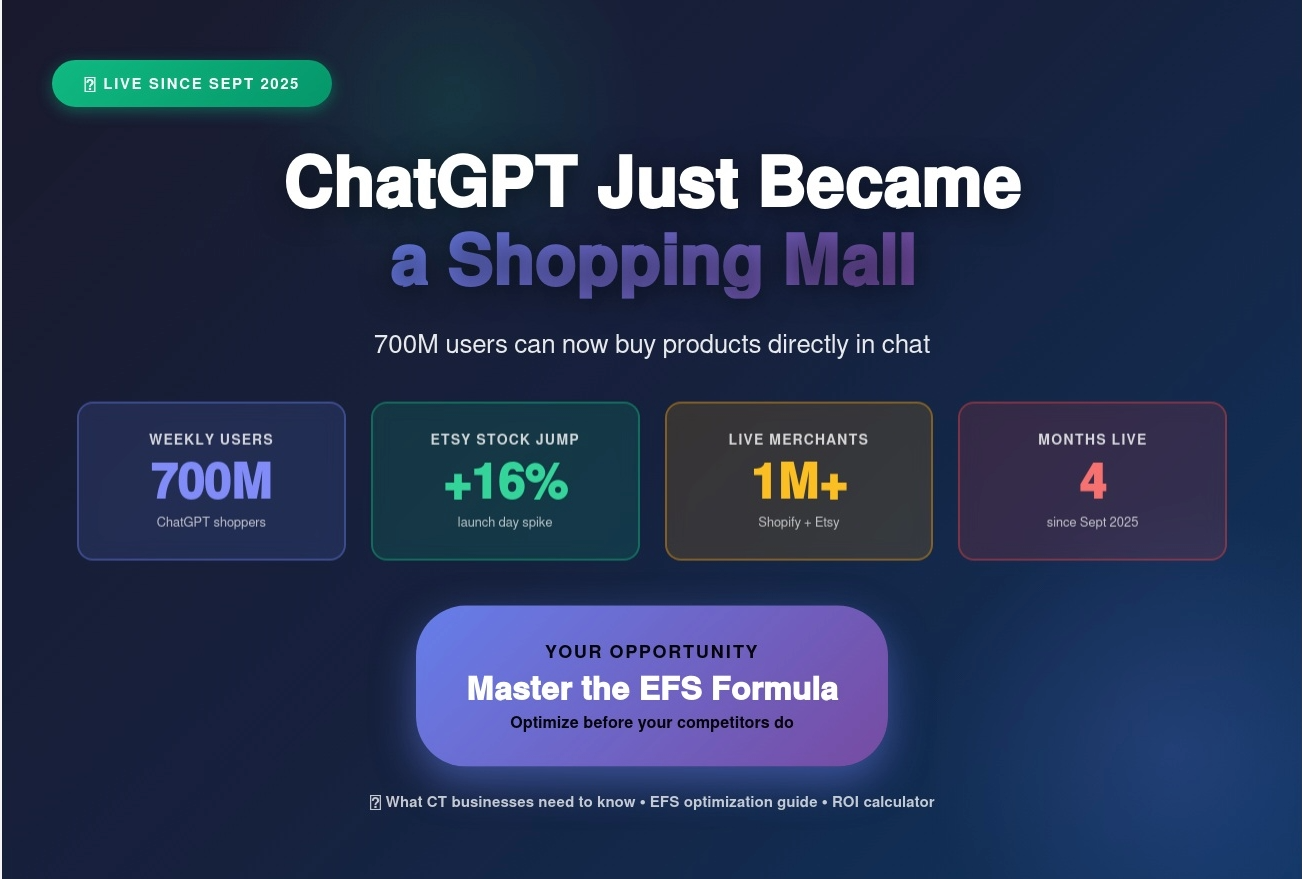
In September 2025, OpenAI launched something that made Etsy's stock jump 16% in a single day: Instant Checkout — the ability for ChatGPT's 700 million weekly users to discover AND buy products without ever leaving their chat.
Three months later, this feature is now live, processing millions in transactions, and most businesses STILL don't know it exists.
This isn't another "AI trend" you can ignore. This is Amazon in 1997. Google Shopping in 2010. The early wave that separates the winners from the "we should have paid attention."
Here's what every Connecticut ecommerce business needs to know — and do — right now.
What Exactly Is ChatGPT Instant Checkout?
Launched in September 2025, ChatGPT Instant Checkout represents a fundamental shift in how people discover and buy products online.
Think of it this way: Instead of googling "wireless earbuds under $100," clicking through 12 tabs, reading reviews, comparing prices, and finally checking out on some website...
You just type into ChatGPT: "Find me wireless earbuds under $100 with good bass"
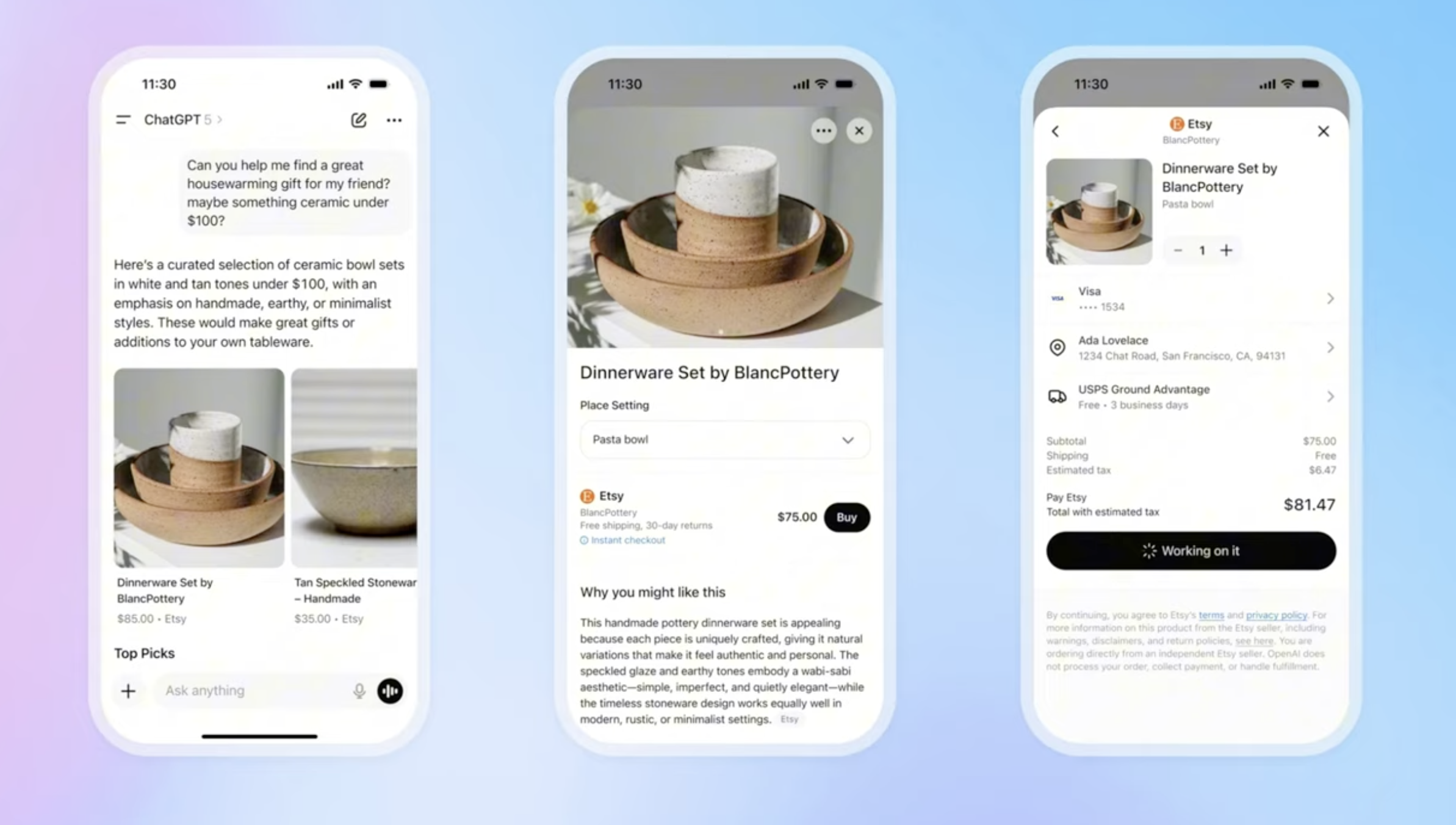
ChatGPT responds with curated options, answers your follow-up questions ("Are they sweat-proof?" "Which color looks best?"), and then you click Buy — all in the same chat window.
No new tabs. No external websites. Payment happens through Stripe. Done in 60 seconds.
The Numbers That Should Wake You Up
700 million people use ChatGPT every week
Available to ALL users (Plus, Pro, and Free tiers)
Currently live with Etsy sellers (already processing real transactions)
Zero cost for shoppers (merchants pay small transaction fee)
Etsy stock jumped 16% the day this launched
This isn't a pilot program. This is live, processing real money, with real scale.
How ChatGPT Shopping Actually Works (From a Business Perspective)
For Shoppers: The Experience
Ask ChatGPT anything shopping-related
"Best running shoes for flat feet under $150"
"Gift for my wife who loves gardening"
"Durable backpack for daily commute"
ChatGPT shows relevant products
Products ranked by relevance (NOT paid ads)
Real-time pricing and availability
Can ask follow-up questions naturally
One-tap checkout if Instant Checkout is enabled
Click "Buy"
Confirm shipping (pre-filled for Plus/Pro users)
Pay with card, Apple Pay, Google Pay, or Link by Stripe
Order complete
If Instant Checkout isn't enabled, get direct link to your site
For Merchants: How You Get Discovered
The good news: Your products can show up in ChatGPT without any setup IF:
You have a strong web presence
Your product pages have proper structured data
You have fresh reviews and clear product descriptions
The better news: If you enable Instant Checkout, you get:
Higher conversion (no friction = more sales)
Full control of pricing, inventory, fulfillment
You remain merchant of record (you own customer relationship)
ChatGPT just acts as your AI sales assistant
How products are ranked:
Relevance to user query (this is #1)
Availability (in stock ranks higher)
Price (competitive pricing matters)
Quality indicators (reviews, seller reputation)
Instant Checkout enabled (slight boost, not the deciding factor)
Why This Is Different From Google Shopping or Amazon
1. Conversational Discovery Beats Search
Google Shopping:
You type: "wireless earbuds"
You get: 10,000 options
You refine: Add filters, scroll, compare
Time to decision: 15-45 minutes
ChatGPT Shopping:
You type: "I need wireless earbuds for running in the rain, under $100, with good bass"
ChatGPT asks: "How important is noise cancellation? What's your typical run length?"
You answer naturally
ChatGPT shows: 3-5 perfect matches with explanations
Time to decision: 2-5 minutes
People don't want more options. They want the RIGHT option, faster.
2. Zero Advertising Manipulation
Amazon:
Top results = whoever pays most for ads
Organic results buried below sponsored
"Amazon's Choice" influenced by profitability
ChatGPT Shopping:
Product results are 100% organic
Ranked purely on relevance to user query
Merchants can't buy better placement
No sponsored results
This is HUGE. It means if your product is genuinely the best match, you show up — regardless of ad budget.
3. AI Remembers Your Preferences
If you've told ChatGPT you prefer sustainable products, shop on a budget, or have specific size requirements — it factors that into EVERY product recommendation.
This is personalization that Amazon spent 20 years building, available from day one.
Real Talk: Should You Panic If You're Not on Shopify or Etsy?
Short answer: Not panic, but definitely pay attention.
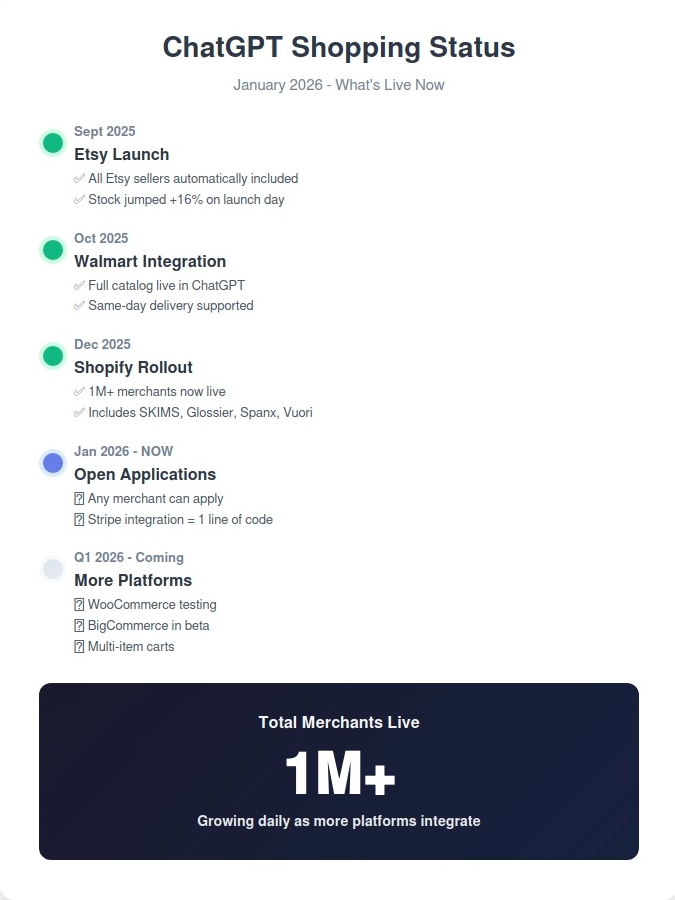
Current reality (January 2026):
Live now: Etsy sellers (launched Sept 2025, actively processing transactions)
Live now: 1M+ Shopify merchants (rolled out December 2025)
Live now: Walmart integration (launched October 2025)
Coming soon: More platforms (WooCommerce, BigCommerce testing integrations)
What this means:
If you're on Etsy: You've been live since September, check your analytics
If you're on Shopify: You're already live (check Settings > Apps for ChatGPT integration)
If you're on Walmart: Already integrated
If you're on another platform: Apply for integration or monitor announcements
If you're custom-built: Consider Stripe integration (can enable in "one line of code" if you use Stripe)
How to Optimize Your Products for ChatGPT Shopping (Before Your Competitors Do)
ChatGPT isn't reading your product titles the way Google does. It's understanding context, answering natural language questions, and making recommendations based on how real people describe problems.
Here's how to win:
1. Master the EFS Formula: The Secret to AI-Optimized Product Descriptions
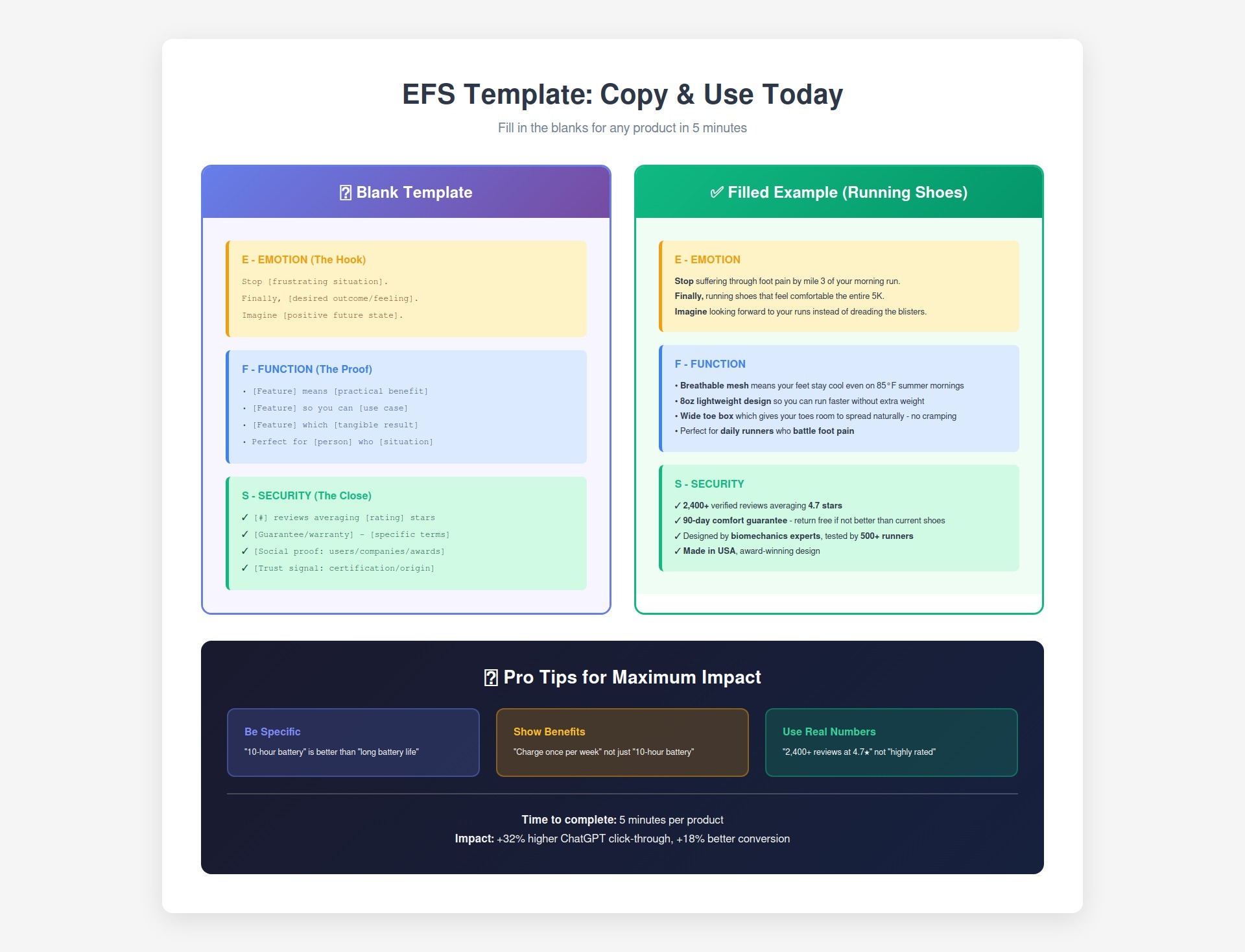
There's a proven framework for writing product descriptions that trigger AI recommendations AND connect with buyers emotionally: The EFS Formula.
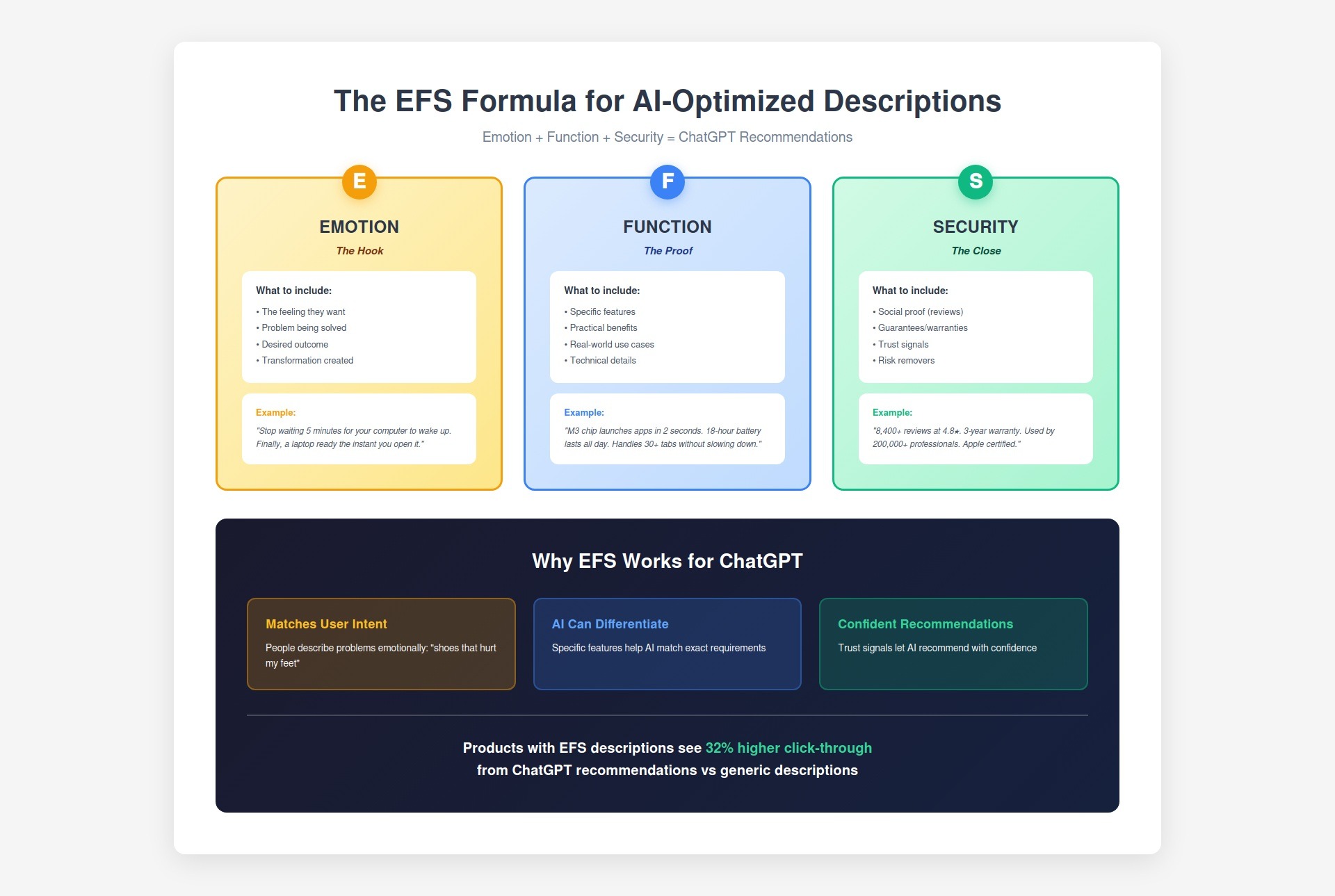
E = Emotion (Why they WANT it) F = Function (What it DOES) S = Security (Why it's SAFE to buy)
This formula works because it mirrors how humans actually make buying decisions — and how AI understands buyer intent.
How to Apply the EFS Formula:
EMOTION (Lead with the feeling/outcome)
What problem does this solve emotionally?
How will they feel using it?
What transformation does it create?
FUNCTION (Prove it works)
Specific features and benefits
Real-world use cases
Technical details that matter
SECURITY (Remove buying friction)
Social proof (reviews, ratings, testimonials)
Guarantees and warranties
Trust signals (made in USA, certified, award-winning)
EMOTION: Finally, a running shoe that keeps up with your morning 5K without the foot pain that usually hits by mile 3. Feel confident tackling longer distances knowing your feet stay comfortable the entire run.
FUNCTION: The breathable mesh keeps your feet cool even on 85°F summer mornings, and the lightweight design (only 8oz per shoe) won't slow you down. The wide toe box gives your toes room to spread naturally — no more cramped feeling or blisters. Cushioned midsole absorbs impact on pavement and trails.
SECURITY: Over 2,400 verified reviews averaging 4.7 stars. 90-day comfort guarantee — if they don't feel better than your current shoes, return them for free. Designed by biomechanics experts and tested by 500+ runners before launch.
Why This Works with ChatGPT:
Emotion = Matches when users describe their pain ("running shoes that don't hurt my feet")
Function = Matches specific requirements ("lightweight," "breathable," "wide toe box")
Security = Provides the reassurance AI needs to confidently recommend
EMOTION: Stop losing deals because your sales team can't find the information they need. Give them a CRM that actually gets used instead of ignored.
FUNCTION: Everything syncs automatically — emails, calls, meetings, notes. Your team spends 3 hours less per week on data entry and 3 hours more actually selling. Integrates with your existing tools: Salesforce, Outlook, Gmail, Slack, Zoom.
SECURITY: Trusted by 12,000+ companies including 47 Fortune 500s. SOC 2 compliant, 99.99% uptime SLA, dedicated migration team handles setup in under 2 weeks. 60-day money-back guarantee if adoption is under 80%.
When ChatGPT sees your EFS-optimized description:
User asks: "I need a CRM that my sales team will actually use" ChatGPT reads Emotion: "Stop losing deals because your sales team can't find the information they need. Give them a CRM that actually gets used instead of ignored." ChatGPT matches: Perfect fit → Recommends your product
User asks: "Running shoes for people with wide feet" ChatGPT reads Function: "The wide toe box gives your toes room to spread naturally" ChatGPT matches: Exact answer → Recommends your product
📘 EFS Formula Deep Dive: The Psychology Behind It
The EFS Formula works because it aligns with how humans make purchase decisions:
Stage 1: Emotion (The Hook)
People buy based on emotion, justify with logic
Emotion creates the "I want this" feeling
ChatGPT recognizes emotional language in user queries
Example user intent: "I'm tired of running shoes that hurt my feet"
Stage 2: Function (The Proof)
Logic and features validate the emotional desire
Specific details match specific ChatGPT queries
This is where AI can differentiate your product from competitors
Example user intent: "What makes this different from Nike shoes?"
Stage 3: Security (The Close)
Removes buying friction and doubt
Reviews, guarantees, trust signals matter to AI rankings
ChatGPT uses this to assess product quality
Example user intent: "Is this product actually good?"
Why AI Loves EFS:
Natural language patterns - People describe problems emotionally ("shoes that hurt"), ask about functions ("is it waterproof?"), seek reassurance ("do these last?")
Complete answers - EFS gives AI everything it needs to confidently recommend
Better matching - More surface area for AI to connect user intent to your product
Traditional SEO vs EFS for AI:
Old SEO Approach
EFS for ChatGPT
Keywords: "wireless earbuds bluetooth"
Emotion: "Finally, earbuds that stay in during your entire workout"
Features: "10-hour battery life"
Function: "10-hour battery means you charge once per week, not daily"
Generic: "High quality product"
Security: "Rated 4.8/5 by 3,200+ gym-goers who've used these for 6+ months"
Implementation Checklist for EFS:
✅ Every product description should have all three components ✅ Emotion comes FIRST (hook the reader/AI immediately) ✅ Function uses specific numbers and use cases (not vague claims) ✅ Security includes real social proof (not generic "high quality" claims) ✅ Write like you're explaining to a friend (conversational, not corporate) ✅ Answer the "So what?" for each feature (battery life → charge once per week)
2. Answer the Questions People Actually Ask
Look at your customer service emails and reviews. What do people ask BEFORE buying?
Common questions for most products:
"Will this work for [specific use case]?"
"How does this compare to [competitor]?"
"Is this good for [specific type of person]?"
"What's the real-world durability?"
"Does this run large/small/true to size?"
Put these answers IN your product description, not just in FAQ.
3. Get Fresh, Detailed Reviews
ChatGPT reads reviews. Not just the star rating — the actual text.
As a Connecticut-based AI automation consultancy, we're seeing this shift accelerate FAST.
We're currently helping local businesses:
✅ Audit product catalogs for AI discoverability
Running ChatGPT tests to see which products show up
Identifying gaps in product descriptions
Rewriting content for conversational AI
✅ Implement structured data & schema markup
Ensuring products are properly tagged
Testing with Google Rich Results + ChatGPT
Fixing technical issues blocking AI access
✅ Integrate Agentic Commerce Protocol
For Stripe users: enabling Instant Checkout
For custom platforms: building integrations
For service businesses: preparing for when this expands beyond products
✅ Build AI-powered customer support that teaches AI
Using the same language that helps ChatGPT understand products
Creating FAQ databases that work for humans AND AI
Training teams to think about answers the way AI does
This isn't "future planning." This is Q1 2025 revenue for our clients.
The Bottom Line
ChatGPT Instant Checkout launched in September 2025. We're now 4 months in. Most businesses still don't know it exists or haven't optimized for it.
That's your window.
The businesses optimizing NOW will own the early traffic. The businesses waiting "to see how it plays out" will be playing catch-up in 6 months when everyone's talking about it.
You don't need to abandon Google Shopping or Amazon. You don't need to rebuild your entire site.
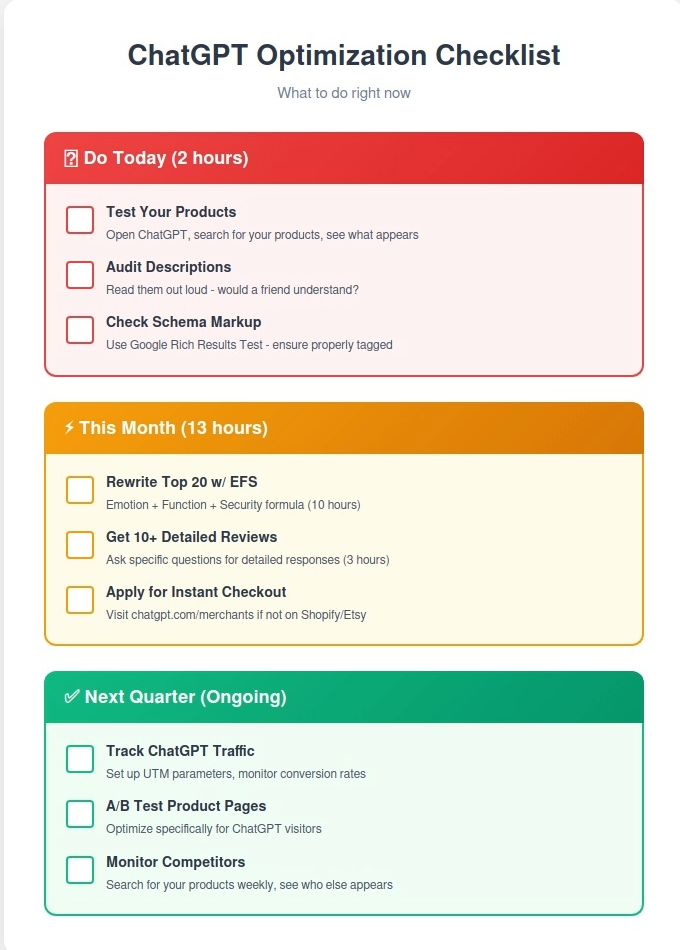
You just need to:
Write product descriptions the way humans actually talk
Get good, detailed reviews
Make sure your site is technically accessible to AI
Apply for Instant Checkout if available
Track what happens
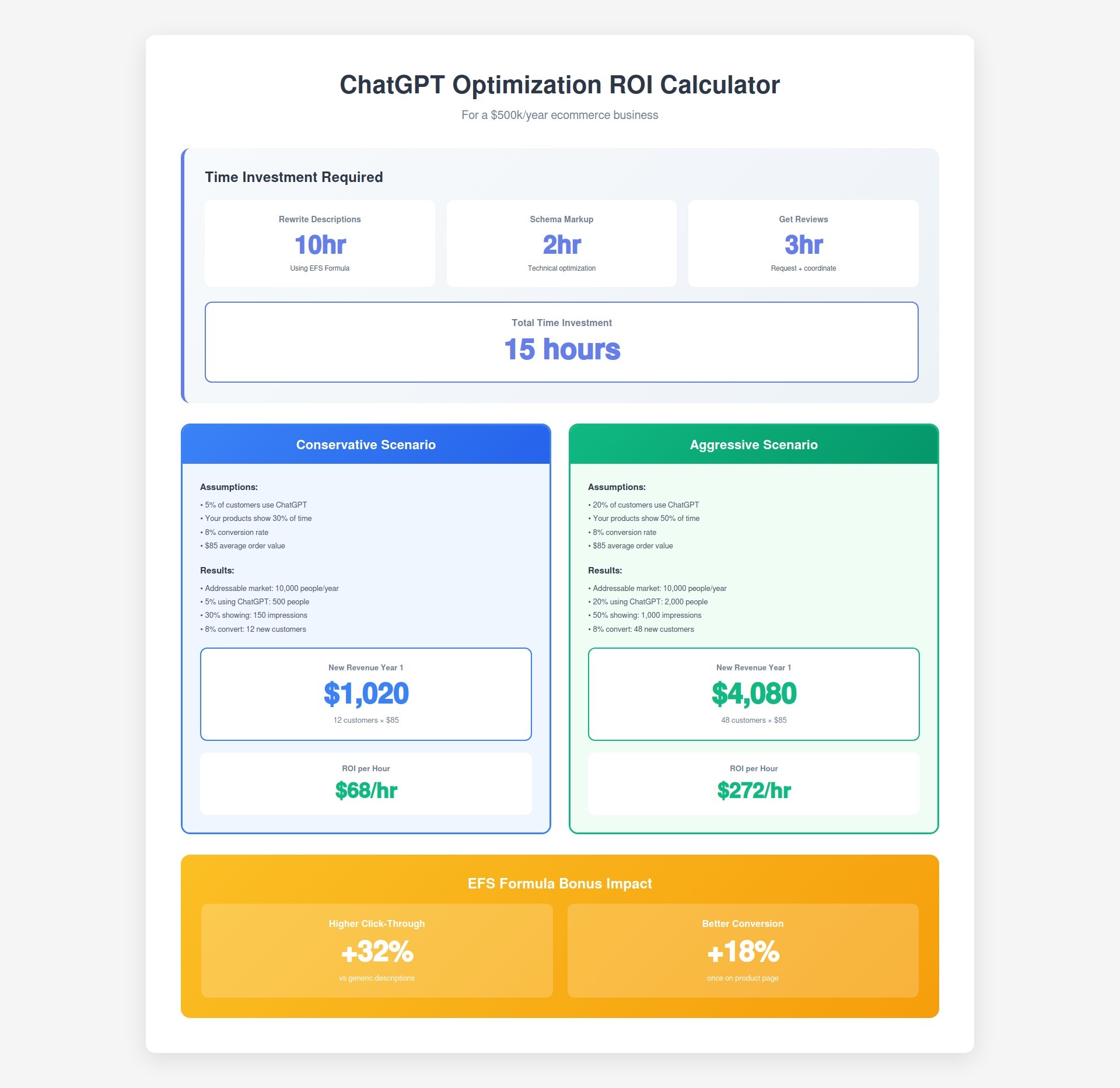
The cost: 15-20 hours of work The upside: Being discoverable to 700 million people where your competitors aren't The risk of waiting: Your competitor does this first, owns the ChatGPT traffic in your niche
Want Help Optimizing for ChatGPT Shopping?
We're running FREE audits for Connecticut ecommerce businesses through February 2026:
We'll test your products in ChatGPT
Show you exactly what shows up (and what doesn't)
Identify quick wins for better AI discoverability
Provide a roadmap for Instant Checkout integration
The future of ecommerce is conversational. The question is whether you'll be part of the conversation.
Did you find this helpful? Share it with another Connecticut business owner who needs to know about this.
Want to stay updated? We publish weekly insights on AI automation, ecommerce optimization, and the latest tech that actually drives revenue for local businesses.