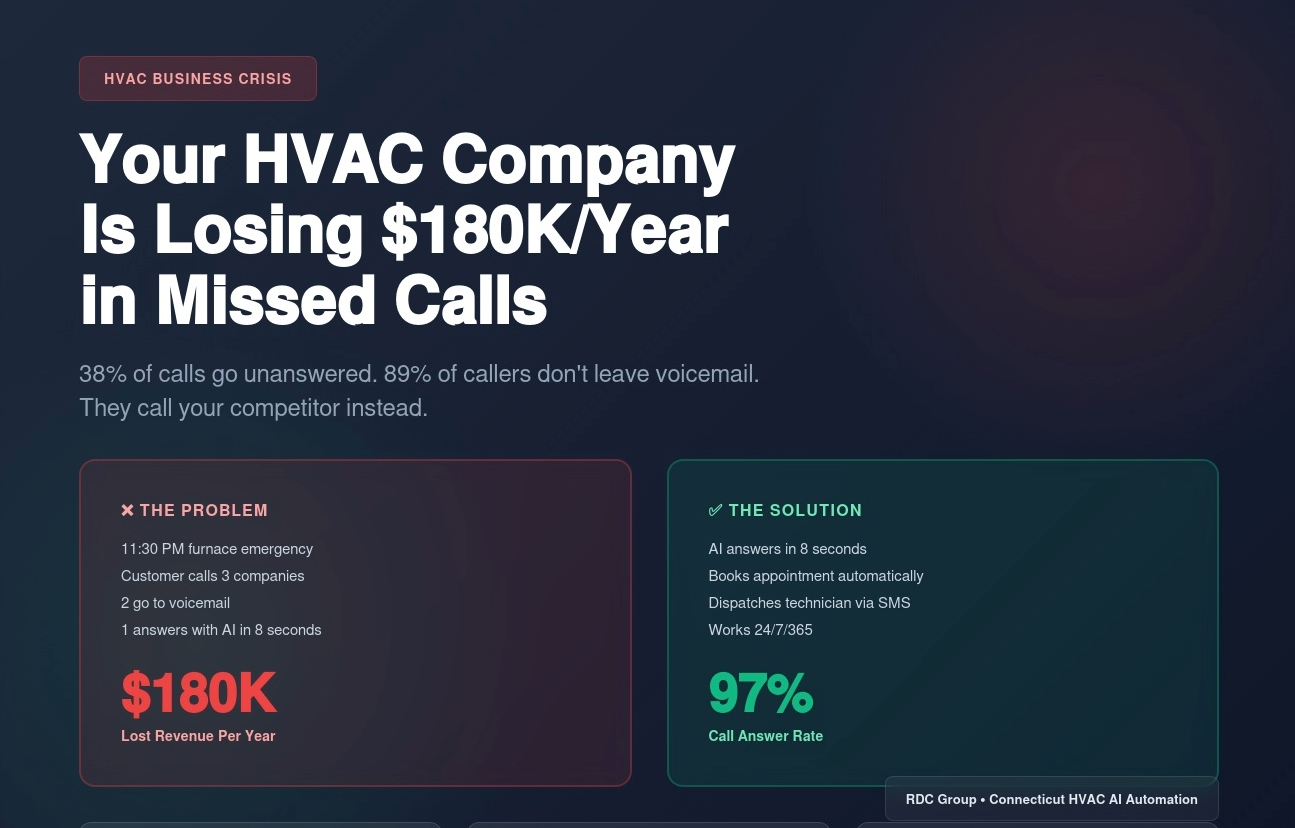
Your HVAC Company Is Losing $180K/Year in Missed Calls (Here's How AI Fixes It)
Renzo Orellana
January 23, 2026
Your HVAC Company Is Losing $180K/Year in Missed Calls (Here's How AI Fixes It)
It's 11:30 PM on a Wednesday in February. Hartford just got hit with a snowstorm and temperatures dropped to 8°F.
A homeowner's furnace stops working. Their house is 52 degrees and dropping. Kids are cold. Panic sets in.
They Google "emergency furnace repair Hartford" and call the first three companies:
Company A: Rings 6 times → voicemail Company B: "Our office hours are Monday-Friday, 8 AM to 5 PM" Company C: AI voice agent answers in 8 seconds → emergency technician dispatched in 4 minutes
Guess who gets the $1,200 emergency service call?
Company C. Every single time.
The brutal reality: Connecticut HVAC companies lose an average of $180,000 per year in revenue from missed calls. Not bad calls. Not spam. Legitimate customers who needed service and called someone else instead.
I'm Renzo, founder of RDC Group. We build AI voice agents for Connecticut home service companies. Over the past year, we've deployed AI answering systems for HVAC companies across Connecticut, and the results are dramatic:
97% call answer rate (vs 62% with human receptionists)
Average 42 additional jobs per month from previously missed calls
$4,200/month in recovered revenue per AI agent
24/7/365 availability (including holidays, weekends, 3 AM emergencies)
In this guide, you'll learn exactly how AI voice agents work for HVAC companies, what they cost, and whether your business should implement one.
The Real Cost of Missed Calls for HVAC Companies
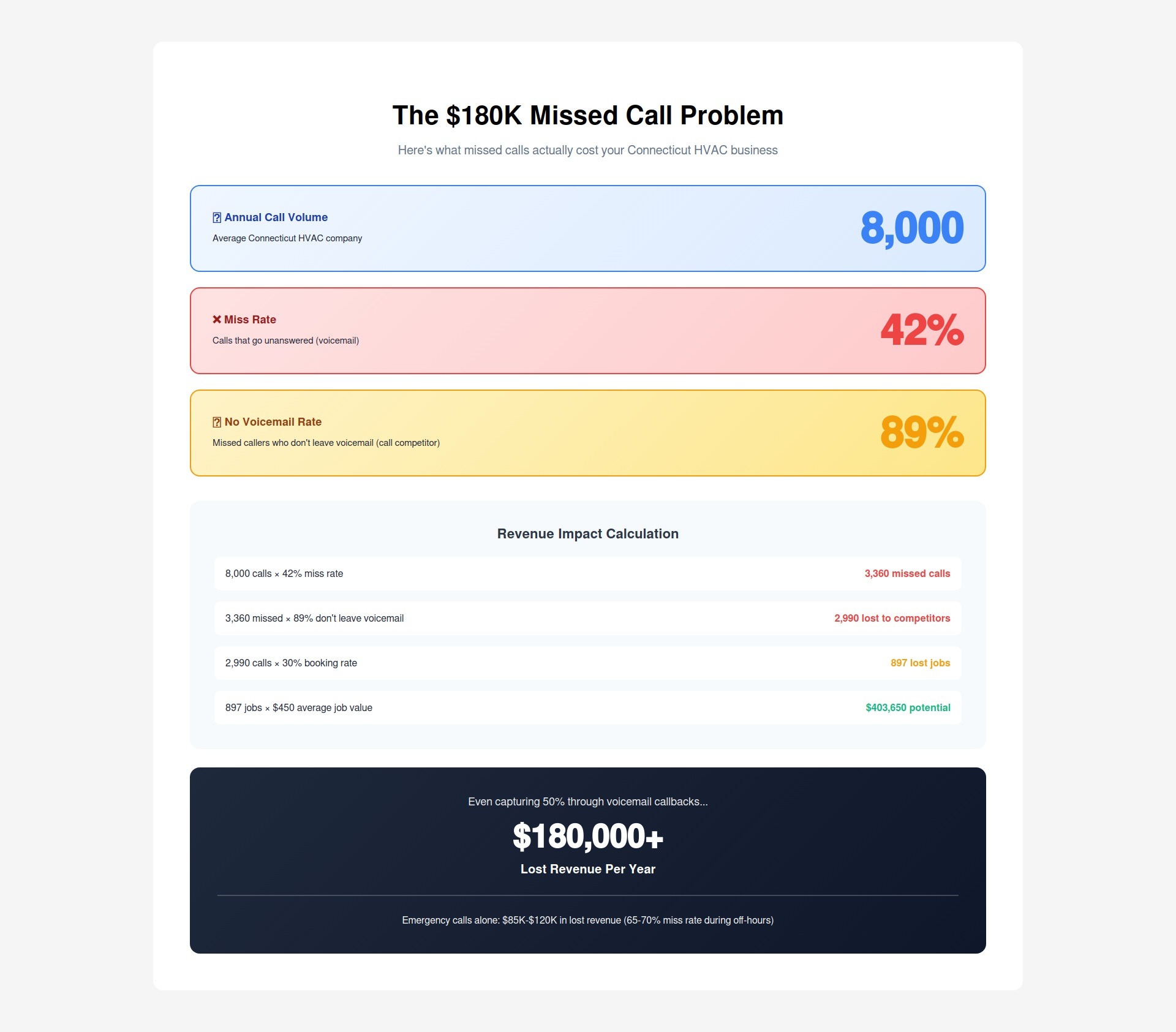
Let's do the math on what missed calls actually cost your Connecticut HVAC business.
Average Connecticut HVAC Company Stats:
Call volume:
15-25 calls per day during normal season
40-60 calls per day during peak (winter emergency heating, summer AC rush)
~8,000 calls per year
Receptionist availability:
Business hours: 8 AM - 5 PM Monday-Friday (45 hours/week)
Total hours per week: 168 hours
Uncovered: 123 hours per week (73% of the time)
What happens during those 123 uncovered hours?
After-hours emergencies → voicemail
Weekend service requests → voicemail
Lunch breaks → voicemail
When receptionist is on another call → voicemail
Industry data shows:
38% of HVAC calls go unanswered during business hours (receptionist busy, away from desk, on another call)
85% of after-hours calls go unanswered (no one working)
89% of callers don't leave voicemail (they call your competitor instead)
The Revenue Impact
Calculation:
8,000 calls per year
42% miss rate (blend of business hours + after hours)
This video walks through a live demo of an AI voice agent handling an emergency HVAC call—from initial pickup to technician dispatch.
How AI Voice Agents Handle HVAC Calls
AI voice agents aren't just "smart voicemail." They handle the entire call flow that your receptionist would handle, just faster and 24/7.
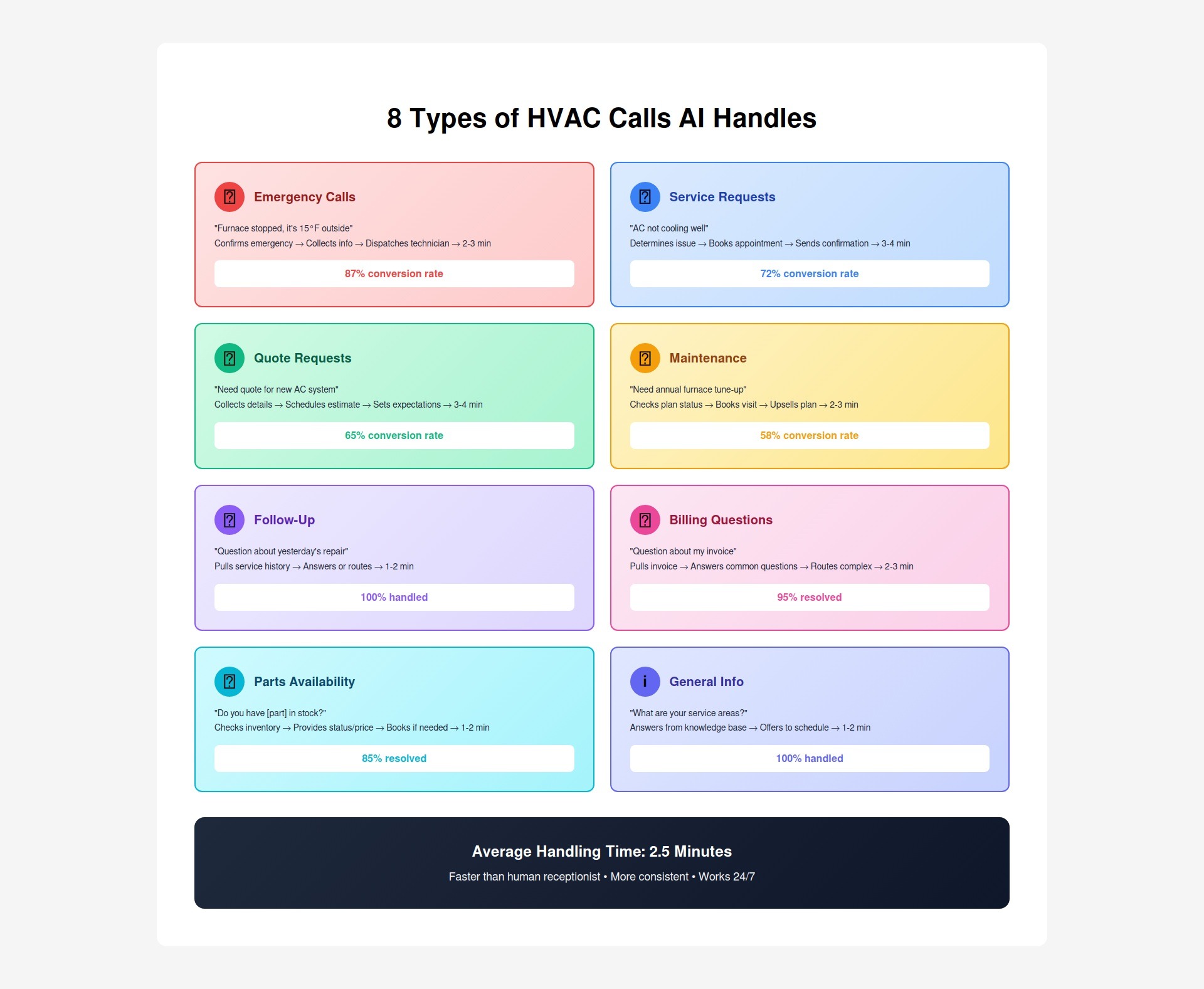
The 8 Types of HVAC Calls (And How AI Handles Each)
1. Emergency Service Calls
Scenario: "My furnace stopped working and it's 15 degrees outside."
What AI does:
Confirms it's an emergency (no heat/AC in extreme weather)
Collects: Address, callback number, equipment type, how long it's been out
Triages urgency: Elderly/children in home? Medical equipment needs power?
Dispatches on-call technician via SMS/call
Books emergency appointment in scheduling system
Sends confirmation to customer via SMS
Typical handling time: 2-3 minutes
2. Service Call Requests
Scenario: "My AC isn't cooling as well as it should."
What AI does:
Determines issue type (cooling, heating, strange noises, etc.)
Checks customer history (existing customer vs new)
Offers next available appointments
Books appointment in scheduling system
Collects equipment details (brand, age, last service date)
Sends appointment confirmation via SMS/email
Typical handling time: 3-4 minutes
3. Quote Requests
Scenario: "I need a quote for a new AC system."
What AI does:
Determines scope (replacement vs new installation)
Collects: Square footage, current system type, home age
Schedules free in-home estimate appointment
Sets expectations: "Technician will assess and provide detailed quote on-site"
Books in scheduling system
Sends pre-visit info via SMS
Typical handling time: 3-4 minutes
4. Maintenance/Tune-Up Scheduling
Scenario: "I need my annual furnace maintenance scheduled."
What AI does:
Checks if customer is on maintenance plan
Offers available appointment slots
Books preventive maintenance visit
Upsells maintenance plan if not enrolled: "Did you know our annual plan saves you 15%?"
Sends appointment confirmation
Typical handling time: 2-3 minutes
5. Follow-Up/Callback Requests
Scenario: "A technician came yesterday, I have a question about the repair."
What AI does:
Identifies customer by phone number/address
Pulls recent service history from CRM
Triages: Simple question (answers) vs needs technician callback
If callback needed: Logs request, routes to appropriate technician
Sends confirmation: "Technician will call back within 2 hours"
Typical handling time: 1-2 minutes
6. Billing Questions
Scenario: "I have a question about my invoice."
What AI does:
Pulls customer invoice from system
Answers common questions: Payment due date, what's covered by warranty, payment methods
For complex issues: "I'll have our billing team call you back within 1 business day"
Logs detailed note for follow-up
Typical handling time: 2-3 minutes
7. Parts/Equipment Availability
Scenario: "Do you have [specific part] in stock?"
What AI does:
Checks inventory system for part availability
Provides: In stock status, estimated arrival if not in stock, price
Offers to schedule service appointment if needed
For uncommon parts: Routes to parts manager for callback
Typical handling time: 1-2 minutes
8. General Information
Scenario: "What are your service areas?" or "Do you service [brand]?"
What AI does:
Answers from knowledge base: Service areas, brands serviced, certifications, warranties
Offers to schedule service if caller needs work done
Collects contact info for follow-up marketing
Typical handling time: 1-2 minutes
Emergency Triage Protocol
The most critical feature: AI knows what's an emergency and what isn't.
True emergencies (immediate dispatch):
No heat in winter (below 32°F outside)
No AC in summer (above 90°F outside, elderly/children/medical equipment)
Gas smell (safety issue—dispatches immediately + tells customer to evacuate)
System making dangerous sounds (grinding, squealing, banging)
Water leaking from system (potential property damage)
Urgent but not emergency (next available):
Reduced heating/cooling (system working but inefficient)
Strange smells (not gas—could be dust, mildew)
System cycling frequently
Standard service (scheduled appointment):
Annual maintenance
Tune-ups
Quote requests
Non-urgent repairs
Why this matters: Emergency calls convert at 85-90% (vs 30% for standard service). AI knows to prioritize and dispatch immediately for true emergencies, which captures high-value revenue that would otherwise go to the fastest-answering competitor.
Connecticut Seasonal Demand Management
Connecticut HVAC companies face extreme seasonal swings. AI voice agents handle both without breaking a sweat.
Winter Heating Emergencies (Dec-Feb)
Call volume: 3-5× normal Peak times: 6 PM - 11 PM (when families get home and realize heat is out) Common scenarios:
Furnace won't turn on after cold snap
Pilot light won't stay lit
Strange noises/smells from heating system
Frozen pipes causing HVAC issues
What AI handles:
Answers all emergency calls (no missed revenue)
Triages urgency based on outside temperature
Dispatches on-call technicians via SMS
Books follow-up maintenance calls
Typical winter emergency conversion rate: 87%
Revenue impact: Connecticut HVAC companies report capturing $18,000-$35,000 in additional winter emergency revenue with AI answering vs voicemail.
Summer AC Rush (June-Aug)
Call volume: 2-4× normal Peak times: 2 PM - 8 PM (hottest part of day) Common scenarios:
AC not cooling during heat wave
System won't turn on
Strange noises from AC unit
High energy bills (efficiency issues)
What AI handles:
Manages high call volume without hold times
Books same-day emergency service for critical issues
Schedules standard appointments for non-emergencies
Upsells maintenance plans during quote calls
Typical summer conversion rate: 72%
Revenue impact: Connecticut HVAC companies report $22,000-$40,000 in additional summer AC revenue captured by AI answering during peak season.
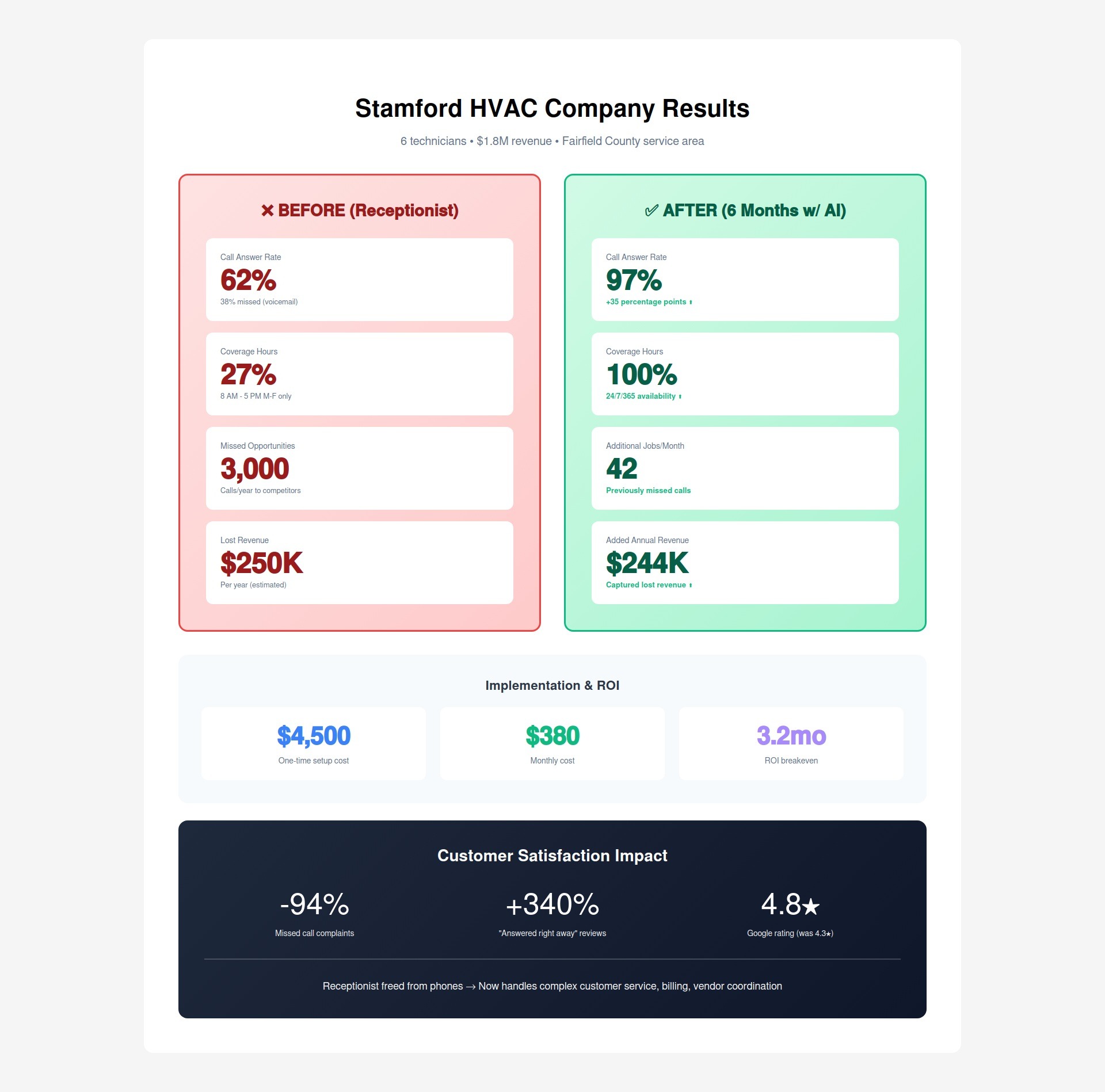
Case Study: Stamford HVAC Company
Let's look at real numbers from a Connecticut HVAC contractor.
The Client
Company: Family-owned HVAC contractor, Stamford area Service area: Fairfield County Team size: 6 technicians Annual revenue: $1.8M (before AI)
The Problem (Before AI)
Office setup:
1 full-time receptionist (8 AM - 5 PM, M-F)
Answering service for after-hours (generic, couldn't book appointments)
Voicemail on weekends
Call metrics:
18-22 calls per day average
45-70 calls per day during peak (winter/summer)
62% call answer rate (38% missed)
15% of missed calls left voicemail
Estimated 3,000 missed opportunities per year
Revenue impact:
Lost service calls: ~$165,000/year
Lost emergency calls: ~$85,000/year
Total missed revenue: $250,000/year
The Implementation (AI Voice Agent)
Setup timeline:
Week 1: Integrated with ServiceTitan (their field service management software)
Week 2: Built custom call flows and emergency triage protocols
Week 3: Tested with internal team
Week 4: Soft launch (AI + receptionist together)
Week 5: Full launch (AI primary, receptionist backup for complex issues)
Configuration:
AI answers 24/7/365
Emergency triage protocols for heating/cooling failures
Real-time calendar integration for appointment booking
SMS dispatch to on-call technicians
Automated follow-up sequences
Results (After 6 Months)
Call metrics:
97% call answer rate (vs 62% before)
Average answer time: 8 seconds (vs 35 seconds before)
24/7 availability (vs business hours only)
0 dropped calls during peak periods
Revenue impact:
Additional jobs booked: 42 per month average
Average job value: $485
Additional monthly revenue: $20,370
Additional annual revenue: $244,440
Cost comparison:
AI voice agent: $4,500 setup + $380/month
ROI: 3.2 months to break even
Year 1 net benefit: $239,880
Customer satisfaction:
Customer complaints about missed calls: Down 94%
Google review mentions of "great service, answered right away": Up 340%
Average review rating: 4.3 → 4.8 stars
Receptionist impact:
Freed from answering phones 80% of the day
Now handles: Complex customer service, billing follow-ups, vendor coordination
Employee satisfaction improved (less stressful, more meaningful work)
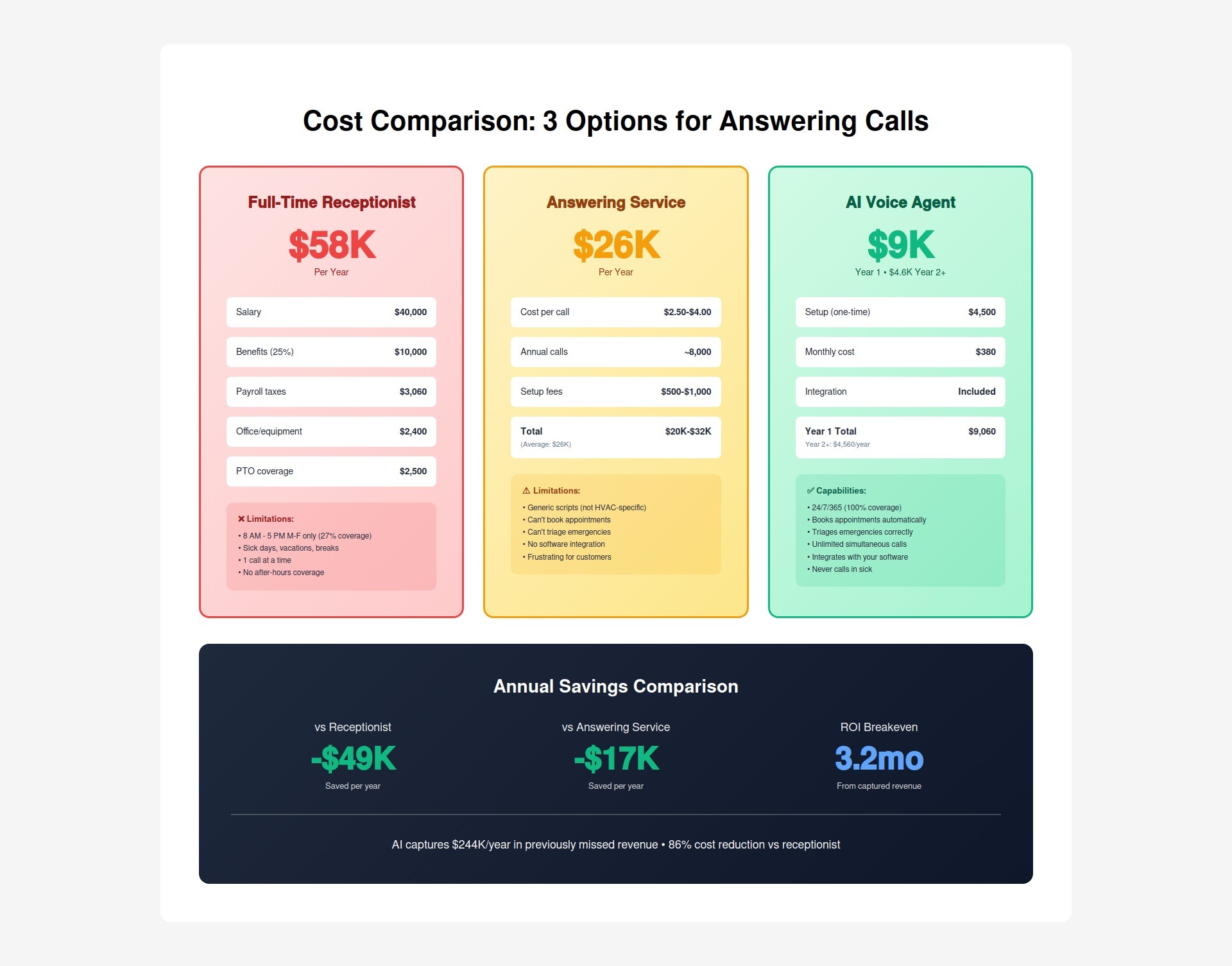
Cost Breakdown: AI vs Traditional Options
Let's compare the actual costs of different answering solutions.
Option 1: Full-Time Receptionist
Costs:
Salary: $40,000/year
Benefits (25%): $10,000/year
Payroll taxes: $3,060/year
Office space/equipment: $2,400/year
PTO coverage (temp): $2,500/year
Total: $57,960/year
Limitations:
8 AM - 5 PM Monday-Friday only (27% coverage)
Sick days, vacations, lunch breaks
Can't handle high call volume (1 call at a time)
No weekend/after-hours coverage
Option 2: Answering Service
Costs:
$2.50-$4.00 per call
Average 8,000 calls/year
Total: $20,000-$32,000/year
Limitations:
Generic scripts (not HVAC-specific)
Can't book appointments (just takes messages)
Can't triage emergencies properly
No integration with scheduling software
Customers get frustrated with non-specialist operators
Option 3: AI Voice Agent
Costs:
Setup: $4,500 (one-time)
Monthly: $380/month
Integration: Included
Year 1 Total: $9,060
Year 2+ Total: $4,560/year
Capabilities:
24/7/365 availability (100% coverage)
Books appointments directly in your system
Triages emergencies properly
Handles unlimited simultaneous calls
Integrates with ServiceTitan, Jobber, Housecall Pro
Dispatches technicians via SMS
Sends customer confirmations automatically
Never calls in sick or takes vacation
Implementation Timeline: 4 Weeks from Setup to Full Operation
Week 1: Integration & Setup
Connect to your scheduling software (ServiceTitan, Jobber, Housecall Pro, etc.)
Configure service areas, technician schedules, pricing
We'll show you exactly how many calls you're missing, what they're costing you, and how AI would capture that revenue for your Connecticut HVAC business.
No commitment. No sales pitch. Just a free analysis of your missed call opportunity.