Vapi AI pricing is adding up fast in 2026. Here's what Connecticut businesses are switching to instead — honest comparison of Vapi vs Retell AI vs Bland AI with real cost breakdowns.
A client called me last month. He'd built a solid AI voice agent using Vapi. It was working — booking appointments, qualifying leads, answering after-hours calls. Then his monthly invoice hit $2,400 and he called to ask what happened.
Nothing broke. He just didn't realize how Vapi's pricing actually works. And he's not alone.
I'm Renzo, founder of RDC Group. We've built AI voice agent systems for Connecticut businesses across HVAC, dental, plumbing, law, and marketing — using Vapi, Retell AI, Bland AI, and a few others. I've had clients on Vapi who couldn't be happier. I've had others who switched platforms within 90 days because the billing was unpredictable.
This guide is for business owners who are either already on Vapi and wondering if the pricing is going to keep climbing, or who are evaluating AI voice agent platforms before committing. I'll break down the real costs, the real differences, and which platform actually fits your situation.
Vapi didn't change its pricing dramatically. What changed is that businesses started using it more seriously — and that's where the complexity hits.
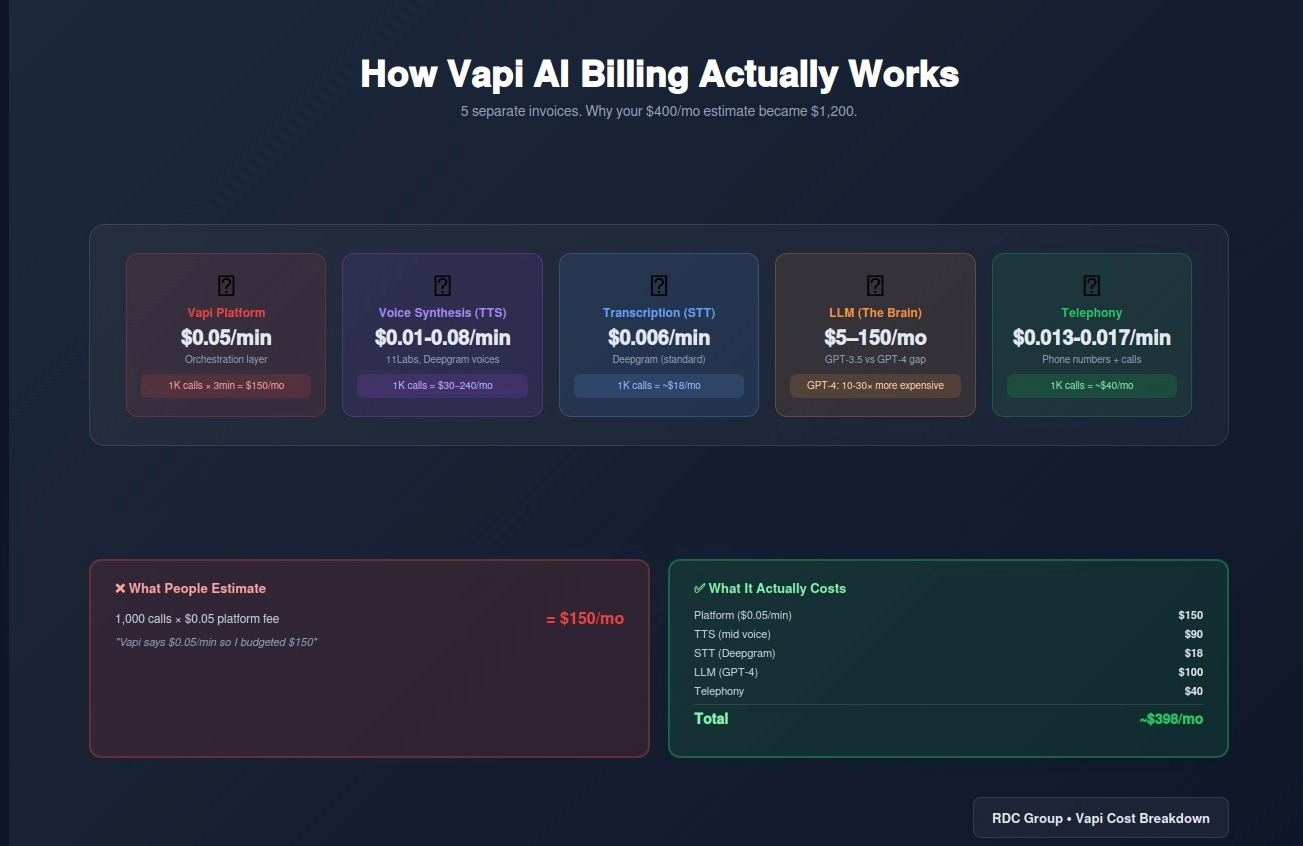
Here's how Vapi's billing actually works: You don't pay one flat monthly fee. You pay separately for each component of your voice agent.
Component 1: Vapi Platform Fee $0.05 per minute of call time. Sounds small. A 3-minute call costs $0.15. 1,000 calls per month at 3 minutes average = 3,000 minutes = $150/month just for the platform layer.
Component 2: Voice Synthesis (Text-to-Speech) Vapi uses 11Labs, Deepgram, or other TTS providers for the actual voice. Costs range from $0.01-0.08 per minute depending on the provider and voice quality. For 3,000 minutes: add $30-240/month.
Component 3: Speech-to-Text (Transcription) Every word your caller says needs to be transcribed so the AI understands it. Deepgram (the most common provider through Vapi) charges around $0.0059 per minute. For 3,000 minutes: add $17.70/month.
Component 4: LLM Usage (The Brain) The actual AI model deciding what to say costs money per token. GPT-4 Turbo at roughly $0.01/1,000 input tokens for a typical voice conversation. A 3-minute call might generate 500-1,500 tokens. For 1,000 calls: $5-15/month at GPT-3.5, or $50-150/month at GPT-4.
Component 5: Phone Numbers + Telephony Outbound calling or dedicated inbound numbers add $1-3/month per number plus $0.013-0.017 per minute for call time.
Total for 1,000 calls at 3 minutes each on Vapi:
At 3,000 calls/month, that's roughly $1,200/month — just in API costs, before any build or maintenance fees.
This isn't Vapi ripping you off. These are real infrastructure costs. But the multi-vendor billing model means the invoice surprises people because there's no single line item that says "your AI calling costs X/month."
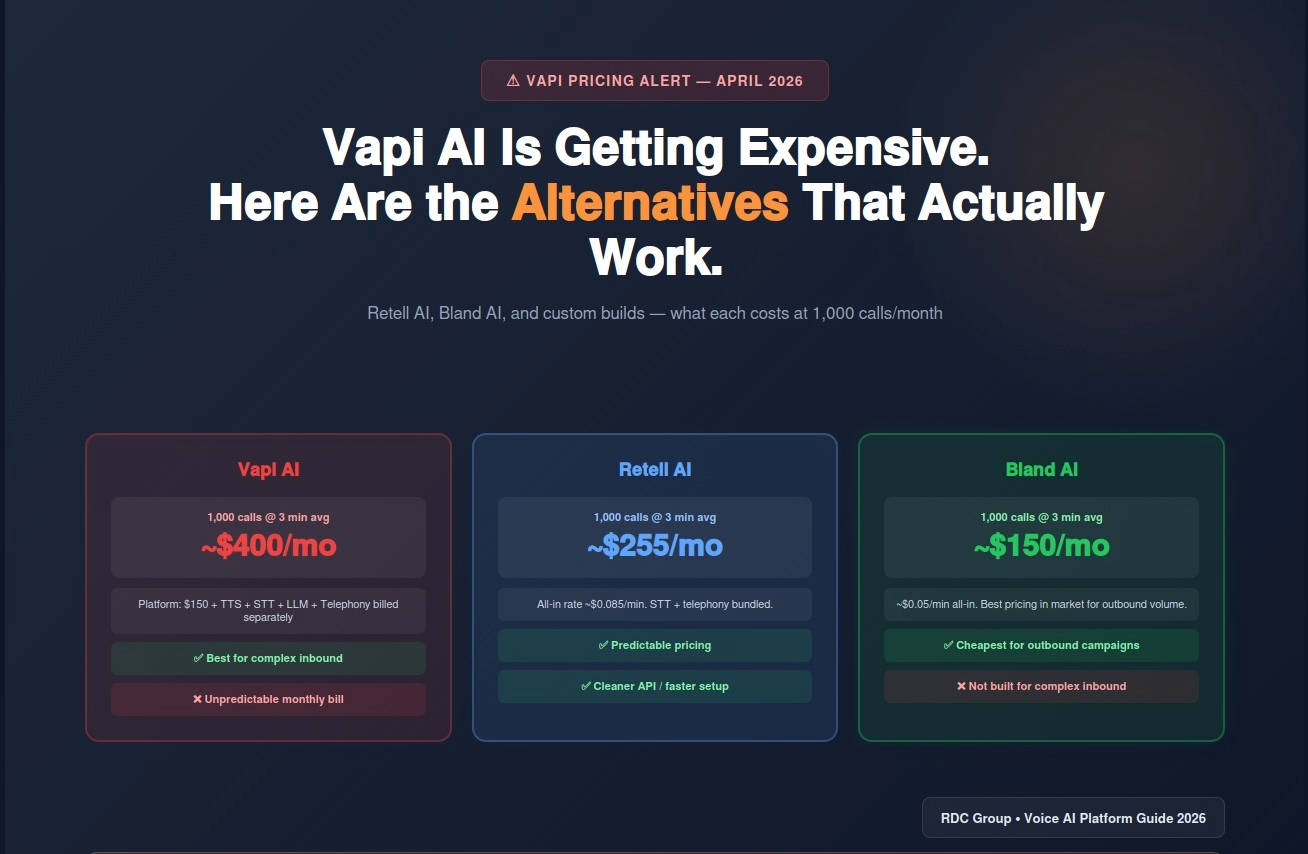
Retell AI
Retell AI is the platform gaining the most momentum right now as a Vapi alternative. The core difference: Retell bundles more functionality into a simpler pricing model.
Instead of paying separately for orchestration, STT, TTS, and telephony, Retell includes STT and their own telephony infrastructure in the base rate. Their pricing is roughly $0.07-0.10 per minute all-in, compared to Vapi's $0.08-0.15+ per minute when you add up all components.
For a business running 1,000 calls at 3 minutes average: Retell comes in at $210-300/month vs Vapi's $350-450/month. At scale, this difference compounds.
Retell's other advantage: the developer experience. Builders consistently report that Retell's API documentation is cleaner, the phone number setup is faster, and the call routing logic is easier to configure. The tradeoff is fewer customization options for edge cases — Vapi wins if you need very specific voice behavior, unusual integrations, or complex multi-agent handoff logic.
Bland AI
Bland AI is the most affordable option for pure outbound calling volume. Their pricing is closer to $0.04-0.06 per minute all-in, which at 1,000 calls at 3 minutes comes to $120-180/month — significantly cheaper than both Vapi and Retell.
The catch: Bland AI is built primarily for high-volume outbound campaigns. If you need a sophisticated inbound support agent that handles complex queries, transfers to humans, and integrates deeply with your CRM in real time, Bland AI falls short. If you need to make 500 calls per day to qualify leads and book appointments, Bland AI is excellent and very cost-effective.
I've used Bland AI for outbound lead qualification campaigns with Connecticut home service contractors. For a simple script — qualify the lead, answer objections, book a meeting — it works extremely well at 40-50% lower cost than Vapi.
AI Voice Agent (Custom Build)
The third option isn't a single platform — it's building your own voice agent stack from components. This is what we do at RDC Group for clients who need both cost control and flexibility.
The stack: Vapi or Retell for voice handling, Deepgram for STT (negotiated enterprise rates), 11Labs for voice (with volume discount), GPT-4o for the LLM, n8n for the workflow automation layer, and Airtable or HubSpot for CRM integration.
The benefit of this approach: when one component gets cheaper (and AI pricing drops 20-30% annually), you swap it out. You're not locked into any single platform's price structure. The downside: it takes real technical work to build and maintain.
Voice Quality: Vapi wins. Access to 11Labs' best voices with fine-grained control over emotion, pacing, and style. Retell AI uses solid voices but with fewer customization options. Bland AI sounds natural but more limited.
Ease of Setup: Retell wins for most users. Cleaner API documentation, faster phone number provisioning, simpler call routing. Vapi has powerful features but the configuration complexity shows at setup. Bland AI is easy for basic outbound but gets complicated for inbound logic.
Pricing Predictability: Retell wins. One rate per minute, all-in. You know what a call costs before you build the system. Vapi's multi-vendor billing makes forecasting harder. Bland AI is predictable for outbound but has more complexity for inbound.
Complex Inbound Calls: Vapi wins. If your AI agent needs to handle multi-turn conversations, real-time database lookups, human handoff based on sentiment, and complex conditional logic — Vapi handles this better than the alternatives. Retell is catching up. Bland AI is not designed for this.
Outbound Calling at Scale: Bland AI wins on cost, Retell wins on features. If cost is the primary constraint and the script is simple, Bland AI. If you need CRM integration and better call analytics, Retell.
Multi-Agent Systems: Vapi wins. For enterprise systems where one AI agent hands off to another (qualification agent → scheduling agent → support agent), Vapi's architecture handles this more cleanly.
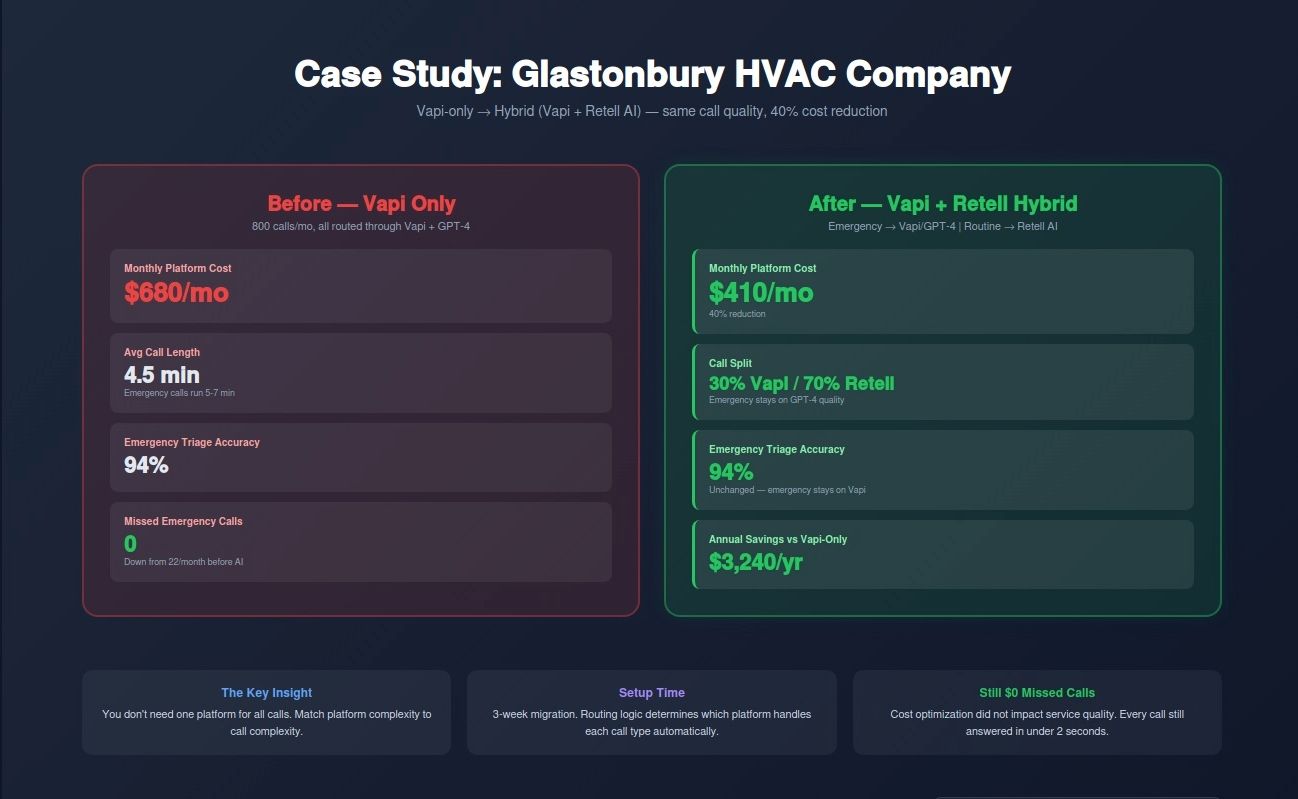
A Glastonbury HVAC company came to us in late 2025 wanting an AI voice agent to handle inbound after-hours calls. Emergency triage, appointment scheduling for non-emergencies, and dispatch for real emergencies.
We initially built on Vapi because of its flexibility. Three months in, the costs were higher than expected — around $680/month for roughly 800 calls/month, mostly because emergency calls ran longer (5-7 minutes average) and required GPT-4 for accurate triage logic.
After a cost review, we migrated the non-emergency call handling (70% of volume) to Retell AI and kept emergency triage on Vapi where GPT-4 quality mattered most. The hybrid approach brought monthly costs down to $410 — a 40% reduction while maintaining quality where it counted.
Before (Vapi only): Monthly call volume: 800 calls Average call length: 4.5 minutes Monthly platform cost: $680 Emergency accuracy rate: 94% Missed emergency calls: 0 (down from 22/month before AI)
After (Vapi for emergency, Retell for non-emergency): Monthly call volume: 800 calls (same) Monthly platform cost: $410 Emergency accuracy rate: 94% (unchanged — still on Vapi) Non-emergency satisfaction: comparable Annual savings vs Vapi-only: $3,240
The takeaway: you don't have to use one platform for everything. The smartest AI voice deployments in 2026 use the right tool for each call type.
❌ Mistake 1: Choosing Based on Demo Quality Alone
Every platform's demo sounds incredible. That's the point of a demo. The real test is how it performs on real calls with real customers who speak fast, mumble, get frustrated, and ask questions the script didn't anticipate. Before committing to any platform, run a 2-week pilot with 100 real calls. That's your actual benchmark.
❌ Mistake 2: Underestimating Call Length
Every voice AI pricing estimate you'll see assumes short calls. Your AI agent demo ran 90 seconds. Your actual customer calls run 4-6 minutes because they ask follow-up questions, need clarification, or ramble. A call you estimated at $0.20 cost is actually $0.60. At 1,000 calls/month, that's $400 in unexpected costs. Always estimate with your real average call length from existing call data.
❌ Mistake 3: Building on the Cheapest Platform First
Bland AI is cheap. If your use case grows beyond basic outbound scripts, you'll end up rebuilding everything on a more capable platform 6 months later. I've seen this three times with Connecticut businesses who built on Bland AI for cost reasons and ended up paying twice — once to build on Bland AI, once to migrate to Retell or Vapi.
❌ Mistake 4: No Human Escalation Path
The most expensive mistake isn't in API costs — it's in angry customers who got stuck in a loop with an AI that couldn't handle their specific situation and had no way to reach a human. Every AI voice system I build includes a clear escalation trigger: after 2 failed attempts to resolve, route to human. Always.
❌ Mistake 5: Ignoring Compliance Requirements
Connecticut and federal regulations around AI phone calls have specific disclosure requirements. Your AI agent must identify itself as an AI if asked directly. Call recording consent requirements vary by state. TCPA compliance for outbound calling has real consequences if violated. This isn't optional — build compliance in from day one.
Week 1: Define Your Call Type
The platform choice depends entirely on what your AI agent needs to do. Map out your top 3 most common call scenarios. For each: what does the caller want, what information does your AI need to look up, what's the ideal outcome, and what should happen if the AI can't help? This mapping takes 3-4 hours and determines whether you should be on Bland AI, Retell, or Vapi.
Week 2: Choose Platform and Build V1
Based on your call mapping: simple outbound qualification → Bland AI. Inbound appointment scheduling with moderate complexity → Retell AI. Complex multi-turn inbound with real-time data lookups → Vapi. Build the first version with the 3 core scenarios. Nothing else. Get something working before you add complexity.
Week 3: Real Call Testing
Route 50 real calls to the AI agent. Monitor every call recording. Score each one: did it resolve the caller's need, did it sound natural, did it handle off-script questions gracefully? Expect 60-70% success rate at this stage. That's normal. The refinement comes from call data.
Week 4: Refinement and CRM Integration
Fix the top 5 failure scenarios based on call data. Connect the AI agent to your CRM so booked appointments appear automatically, lead status updates on connection, and your team gets real-time Slack/SMS notifications when calls convert. This integration step doubles the business value of the AI agent.
We've built AI voice agent systems for Connecticut businesses across HVAC, dental, plumbing, legal, and e-commerce. Here's what it typically looks like:
Build (One-Time): $3,800-$6,500 Includes: platform selection consultation, script development and optimization, CRM integration, calendar booking setup, compliance configuration, human escalation logic, testing and refinement, and team training.
Monthly Maintenance: $380-$600/month Monitoring call quality, updating scripts based on new scenarios, CRM integration maintenance, and adding new call flows as your business changes.
Platform costs (paid directly by you): $150-$600/month depending on call volume and platform — this is separate from our fees and goes directly to Vapi, Retell, or Bland AI.
If your business misses after-hours calls, takes hours to respond to inbound leads, or pays a human to answer the same questions 50 times per day — an AI voice agent pays for itself within the first month in most cases.
Free AI Voice Agent Assessment
We'll review your specific situation and give you:
Contact: Email: renzo@rdcgroup.co Phone: (860) 968-0135 Website: rdcgroup.co
Book Your Free Voice Agent Assessment →
No commitment. No sales pitch. Just a clear picture of which platform fits your business and what it will actually cost.
RELATED: You're Losing $50k/Year to Missed Calls (Here's How AI Fixes It)
RELATED: Hiring a Receptionist vs AI Voice Agent: 2026 Total Cost Breakdown