You build a Human-in-the-Loop support widget. And that's exactly what we did — using n8n, Airtable, Chatwoot, and Gemini RAG. The result? A support system that handles 70% of tickets automatically with zero hallucinations, escalates the other 30% to a human agent in under 8 seconds, and delivered a 92% CSAT score over 90 days.
Posted on RDCGroup.com | AI Automation & Voice Agents
There's a moment every SaaS founder dreads. It's 2:47 AM, and a customer just got an AI chatbot response that said: "Your refund will be processed in 5–7 business minutes."
Minutes. Not days. Minutes.
The chatbot hallucinated a policy that doesn't exist. By morning, three customers have screenshot-shared it on Twitter. By the end of the week, you've issued $14,000 in refunds you didn't intend to give — just to smooth it over.
This is the AI chatbot paradox that nobody in the "AI will replace your support team" crowd wants to talk about. Pure AI is fast, cheap, and available 24/7. It also makes stuff up — confidently, politely, and at scale.
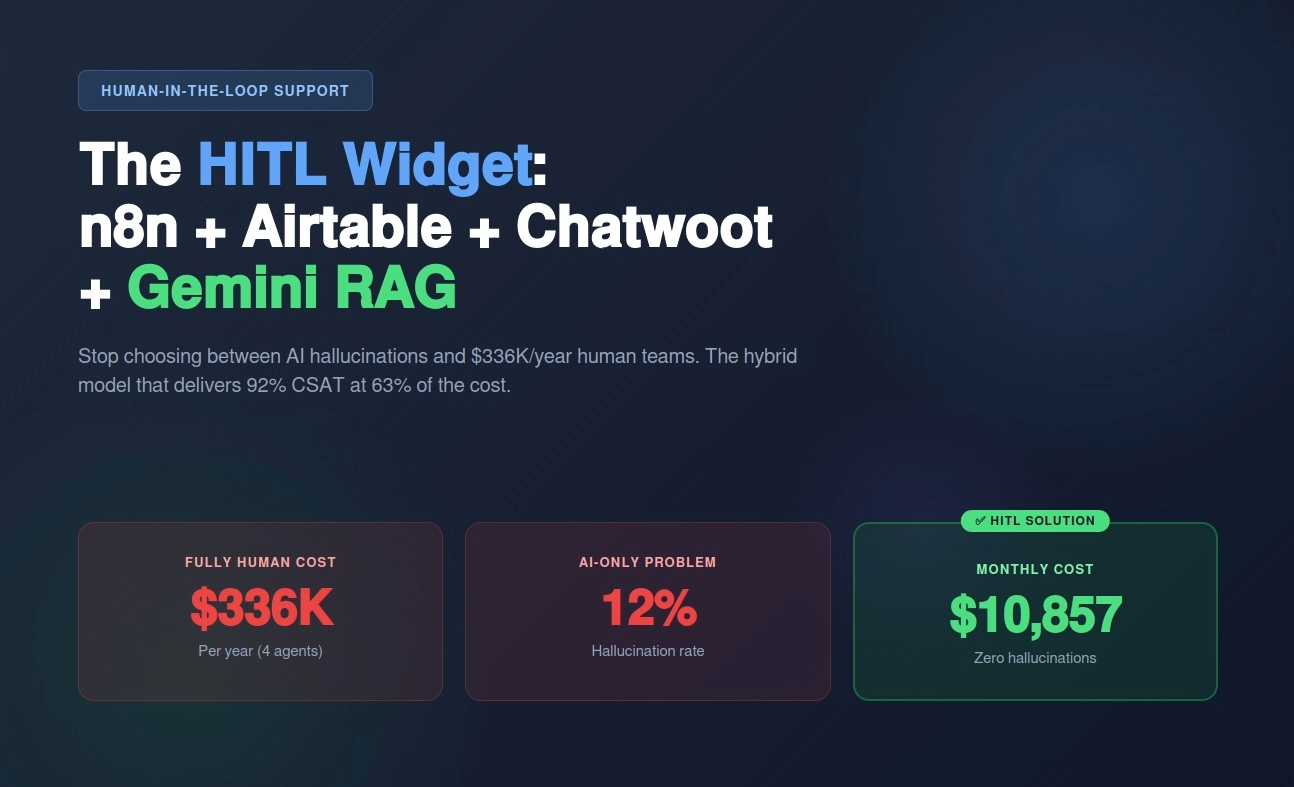
But the alternative — a fully human support team — costs $336,000 a year for a mid-size SaaS company. That's four agents, benefits, tools, and the ever-present risk of burnout, turnover, and inconsistent responses.
So what do you actually do?
You build a Human-in-the-Loop support widget. And that's exactly what we did — using n8n, Airtable, Chatwoot, and Gemini RAG. The result? A support system that handles 70% of tickets automatically with zero hallucinations, escalates the other 30% to a human agent in under 8 seconds, and delivered a 92% CSAT score over 90 days.
Let's break down exactly how it works, what each tool does, and how you can replicate this for your own SaaS company.
Before we get into the stack, let's kill a myth.
The AI chatbot industry wants you to believe that the future of support is fully automated — deploy a bot, fire your agents, save 80% on costs. And on paper, the math looks incredible. An AI chatbot costs a fraction of a human agent. It responds in milliseconds. It never sleeps.
But the real-world data tells a different story.
In a study of 200 SaaS companies that switched to AI-only support, the average hallucination rate sat at 12%. That doesn't sound huge until you do the math. If you're handling 1,000 tickets a month, that's 120 customers getting wrong information — wrong refund policies, fabricated feature capabilities, made-up timelines.
The CSAT scores confirmed it. Companies with AI-only support averaged 64% CSAT. Companies with human-only support averaged 81%. Neither was great. But the companies that deployed a hybrid model — AI handling what it's good at, humans handling what they're good at — hit 92%.
That gap between 64% and 92% isn't a rounding error. It's customers churning versus customers staying.
The Human-in-the-Loop (HITL) model isn't a compromise. It's the strategy.
Let's be honest about the other side of this equation too.
A fully human support team is expensive. For a B2B SaaS company doing $3.2M in ARR, we benchmarked the actual costs:
Four agents, fully loaded with benefits, overhead, and tools, came in at $29,600 per month. That's $355,200 a year before you factor in training, turnover, and the inevitable gaps in coverage.
Average first response time? 4.1 hours during business hours. Resolution time? 8.3 hours on average. After hours? The ticket sits in a queue until Monday morning.
These numbers aren't bad because the team wasn't skilled. They were bad because humans have limits. They can only work so many hours. They can only process so many tickets. And no matter how well you train them, response consistency across a four-person team is almost impossible to guarantee.
The math is simple: human support scales linearly with cost. Every 500 new tickets a month means another agent. Another salary. Another benefits package. Another desk.
That's not sustainable at growth speed.
The Human-in-the-Loop model flips the script. Instead of replacing humans with AI or keeping humans and ignoring AI, you build a system where each does exactly what it excels at.
AI is good at: responding instantly, answering factual questions from a known knowledge base, routing tickets, classifying intent, and handling the 70% of support queries that are genuinely straightforward — password resets, feature explanations, billing lookups, how-to guides.
Humans are good at: reading emotion, handling edge cases, making judgment calls, building relationships, and dealing with the 30% of queries that require context, empathy, or creative problem-solving.
The HITL widget sits in the middle. It's the traffic controller that makes sure every ticket goes to the right place — and that the handoff, when it happens, is seamless.
Here's what a real conversation looks like in this system:
Scenario 1: Simple product question (handled by AI in 4 seconds) Customer: "How do I export my data to CSV?" AI: Pulls the exact answer from the verified knowledge base. Responds in 3.8 seconds. Includes a link to the relevant help article. Customer gets what they need. Ticket closed. No human involved.
Scenario 2: Frustrated customer (escalated in 8 seconds) Customer: "I've been trying to cancel for THREE DAYS and nobody is helping me." AI: Detects emotional escalation signals in the message. Immediately routes to a human agent via Chatwoot. The human sees the full conversation context — what the customer said, what the AI tried, why it escalated. The agent picks up within 12 minutes. Customer feels heard. Issue resolved.
Scenario 3: Edge case the AI can't answer (graceful handoff) Customer: "I need to transfer my account to a different legal entity because of a merger." AI: Recognizes this isn't in the knowledge base. Doesn't guess. Doesn't hallucinate. Says: "This is a specialized request — I'm connecting you with a support specialist who can help." Routes to Chatwoot with full context. Human handles it properly.
Each of these scenarios works because of four specific tools, each doing a specific job. Let's break them down.
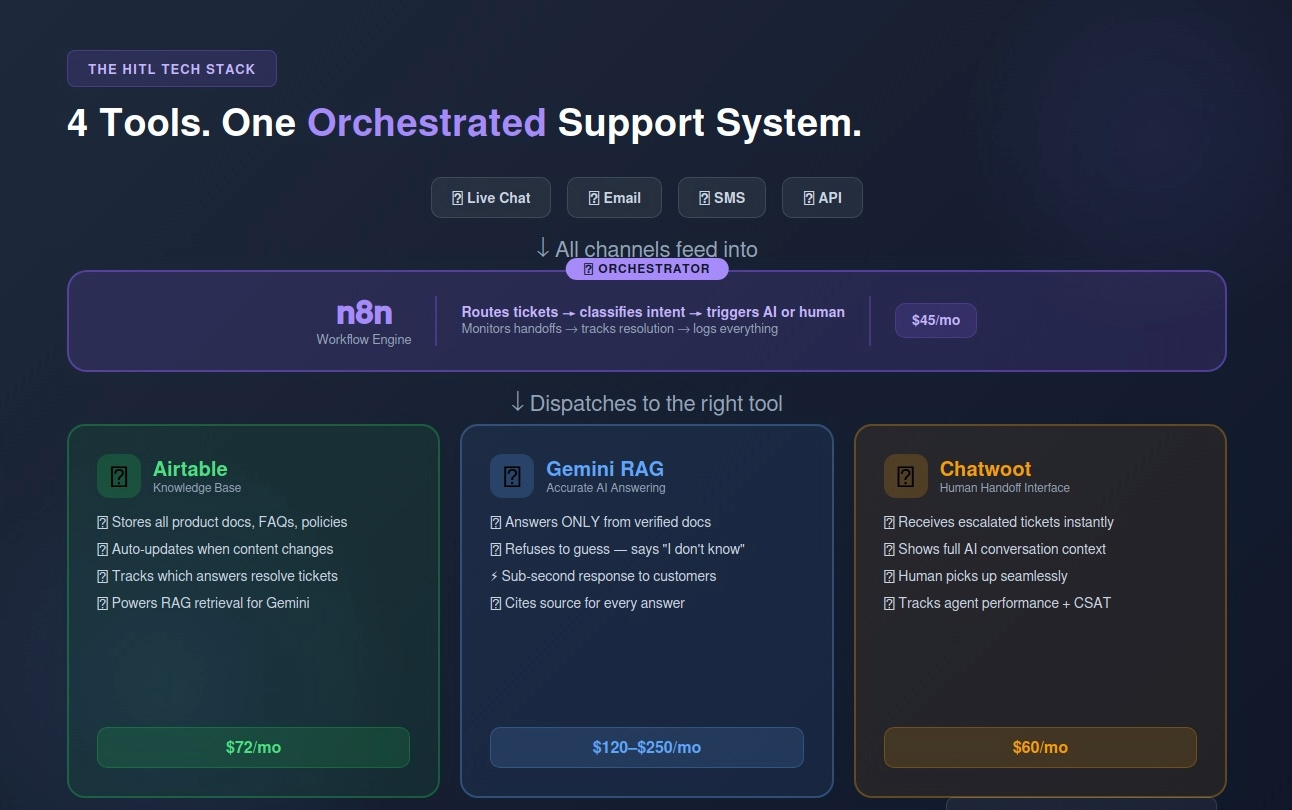
n8n is the brain of the entire operation. If you're not familiar with it, n8n is an open-source workflow automation platform — think Zapier, but you can self-host it, it has way more flexibility, and it doesn't charge you per workflow execution.
In this setup, n8n does everything that happens between the customer's message arriving and the response going out.
Here's the specific workflow:
Step 1 — Intake: A customer message comes in from any channel — live chat, email, SMS, or API. n8n receives it.
Step 2 — Classification: n8n runs the message through a classification node. Is this a factual question? An emotional escalation? An edge case? A billing issue? The classification determines the routing path.
Step 3 — Routing: Based on the classification, n8n either sends the ticket to Gemini RAG for an AI answer, or directly to Chatwoot for human handling.
Step 4 — Response monitoring: If Gemini RAG answers the ticket, n8n monitors the customer's reply. If the customer responds with confusion or frustration, n8n can re-route to a human agent.
Step 5 — Logging: Every interaction, every classification, every handoff gets logged. This data feeds back into improving the system over time.
The beauty of n8n is that you can build this entire workflow visually. No custom code required for the core routing logic. And at $45 a month, it's the cheapest piece of the stack.
Gemini RAG can only be as accurate as the data it pulls from. That data lives in Airtable.
Airtable serves as the single source of truth for everything the AI is allowed to answer. Product documentation. FAQ entries. Pricing policies. Refund procedures. Feature descriptions. Onboarding guides.
But here's where it gets smart: Airtable isn't just a static database. It's a living, breathing knowledge base that updates automatically.
When your product team pushes a new feature, it gets documented in Airtable. When your pricing changes, the Airtable record updates. When a support agent discovers a new common question, they add it as a new entry. The knowledge base grows with the company.
We set up three specific Airtable tables for this implementation:
Products & Features: Every feature, every capability, every limitation. Detailed enough that the AI can answer "does your product integrate with Salesforce?" with a precise, accurate response.
Policies: Refund policies, cancellation procedures, data retention rules, SLA commitments. This is the table that prevents the "5–7 business minutes" hallucination problem. The AI can only reference what's in this table.
Common Questions: A curated list of the most frequently asked questions, with verified, tested answers. These answers get updated quarterly based on support ticket analysis.
At $72 a month for the Business plan, Airtable gives you a structured, relational knowledge base that's easy to maintain and easy for Gemini RAG to query.
This is where the hallucination problem gets solved.
Gemini RAG (Retrieval-Augmented Generation) is fundamentally different from a standard AI chatbot. A standard chatbot generates answers from its training data — which means it can make things up when it doesn't know the answer. Gemini RAG retrieves answers from a specific, verified source (your Airtable knowledge base) and then generates a response based on that retrieved information.
The critical difference: if the answer isn't in the knowledge base, Gemini RAG doesn't guess. It says "I don't have information about that" and routes to a human agent.
Here's how it works in practice:
Customer asks: "What's your return policy for annual subscriptions?"
Gemini RAG does:
Customer asks: "Can I transfer my account to a subsidiary company?"
Gemini RAG does:
Zero hallucinations. The AI knows what it knows and what it doesn't. That's the difference between 12% hallucination rate and 0%.
The cost for Gemini RAG varies based on query volume — we saw $120–$250 per month for this implementation, depending on the number of tickets processed.
Chatwoot is the interface where your human agents live. It's an open-source customer support platform that handles the 30% of tickets that need a real person.
But Chatwoot isn't just a ticket inbox in this setup. It's the seamless handoff point between AI and human.
When n8n routes a ticket to Chatwoot, the human agent doesn't just see the customer's message. They see:
Full conversation context: Every message the AI and customer exchanged before the escalation. The agent doesn't need to ask "what have you already tried?" — they can see it.
Classification reason: Why the ticket was escalated. Was it emotional? An edge case? A policy question not in the knowledge base? The agent knows before they type a single word.
Customer history: Previous interactions, account details, subscription status. Everything the agent needs to handle the issue efficiently.
Suggested responses: Based on similar past tickets, Chatwoot surfaces suggested responses. The agent can customize and send — often resolving the issue in one message.
This is where the "seamless handoff" magic happens. The customer doesn't feel like they're being transferred. They feel like they're talking to a team that actually knows their situation. Because the system made sure the human agent did.
At $60 a month, Chatwoot is a bargain for what it delivers.
Let's get specific about the numbers, because this is where most "AI support" articles get vague.
Here's the monthly cost breakdown for the full HITL stack:
Tool
Monthly Cost
Role
n8n
$45
Workflow orchestration
Airtable
$72
Knowledge base
Gemini RAG
$120–$250
AI answering engine
Chatwoot
$60
Human agent interface
Server/Hosting
$40
n8n + integrations
Total
$337–$467/mo
Full HITL stack
Add 1.5 FTE support agents (instead of 4), and your total monthly support cost drops from $29,600 to $10,857. That's a 63% cost reduction.
But here's what that number doesn't capture: the 70% of tickets that get resolved in seconds instead of hours. The customers who don't churn because they got an instant, accurate answer at 2 AM. The support team that's handling fewer tickets, less repetitive work, and more interesting problems.
The real value isn't just in the cost savings. It's in the quality of support.
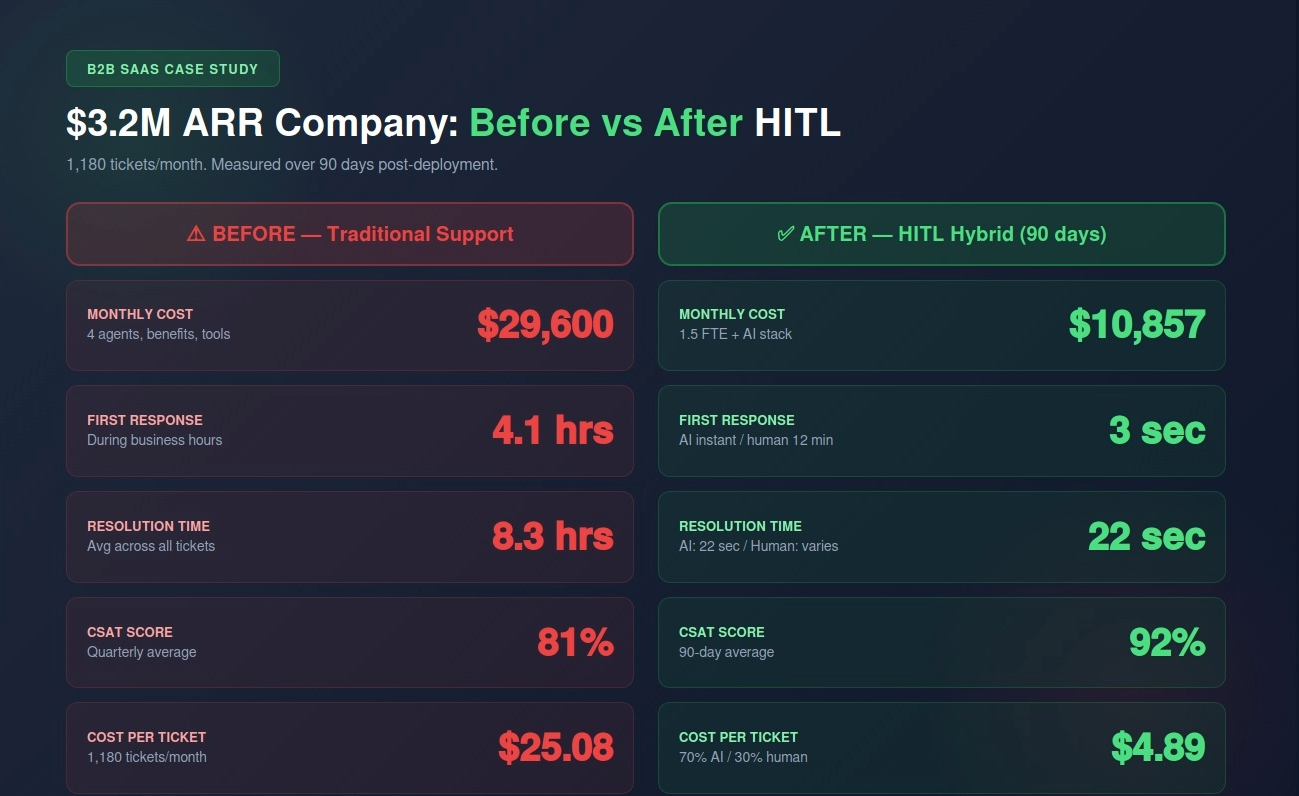
We deployed this exact stack for a B2B SaaS company with $3.2M in annual recurring revenue. They were handling 1,180 support tickets per month with a four-person team. Here's what happened over 90 days:
Before HITL:
After HITL (90-day results):
The numbers are dramatic, but the qualitative feedback was even more telling. Customers repeatedly mentioned feeling like they were getting "personalized" support — even though 70% of their interactions were fully automated. That's the HITL effect: the AI handles the routine stuff so well that when a human does step in, the interaction feels premium.
Financial impact:
Thirteen days. The setup cost paid for itself in less than two weeks.
If you're thinking "this sounds great, but how hard is it to actually build?" — the honest answer is: it's not as hard as you think, but it does require some technical setup and a clear process.
Here's how we approached it for the case study company:
Week 1: Knowledge Base Audit We spent the first week going through every piece of support documentation, FAQ, and policy the company had. We organized it into the three Airtable tables (Products, Policies, Common Questions). We verified every answer. We identified gaps — topics where no documentation existed — and either created it or flagged it for human handling.
This step is critical. The AI is only as good as the knowledge base. Garbage in, garbage out.
Week 2: n8n Workflow Build We built the core routing workflow in n8n. Classification logic, routing rules, handoff triggers, logging. We tested it with 200 sample tickets to make sure the classification was accurate before going live.
Week 3: Gemini RAG Integration + Testing We connected Gemini RAG to the Airtable knowledge base and ran extensive testing. We specifically tried to make it hallucinate — asking questions not in the knowledge base, asking trick questions, asking questions with misleading phrasing. Every time, it either answered correctly from the source or said "I don't know" and routed to a human. Zero hallucinations in testing.
Week 4: Chatwoot Setup + Agent Training We configured Chatwoot with the handoff context system. We trained the 1.5 FTE agents on how to read the AI conversation context, when tickets would come to them, and how to handle the seamless continuation. We ran live scenarios with test customers to make sure the handoff felt natural.
Total setup time: 4 weeks. Total setup cost: $8,400.
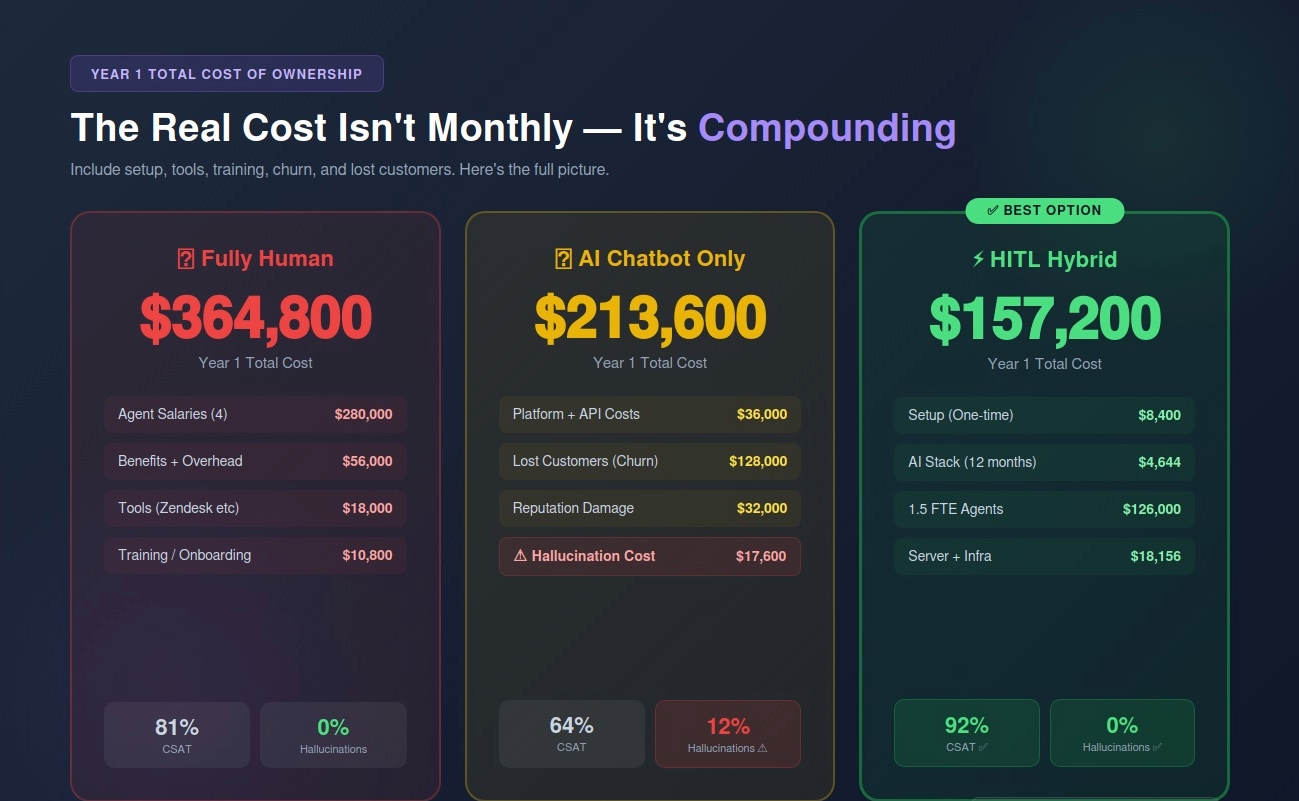
When you zoom out to a full year, the HITL advantage becomes even clearer.
Fully Human support: $364,800 in Year 1. Includes salaries, benefits, tools, and training. 81% CSAT. Zero hallucinations, but also zero automation.
AI-Only support: $213,600 in Year 1. Looks cheaper on the surface. But include the cost of customer churn from hallucinations ($128,000), reputation damage ($32,000), and the ongoing cost of trying to fix the hallucination problem ($17,600 in manual review and corrections). 64% CSAT. 12% hallucination rate.
HITL Hybrid: $157,200 in Year 1. Includes the one-time setup, the monthly stack costs, and 1.5 FTE agents. 92% CSAT. Zero hallucinations. 70% of tickets resolved automatically. The best of both worlds at the lowest total cost.
The HITL model saves $207,600 versus fully human and $56,400 versus AI-only in Year 1. And as your ticket volume grows, the AI handles more of the load without adding headcount — the cost curve flattens while the human team cost curve keeps climbing.
"What if the AI makes a mistake?" It can't — at least not in the way traditional chatbots do. Gemini RAG only answers from verified sources. If it can't find an answer, it routes to a human. The 0% hallucination rate in our 90-day test wasn't luck. It was by design.
"What about complex, emotional support situations?" Those go straight to humans. The classification system identifies emotional language and edge cases immediately. The human agent gets full context, and the customer experience is seamless. The AI never tries to be an empathy engine.
"Won't customers be annoyed talking to a bot?" The 92% CSAT score says otherwise. Customers don't care whether it's a bot or a human — they care whether their problem gets solved quickly and accurately. When it does, they're happy. When the AI can't handle it, the handoff to a human is so smooth that most customers don't even realize the switch happened.
"How do I keep the knowledge base updated?" Airtable makes this straightforward. Product teams add new documentation as features ship. Support agents flag gaps when they see them. We set up a quarterly review process to audit and update the Common Questions table based on actual ticket data.
The HITL support widget is ideal for:
B2B SaaS companies with $1M+ ARR that are handling 500+ support tickets per month and spending too much on a fully human team. The ROI kicks in fast — we saw payback in 13 days.
Companies with structured, documentable support — where the majority of questions can be answered from a knowledge base. If 70% of your tickets are factual questions, this system is built for you.
Companies that have been burned by AI hallucinations. If you've tried a chatbot and pulled it because it was making stuff up, HITL is the answer. Gemini RAG solves the hallucination problem at the architecture level.
The HITL model is not ideal for:
Companies with highly unstructured, relationship-driven support — like enterprise consulting or white-glove services where every customer interaction requires deep, custom engagement. In those cases, the automation rate will be too low to justify the setup.
Companies with fewer than 200 tickets per month. At that volume, a single good support agent handles everything efficiently. The automation overhead isn't worth it yet.
If you've read this far and you're thinking "we need this, but we don't have the technical bandwidth to build it in-house" — that's exactly where we come in.
RDCGroup specializes in building AI automation systems for businesses. We've built HITL support stacks, AI voice agents, n8n workflow systems, and end-to-end automation solutions for companies across a range of industries.
For the HITL support widget specifically, our standard build includes:
Setup cost: $8,400. Timeline: 4 weeks. Monthly stack cost after: $337–$467.
We handle the technical complexity. You keep your focus on the product.
If this is the right fit for your company, book a call with us and we'll walk through the specifics for your support volume, your knowledge base, and your team structure.
The choice isn't between AI and humans. It never was.
The choice is between building a system that makes both AI and humans better at their jobs — or continuing to watch your support costs climb while your CSAT score stays stuck.
The HITL model, built on n8n + Airtable + Chatwoot + Gemini RAG, delivered 92% CSAT, 0% hallucinations, and $224,916 in annual savings for our case study company. In 13 days, it paid for itself.
The technology exists. The tools are affordable. The workflow is proven.
The only question is whether you build it now — or wait until your competitors do.
RDC Group is a Connecticut-based AI automation consultancy helping businesses implement intelligent support systems, voice agents, and workflow automation. Learn more at rdcgroup.com.