How One Ecommerce Brand Cut Customer Support Time 70% with AI Customer Support Automation
December 3, 2025
Most ecommerce brands waste 15-25 hours weekly answering routine inquiries that could be automated. That's $2,400-$4,000 per month spent on repetitive work that AI-powered customer service can handle in seconds, significantly reducing operational costs.
How One Ecommerce Brand Cut Customer Support Time 70% with AI Customer Support Automation
If you run an ecommerce brand, you already know the reality: customer support is a necessary expense that eats up massive amounts of time and money. Your inbox is flooded with "Where's my order?" emails. Your phone rings constantly with questions about return policies. Your customer service team is burned out from answering the same questions 50 times per week.
Most ecommerce brands waste 15-25 hours weekly answering routine inquiries that could be automated. That's $2,400-$4,000 per month spent on repetitive work that AI-powered customer service can handle in seconds, significantly reducing operational costs.
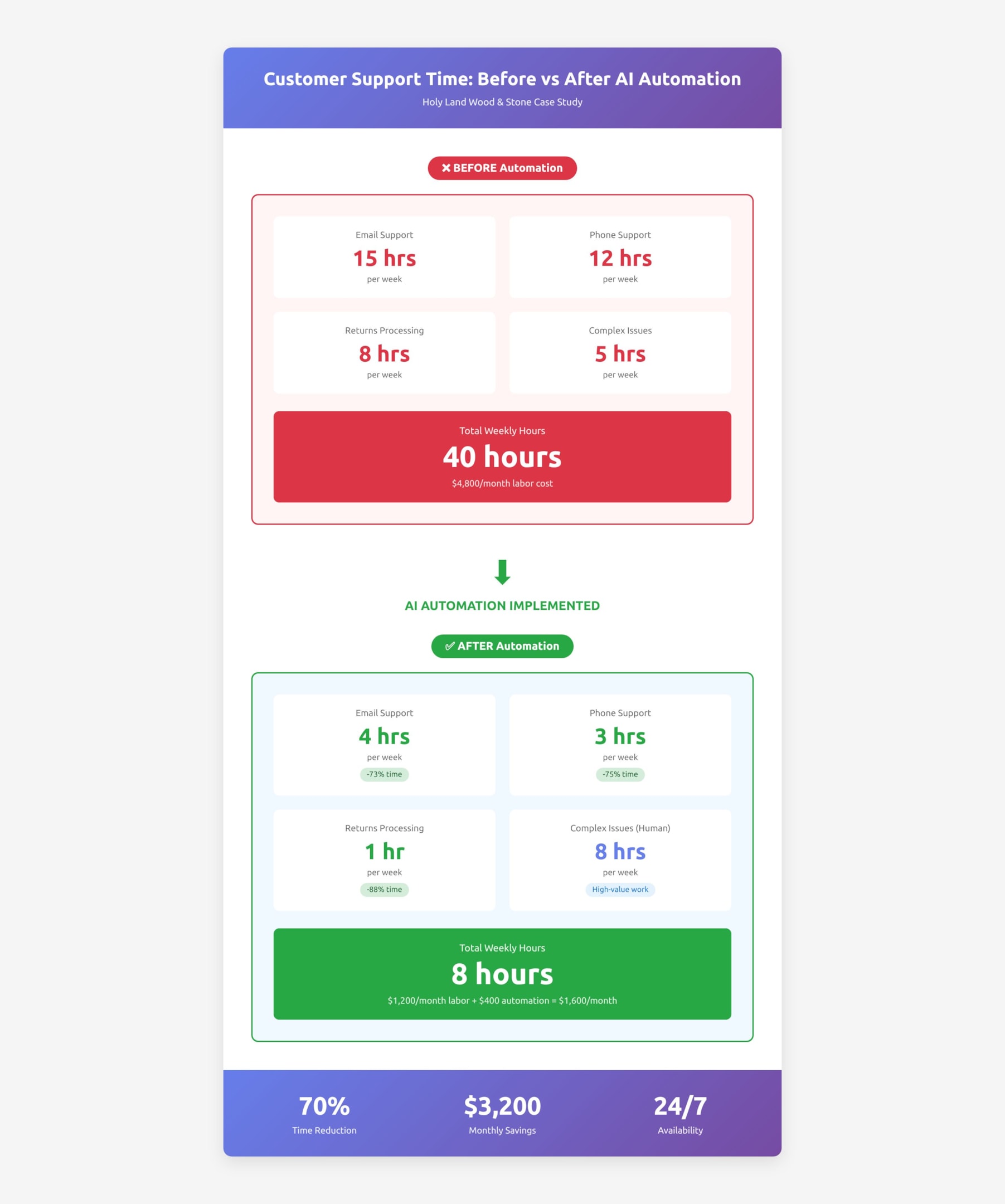
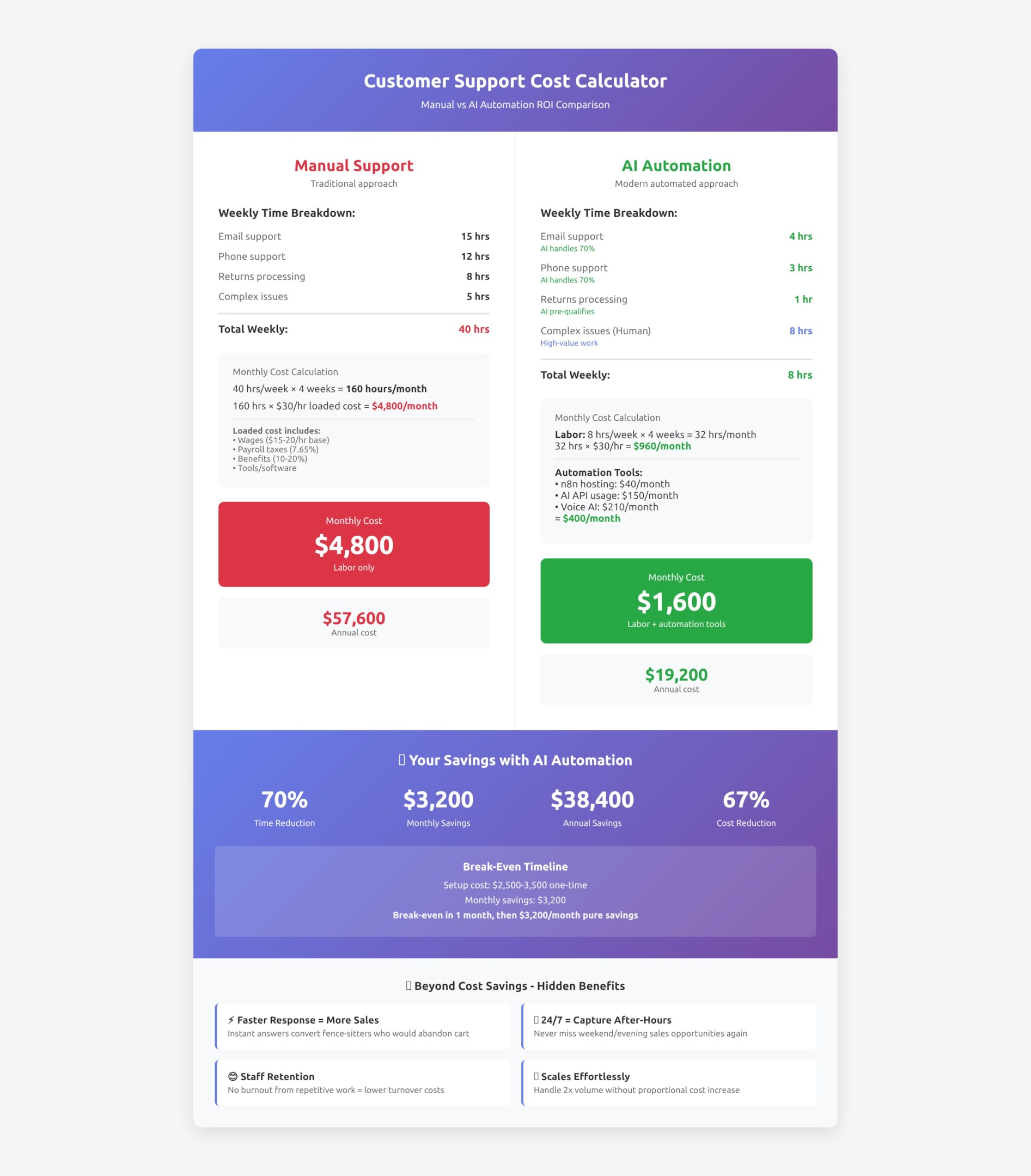
Here's a real example: Holy Land Wood & Stone, a Connecticut-based ecommerce brand selling religious gifts and home decor, was spending 40 combined staff hours weekly on customer support. After implementing AI customer support automation, leveraging AI agents and conversational AI workflows, they cut that to 8 hours per week—a 70% reduction—while improving customer satisfaction scores and delivering more personalized support.
In this article, I'll break down exactly how they transformed customer service with AI, what they automated, and how you can implement the same system in your ecommerce business. If you're doing $50k-$500k monthly revenue and drowning in support requests, this could save you $3,000-$5,000 per month while delivering exceptional service and streamlining your support operations.
The Real Cost of Manual Customer Support
Let's talk numbers because most ecommerce brands don't realize how much they're actually spending on customer service costs.
The average ecommerce brand doing $100k-$300k monthly handles 200-400 customer requests per week. If you have dedicated human agents (or if you're doing it yourself), here's the breakdown:
Time Investment:
Email support: 15-20 hours/week
Phone support: 10-15 hours/week
Live chat: 5-10 hours/week (if you offer self service options)
Total: 30-45 hours weekly
Financial Cost:
Support staff at $15-20/hour = $1,800-$3,600/month
Or founder/owner time at opportunity cost of $100-200/hour = $12,000-$36,000/month
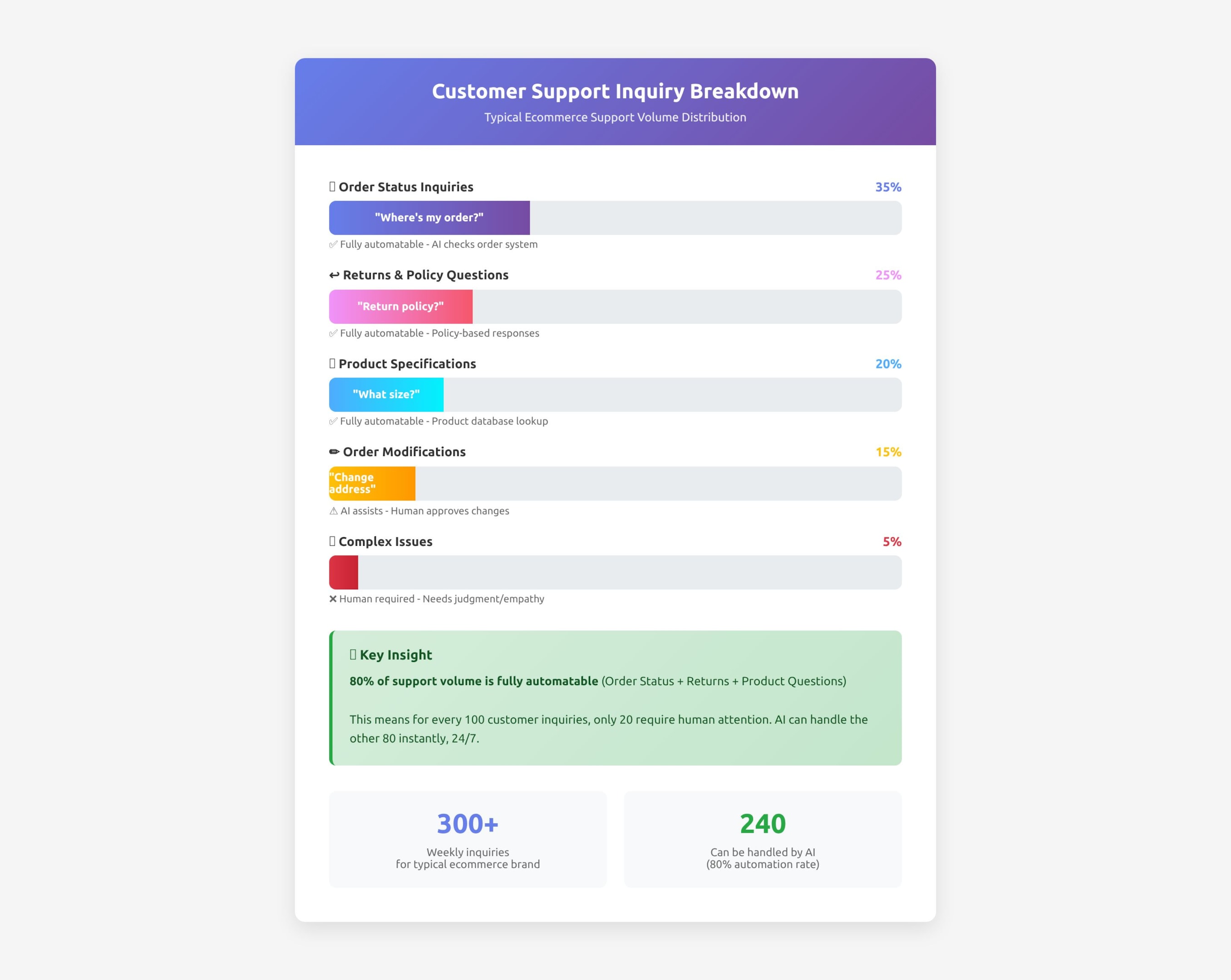
Here's what kills me: 70-80% of those inquiries are routine inquiries. The same questions, over and over:
"Where's my order?" (35% of total volume)
"What's your return policy?" (25% of volume)
Product specifications and compatibility questions (20% of volume)
Order modifications or cancellations (15% of volume)
Actually complex customer inquiries requiring human judgment: 5%
You're paying someone $20/hour to copy-paste tracking numbers from Shopify. You're spending 3-5 minutes per email to say "Our return window is 30 days, here's the link to start a return." You're answering the same product dimension questions that are already listed on your product page.
The brutal math: For a brand spending $3,600/month on support labor, roughly $2,880 of that is paying humans to do work that AI systems can handle instantly with response accuracy and context aware responses.
Case Study: How Holy Land Wood & Stone Automated 70% of Support
Let me show you exactly how this works in practice.
Background
Holy Land Wood & Stone is an ecommerce brand I worked with, specializing in religious gifts, olive wood products, and home decor. They're doing about $180k/month in revenue—a solid mid-market ecommerce business.
Their support situation before automation:
250-350 customer inquiries per week
2 part-time support staff
Combined 40 hours/week spent on support
Cost: $4,800/month in labor
The Manual Nightmare
Email Support Issues:
Their inbox was getting hammered with 150-200 emails weekly. Here's what made it painful:
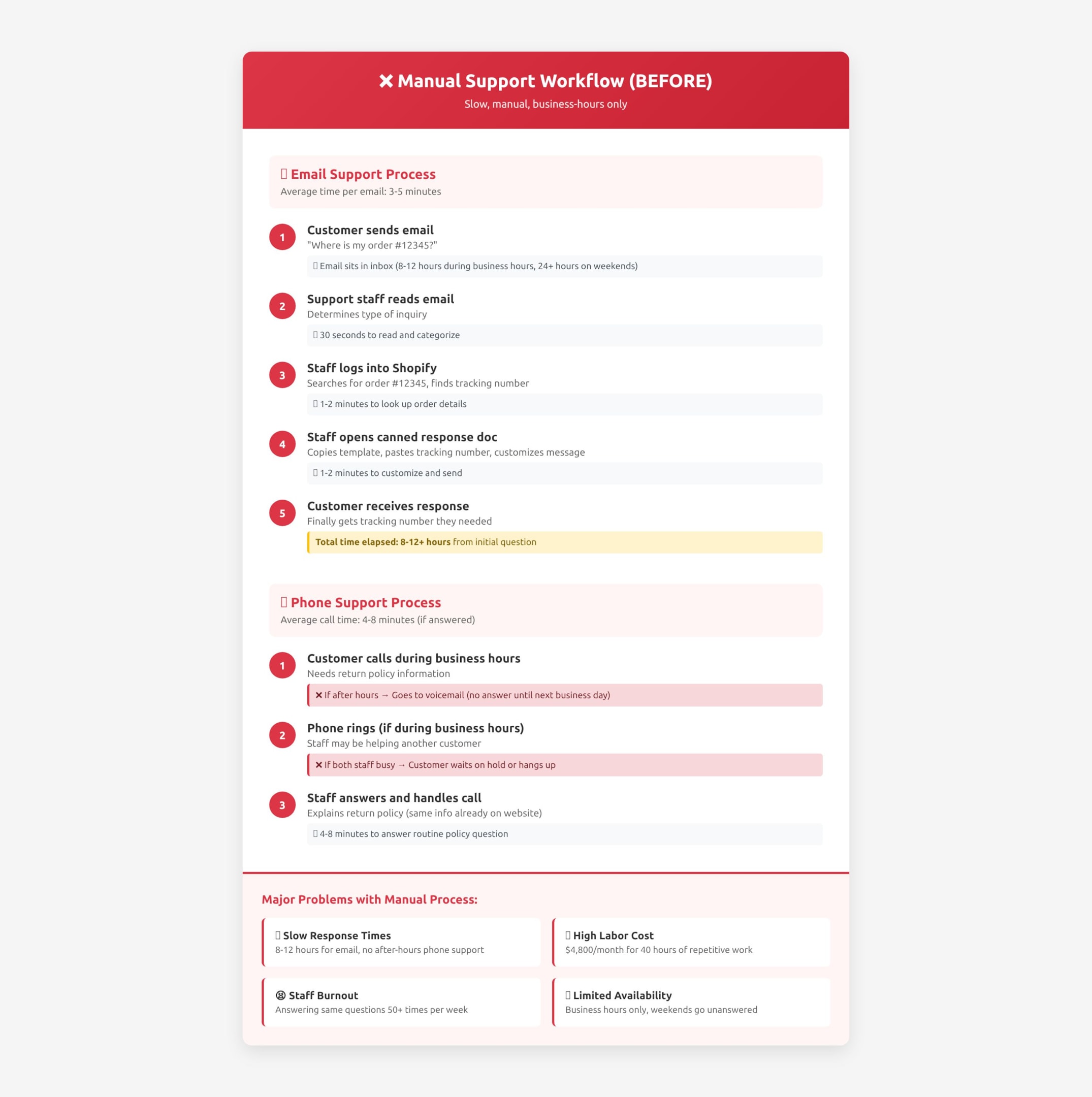
Response time was 8-12 hours during business hours, often 24+ hours if emails came in Friday evening
Every email required manual attention, even though most were identical questions
Support staff were copying and pasting from a document of "canned responses," but still had to:
Read the email
Figure out which canned response applied
Often check Shopify for order details
Customize the response slightly
Send it
This process took 3-5 minutes per email. Doesn't sound like much, but 150 emails × 4 minutes = 10 hours weekly just on automating routine tasks.
Phone Support Issues:
50-80 calls per week, mostly during business hours. The problems:
Phone rang unanswered when both staff members were already helping customers
Most calls were routine: order status checks, shipping questions, return policy inquiries
After-hours calls went to voicemail, creating a backlog for the next business day
Staff spent 12 hours weekly on phone support, with at least 8 of those hours answering questions that didn't require human judgment
The cost breakdown:
Email support: 15 hours/week
Phone support: 12 hours/week
Returns processing: 8 hours/week
Complex issues: 5 hours/week
Total: 40 hours/week = $4,800/month
The AI Powered Customer Service Automation Solution
We built a comprehensive AI customer support automation system using n8n workflows integrated with Claude AI agents built for customer service. Here's exactly what we automated:
Email Automation Workflow:
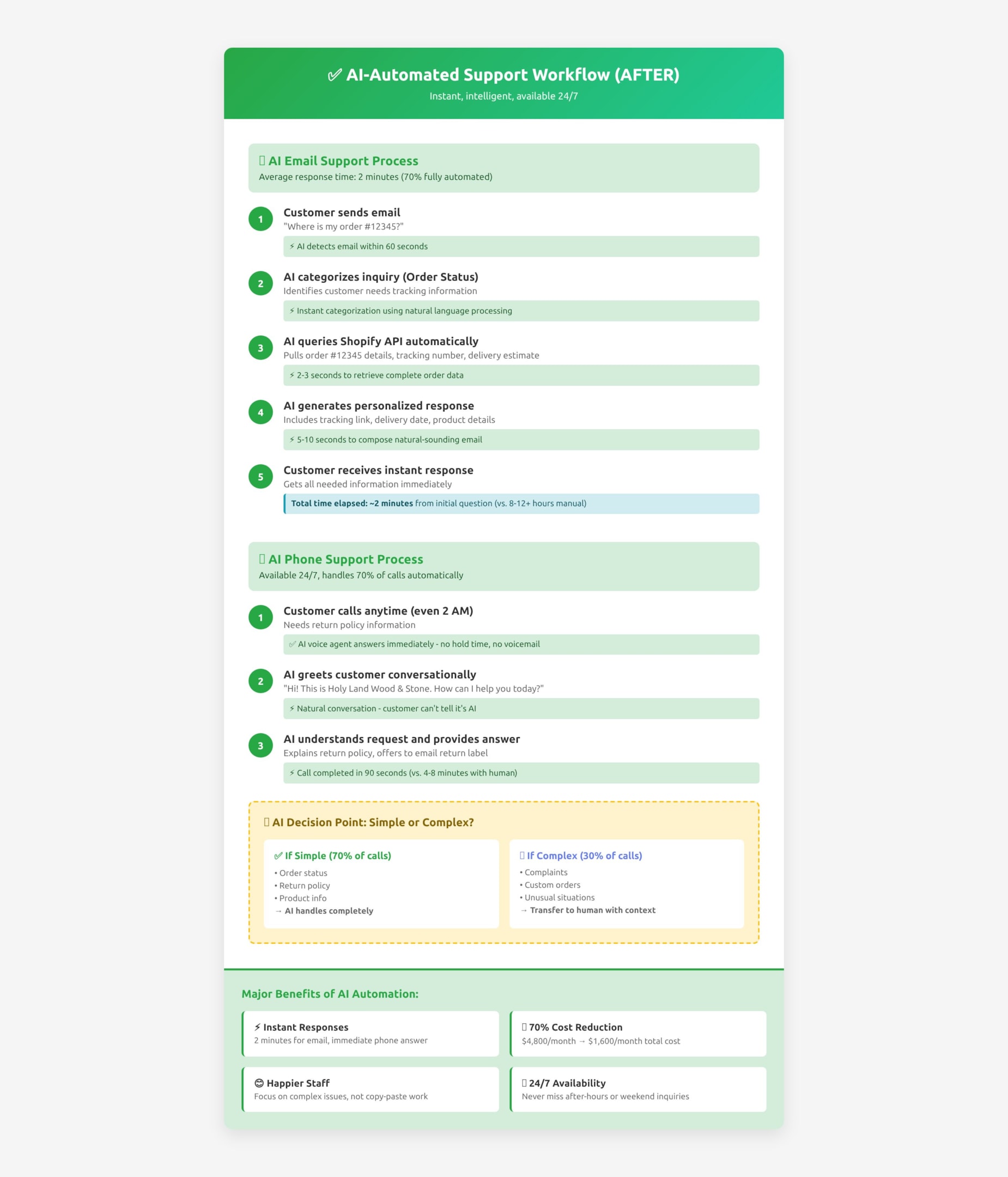
AI reads every incoming support email within 60 seconds of arrival
Categorizes customer requests by intent using natural language processing and analyzing past interactions:
Order status inquiry
Return/exchange request
Product question
Shipping inquiry
Policy question
Complaint/issue
Other/complex
For order-related questions, AI automatically:
Pulls order data from Shopify API
Checks order status, tracking number, delivery estimate based on customer's purchase history
Identifies any shipping delays or issues
Generates personalized response with specific order details
For product questions, AI:
References product database for specifications
Provides dimensions, materials, care instructions
Suggests compatible products if relevant
Links to product page for more details
Auto-responds to tier-1 questions (70% of volume):
Sends immediate personalized support
Includes all relevant information
Provides next steps if needed
Logs interaction in support system
Routes complex customer inquiries to human agents with full context:
Summary of customer issue
Relevant order history and customer data
Previous support interactions
Suggested response (human can modify)
Phone Support Automation:
We implemented an AI chatbot for customer support via voice, leveraging conversational AI:
AI voice agent answers all calls 24/7
Conversational intake: "Hi, this is Holy Land Wood & Stone. How can I help you today?"
Routes based on customer need:
Order status → AI checks system, provides tracking info
Return question → AI explains policy, emails return label
Product question → AI provides specifications
Complex issue → "Let me connect you with someone who can help" (transfers to human with context)
After-hours handling:
AI captures full inquiry details
Emails summary to support team
Sends follow-up email to customer: "We received your call and will respond within 4 business hours"
Creates ticket in support system
Results After 60 Days
The numbers don't lie. Here's what changed:
Time Savings:
Email volume: Still 150-200/week, but AI agents handle 110-140 automatically
Staff time on email: 15 hours/week → 4 hours/week
Phone calls: Still 50-80/week, but AI handles 35-55 automatically
But here's what the numbers don't capture: the customer service team went from burned out and reactive to energized and proactive. They now spend their 8 hours weekly on:
Complex customer issues that actually need human judgment
Proactive outreach to VIP customers
Product feedback analysis
Creating better help documentation
One staff member told me: "I actually enjoy my job now. I'm not a robot copy-pasting tracking numbers. I'm solving real problems."
[INSERT IMAGE 5: RDCGroup ROI Calculator Support Cost Comparison]
What You Can Actually Automate in Customer Support
Based on analyzing support tickets for dozens of ecommerce brands, here's the breakdown of what to automate at each level to improve customer service and support efficiency:
✅ TIER 1: Fully Automate These (70-80% of Volume)
Order Status Inquiries (35% of total support volume)
This is the easiest win. AI can:
Check your order management system automatically (Shopify, WooCommerce, etc.)
Pull tracking number and carrier information
Provide estimated delivery date
Explain any shipping delays with context
Include direct tracking link
Example automated response: "Hi Sarah! Your order #12345 shipped yesterday via USPS Priority Mail. Expected delivery is December 2nd. You can track your package here: [tracking link]. The package includes your Olive Wood Nativity Set and Jerusalem Stone Coasters. Let me know if you need anything else!"
Shipping & Returns Policy Questions (25% of volume)
AI handles this perfectly because policies are clearly defined:
Provides return policy based on product type and purchase date
Handles damaged/defective item scenarios with escalation
Product Specifications (20% of volume)
AI pulls from your product database:
Dimensions, weight, materials
Care instructions
Compatibility with other products
Country of origin
Answers comparison questions ("What's the difference between Product A and Product B?")
Account & Password Issues (5% of volume)
Simple authentication flows:
Password reset links
Account status checks
Order history retrieval
Update shipping/billing addresses
FAQ-Style Questions (5% of volume)
These are straightforward knowledge base queries:
Business hours
Accepted payment methods
International shipping availability
Gift wrapping options
Wholesale inquiries (initial information)
⚠️ TIER 2: AI Assists, Human Approves (15-20% of Volume)
Return/Exchange Processing
AI does the heavy lifting, human makes final call:
AI pre-qualifies: Is return within policy window? Original condition?
AI generates return shipping label
AI suggests resolution (refund vs. exchange)
Human reviews edge cases (outside return window, partial damage, etc.)
Human approves final action
Order Modifications
AI gathers context, human executes:
AI checks if order can be modified (not yet shipped)
AI presents options to customer
AI routes to human for final approval and processing
Human makes judgment call on rush situations
Discount/Refund Requests
AI analyzes, human decides:
AI pulls customer history (purchase frequency, lifetime value)
AI checks if issue warrants refund based on policy
AI suggests resolution amount
Human reviews and makes final decision based on customer relationship
Product Recommendations for Complex Needs
AI provides options, human adds expertise:
AI suggests products based on customer description
AI highlights key features and differences
Human adds personal touch, expertise, upsell opportunities
❌ TIER 3: Human-Only (5-10% of Volume)
Escalated Complaints
These need human empathy and judgment:
Multiple delivery failures
Quality issues requiring subjective assessment
Requests significantly outside policy
Customers who are upset and need to vent
Custom/Bulk Orders
Higher-value conversations:
B2B wholesale inquiries
Custom product requests
Volume pricing negotiations
Special customization requirements
Product Sourcing Requests
Requires expertise and supplier relationships:
"Can you get this specific item?"
International shipping to unusual locations
Special gift sets or corporate orders
How to Build Your Own AI Customer Support Automation System
Let me walk you through the exact process to implement AI customer support automation for your ecommerce brand to reduce ticket volume and improve support efficiency.
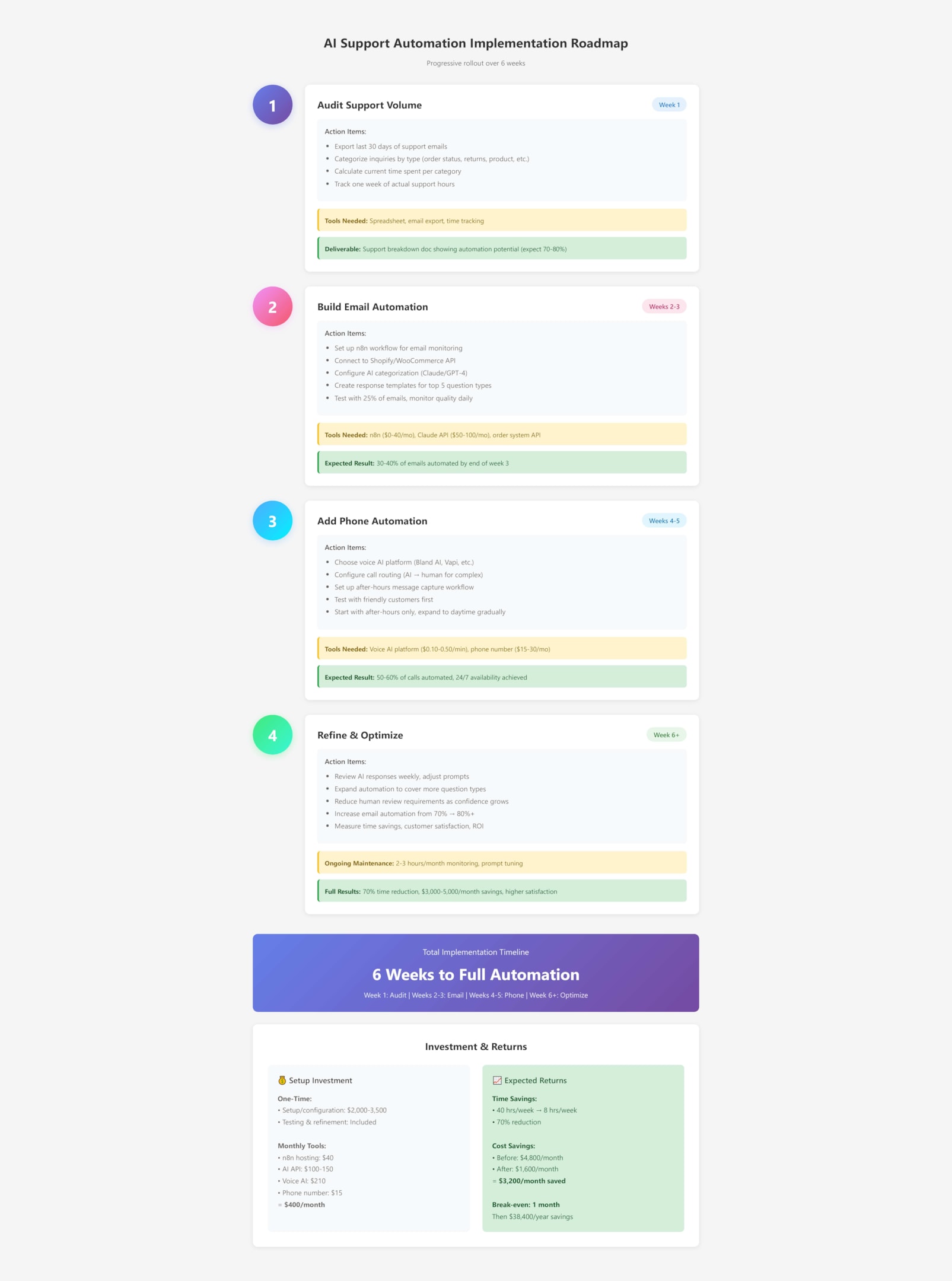
Phase 1: Audit Your Support Volume (Week 1)
Before you automate anything, you need to understand what you're working with.
Action steps:
Export your last 30 days of customer conversations
Pull all emails from your support inbox
Get phone call logs if you track them
Export live chat transcripts if applicable
Categorize every inquiry
Create categories: Order Status, Returns, Product Questions, Shipping, Policy, Complex
Manually tag 100-200 recent inquiries to understand your breakdown
Calculate what % falls into each category
Identify automation opportunity
Which categories are repetitive and rule-based?
Which require human judgment?
What % could be automated with high confidence?
Calculate current customer service costs
Hours spent weekly on support
Hourly cost (staff wages + overhead)
Opportunity cost if founder is doing support
Deliverable: Document showing your support breakdown and automation potential
Phase 2: Start with Email Automation (Weeks 2-3)
Email is the easiest starting point because you can monitor and refine before responses go out.
Build the system:
Set up n8n workflow (or Make/Zapier alternative)
Connect your email (Gmail, Outlook, or support platform API)
Integrate with your order system (Shopify, WooCommerce, etc.)
Configure AI categorization using Claude or GPT-4
Create response templates for your top 5 question types
Set confidence thresholds (only auto-respond when AI is >90% confident)
Test carefully:
Start with 25% of emails (route rest to human review)
Monitor AI responses daily
Adjust prompts based on what works/doesn't work
Gradually increase automation % as confidence improves
Expected timeline: 2-3 weeks to production-ready email automation
Phase 3: Add Phone Support (Weeks 4-5)
Once email is running smoothly, layer in phone automation.
Implementation:
Choose voice AI platform (options: Bland AI, Vapi, custom solution)
Configure call routing (AI handles tier-1, transfers complex to human)
Set up after-hours handling (message capture and follow-up workflow)
Test extensively with friendly customers before full rollout
Phone is higher-stakes than email (customers can't review before it's sent), so:
Start with after-hours calls only
Let AI handle only the most straightforward scenarios
Always offer option to speak with human
Monitor recorded calls and refine
Expected timeline: 2-3 weeks after email system is stable
Phase 4: Refine & Scale (Week 6+)
Now you're in optimization mode.
Continuous improvement:
Review AI interactions weekly
What's working well?
Where is AI getting confused?
What new question types are emerging?
Expand automation coverage
Add new question categories as you build confidence
Reduce human review requirements for proven scenarios
Increase confidence thresholds gradually
Measure and report
Time saved per week
Cost reduction
Customer satisfaction trends
Response time improvements
Tools You'll Need:
Workflow automation: n8n (self-hosted, $0-40/month) or Make ($29-99/month)
AI provider: Claude API ($0.03-0.15 per interaction) or OpenAI
Voice AI: Bland AI, Vapi, or similar ($0.10-0.50 per minute)
Email integration: Native Gmail/Outlook API (free) or support platform
Order system access: Shopify API, WooCommerce API, etc. (usually free)
Cost Breakdown:
Initial setup/build: $2,000-$3,500 (one-time, if you hire someone)
Monthly automation tools: $300-$500
AI usage costs: $100-200/month (based on volume)
Maintenance: 2-3 hours monthly monitoring
Total monthly ongoing cost: $400-700
Common Concerns & Real Answers
Every ecommerce brand I talk to about AI customer service has the same questions. Here are the real answers:
"Won't customers hate talking to AI agents?"
Short answer: Only if the AI is bad.
Long answer: Customers don't care if it's AI or human—they care about getting their problem solved quickly with personalized support. Think about it:
Would you rather wait 8 hours for a human to send you a tracking number, or get it instantly from AI?
Would you rather call during business hours and wait on hold, or get your answer at 11 PM immediately?
Holy Land's customer satisfaction score went UP from 3.8 to 4.6 after implementing AI. Why? Because:
Response time dropped from 8 hours to 2 minutes
Accuracy improved (AI pulls exact info from order system, humans sometimes made mistakes)
24/7 availability meant no more frustrated customers waiting until Monday
The key is making the AI good. If it gives wrong answers or doesn't understand questions, yes, customers will hate it. But if it solves their problem instantly with context aware responses? They love it.
"What if the AI gives wrong information?"
This is the right concern. Here's how to prevent it:
Start with high-confidence scenarios only
Order status checks (pulling from database = 100% accurate)
Policy questions (clearly defined = no ambiguity)
Product specs (from your product data = factual)
Set confidence thresholds
AI only auto-responds when it's >90% confident
Anything uncertain gets human review
You can see what the AI would have sent before it goes out
Monitor everything during rollout
Review every AI response for first 2 weeks
Adjust prompts when you see issues
Build in failsafes ("If you need immediate assistance, call us at...")
Always offer human escalation
"Not finding what you need? Click here to talk to someone"
Phone system always allows "press 0 for human"
Make it easy to override the AI
In 60 days of running Holy Land's automation, the AI error rate was <2%, and most "errors" were edge cases where customers asked ambiguous questions.
"Will I need to fire my customer service team?"
Absolutely not. Here's what actually happens:
Your customer service team goes from doing robotic copy-paste work to actually solving problems. At Holy Land:
Support hours dropped from 40/week to 8/week
But we kept both staff members
They now work 4 hours each instead of 20 hours each
Their work shifted to high-value interactions:
Handling complex customer issues
Proactive outreach to VIP customers
Identifying product quality issues
Improving documentation
Analyzing customer feedback
One of their support staff told me she went from dreading work (answering "Where's my order?" 50 times per week) to actually enjoying it. She's now doing customer success work—building relationships, solving real problems, making customers happy.
Plus, most ecommerce brands are understaffed on support, not overstaffed. AI lets you handle current volume without hiring more people, or lets you scale volume without linear cost increases.
"How long until I see ROI?"
Fast. Here's typical timeline:
Month 1: Setup and testing (costs but no savings yet)
Month 2: 40-50% of inquiries automated = $1,500-2,000 saved
Month 3: 60-70% automated = $2,500-3,500 saved
Month 4+: Full savings = $3,000-$5,000/month
With setup cost of $2,000-3,500, most brands break even in 60-90 days. After that, it's pure savings.
Plus hidden benefits you can't easily measure:
Faster response time = higher conversion rate on the fence customers
24/7 availability = capturing sales you would have lost
Better customer experience = more repeat purchases
Staff retention = no more burned-out support team
One Holy Land customer emailed: "I was going to cancel my order because I didn't hear back after 24 hours. Then I got an instant response at 10 PM with my tracking info. Changed my mind!" That one retained sale paid for a month of automation.
The 2026 Reality: AI Customer Support Automation Is Becoming Table Stakes
Here's what's happening in ecommerce customer support right now:
Customer expectations are changing:
Instant responses are becoming the norm, not the exception
24/7 availability is expected, especially for online-only brands
Customers compare your support to Amazon's (sorry, but it's true)
Slow support = lost sales to faster competitors
A recent study showed that 67% of customers will abandon a purchase if they can't get a quick answer to a pre-sale question. If your support team is offline or swamped, those are lost sales.
Manual support can't scale profitably:
Do the math on hiring your way out of support volume:
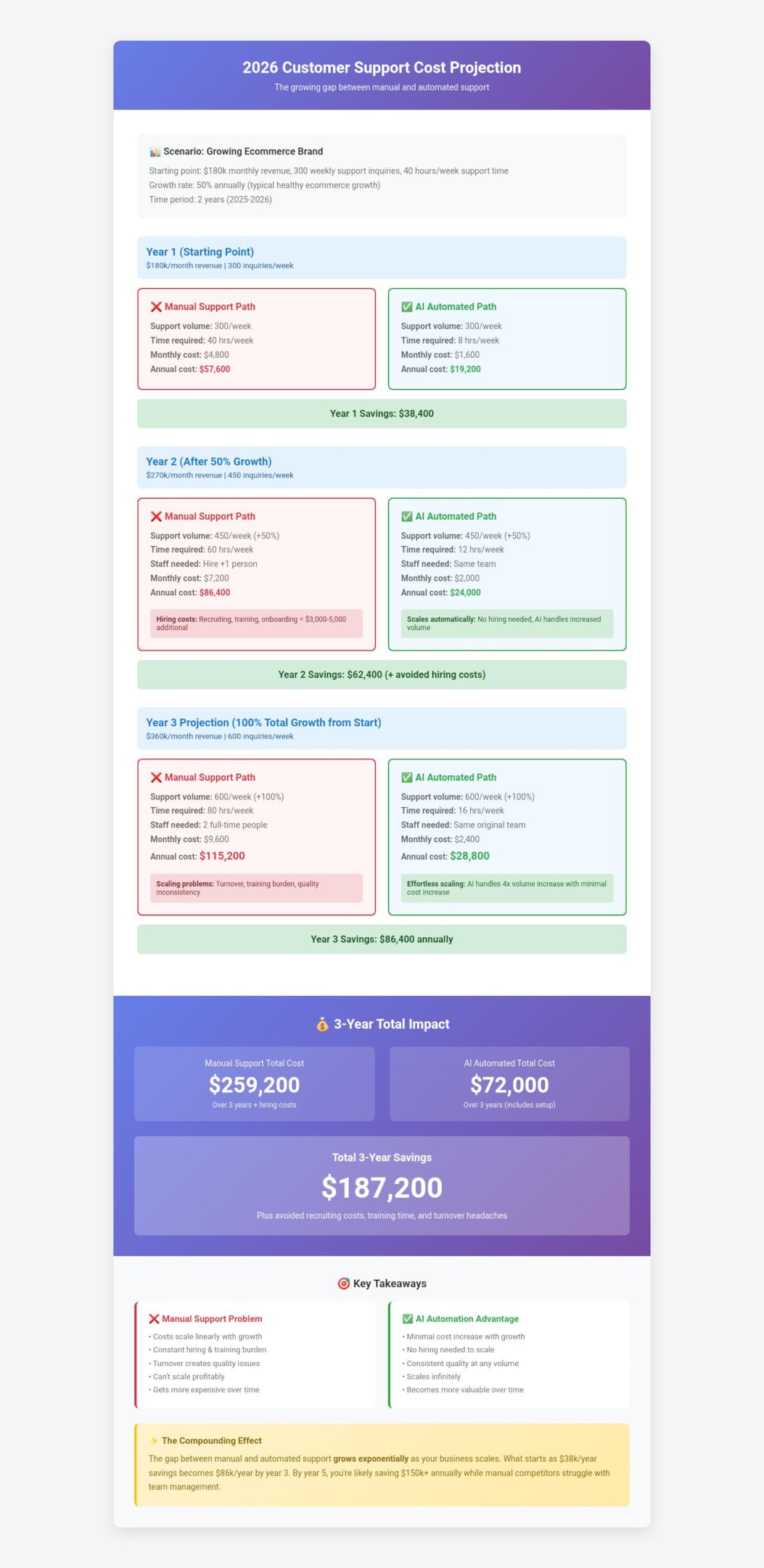
Current volume: 300 inquiries/week = 40 hours support time
You grow 50% (healthy ecommerce growth rate)
New volume: 450 inquiries/week = 60 hours support time
You need to hire another person = +$2,400/month in costs
With AI customer support automation:
Current volume: 300 inquiries/week = 8 hours support time (AI agents handle 70%)
You grow 50%
New volume: 450 inquiries/week = 12 hours support time (AI still handles 70%)
You need +4 hours weekly = +$480/month in costs
Growth with AI costs 1/5th as much as growth with humans.
The competitive landscape is shifting:
Direct-to-consumer brands are implementing AI support (because they have to compete on experience)
Amazon third-party sellers are automating (because margins are thin)
Shopify brands are adopting faster than any other segment
Here's what happens to ecommerce brands in the next 12-24 months:
Brands that implement AI customer support automation:
Save $30k-$60k annually in customer service costs
Increase customer satisfaction with instant, personalized support
Scale support effortlessly as they grow
Free up staff for revenue-generating activities
Stay competitive on customer experience
Brands that stick with manual support:
Pay 3-5x more for same support quality
Lose sales to competitors with faster response times
Burn out support staff with repetitive work
Hit scaling limits (can't afford to hire proportionally)
Fall behind on customer experience expectations
The writing is on the wall: automated customer service for ecommerce isn't a nice-to-have anymore. It's becoming a competitive requirement.
Ready to Cut Your Customer Service Costs 70%?
Customer support automation is no longer experimental—it's proven. The technology works, the ROI is clear, and your competitors are already implementing it.
The facts:
70-80% of support inquiries can be automated today
Typical savings: $3,000-$5,000 per month for mid-market ecommerce
Your customer service team focuses on high-value work instead of copy-paste responses
If you're an ecommerce brand doing $50k+ monthly revenue and spending more than 15 hours weekly on customer support, you're leaving money on the table.
Free Support Automation Audit
Here's what I'm offering Connecticut ecommerce brands:
I'll analyze your support volume and show you:
What percentage of your inquiries can be automated
Expected time savings (hours per week)
Projected cost reduction (dollars per month)
Exact implementation roadmap for your business
ROI timeline
The audit includes:
Review of your last 30 days of support tickets and customer conversations
Breakdown by category and automation potential
Cost-benefit analysis specific to your volume
30-minute strategy call to walk through findings
No obligation, no pressure. I'll show you the numbers and you decide if it makes sense for your business.
Most ecommerce brands discover they can automate 60-75% of support volume and save $2,500-$4,500 monthly. The brands seeing the biggest impact are:
Doing $50k-$500k monthly revenue
Handling 150+ support inquiries weekly
Currently spending 20+ hours weekly on support
Experiencing growth (or want to grow without hiring proportionally)
If this sounds like your business, let's talk.
This article focused on AI customer support automation, automated customer service for ecommerce, AI chatbot for customer support, and strategies to reduce customer service costs with AI for Connecticut ecommerce brands and online retailers.