In this guide, you'll see exactly how the system works, what each tool does, and why this is the most cost-effective creative operation running on Meta right now.
Your Meta spend is up 40% this quarter.
Your creative output is up 12%.
Your CPM is climbing every week because you're running the same 6 ads your designer made last month. Meta's algorithm has seen them. Your audience has seen them. And your cost per click is quietly bleeding your margins dry.
Here's what's actually happening in your ad account right now:
The gap between what Meta requires and what your team can produce is where your ad budget dies.
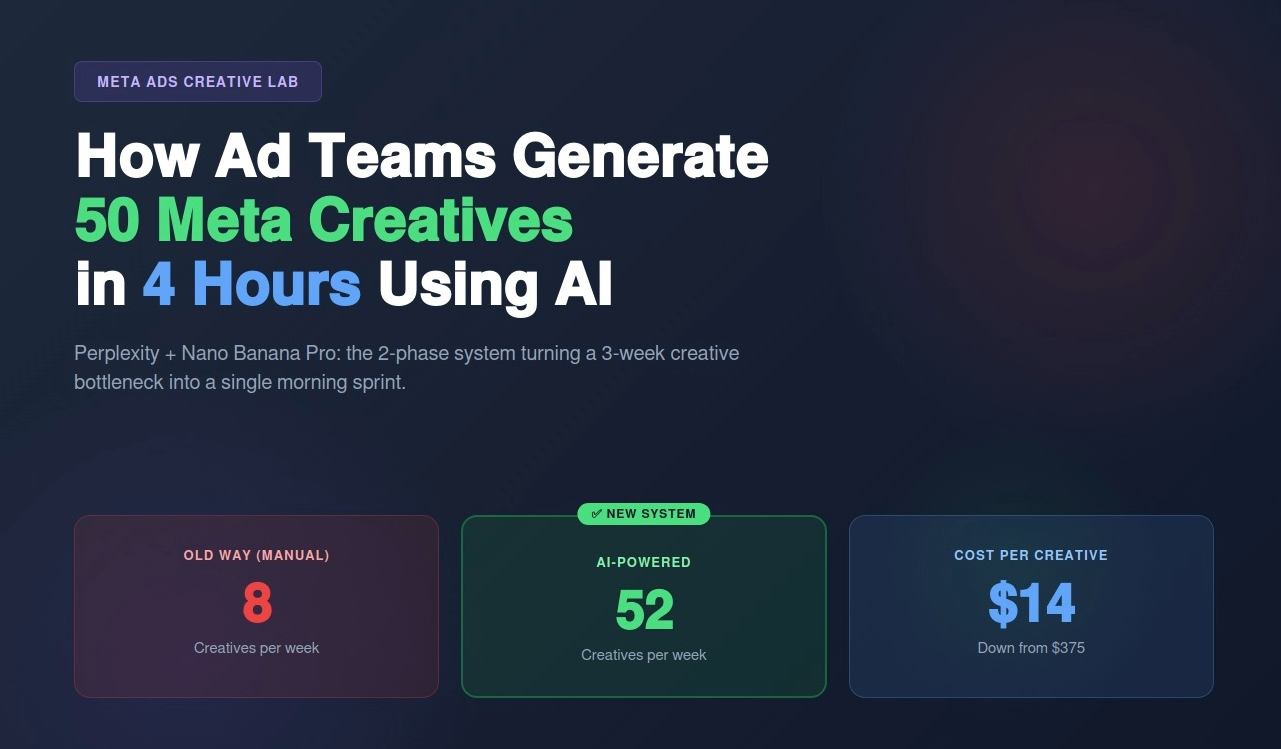
I'm Renzo, founder of RDC Group. We run paid media for brands and agencies. Over the past 8 months, we've built a creative generation system using Perplexity and Nano Banana Pro that produces 50 publication-ready Meta creatives in a single 4-hour session. Here's what that looks like in practice:
In this guide, you'll see exactly how the system works, what each tool does, and why this is the most cost-effective creative operation running on Meta right now.
If you run Meta ads, you already feel this. But let's put exact numbers on it so you know what it's costing you.
Creative fatigue is simple: your audience has seen your ad enough times that they stop engaging. When that happens, Meta charges you more to show it to people who haven't seen it — because the people who have are ignoring it.
The typical fatigue timeline:
For a brand spending $50K/month on Meta:
You need 12–18 fresh creatives every week to keep your top ad sets running at peak performance. Most brands produce 3–4. That means you're running fatigued ads for 60–70% of your active flight, and you're paying premium CPMs the entire time.
The annual cost of that gap: For a $50K/month spender, the difference between sustained high-performance creative and the fatigue-and-pause cycle costs an estimated $180K–$240K per year in wasted ad spend. Same budget. Fewer results.
The old way creative gets made:
That's 8–11 days per creative. At 12–18 creatives per week, you'd need a creative team of 10. Nobody has a creative team of 10.
The shortcuts most teams try:
Stock photo templates look generic and perform mediocre. Canva's batch mode still requires manual decisions for every single ad. AI image generators produce pretty pictures but don't know how to structure an ad — the hook, the composition, the text placement. You still need someone to turn a pretty image into a converting creative.
None of these close the gap. The core problem is that you need strategic creative thinking (the angle, the hook, the emotional trigger) AND production at scale (actually building 50 ads from those ideas). Those are two different skills. Doing both manually is what kills teams.
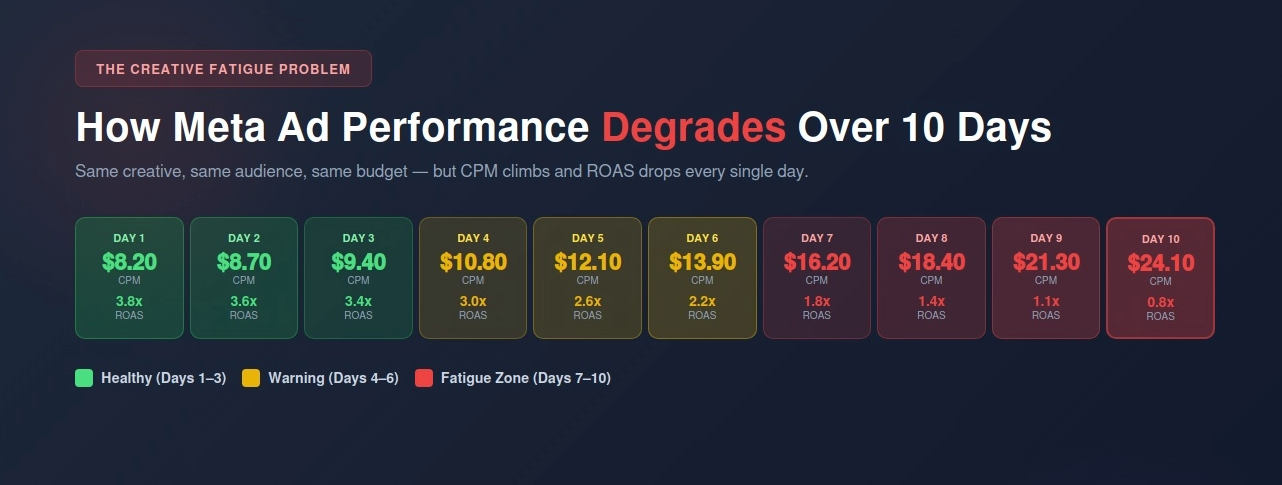
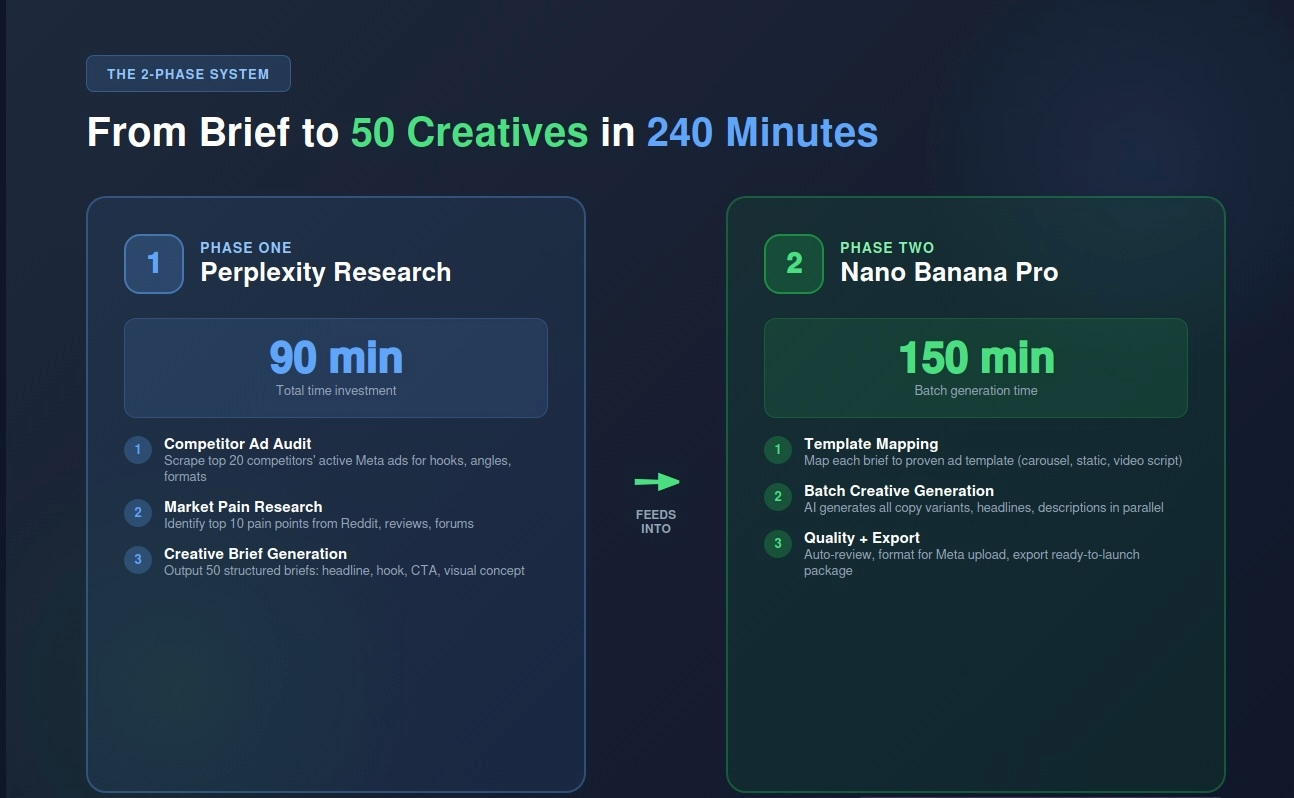
The Perplexity + Nano Banana Pro system doesn't try to do everything at once. It splits creative production into two phases. Phase 1 is strategy — the angles, hooks, and concepts. Phase 2 is execution — turning those concepts into actual ads. Each tool owns one phase. Together, they do in 4 hours what takes a team 2 months manually.
Perplexity handles the research and angle generation. This is where most teams lose 80% of their time — manually scrolling Facebook Ad Library, reading Reddit threads, guessing at what angles might work.
What you actually do in Perplexity:
Step 1 — Competitor creative audit (20 minutes). You pull your top 5 competitors and run structured prompts:
Perplexity pulls from Ad Library, industry blogs, and competitor social pages — and gives you a real-time competitive landscape in 20 minutes instead of 3 hours of manual scrolling.
Step 2 — Audience pain point mining (25 minutes). This is where the best creative angles come from — real frustrations from real people.
You now have a list of actual pain points, in the actual language your audience uses. That's your creative fuel.
Step 3 — Angle generation (25 minutes). Feed the research back into Perplexity with a structured prompt:
"Based on these competitor angles and these customer pain points, generate 10 unique ad creative angles for [Product]. Each angle needs: a hook headline under 30 characters, a supporting headline, the core visual concept, and the emotional trigger it hits. No two angles should overlap."
Output: 10 distinct creative angles, each fully briefed. Ready to build.
Step 4 — Variation expansion (20 minutes). Take the top 5 angles and expand each one into 3 variations:
Perplexity output after 90 minutes: 15 fully briefed creative concepts. Headline, visual direction, emotional hook, and CTA — for each one. Ready for Phase 2.
Nano Banana Pro takes the 15 concepts from Phase 1 and turns them into production-ready ads — images, carousels, video stills — at volume.
What happens:
Step 1 — Template mapping (15 minutes). You select your brand template library (pre-built in Nano Banana Pro with your colors, fonts, logo rules). The system maps each of the 15 concepts to the right format: single image, carousel, story, or slideshow — based on the visual direction from Perplexity.
Step 2 — Batch generation (90 minutes). Nano Banana Pro generates all 15 base creatives simultaneously. Each one follows your brand guidelines while executing the unique visual concept from the brief. AI imagery matching the visual direction. Text overlay placed and sized correctly. Brand elements positioned per your rules.
Step 3 — Variation rendering (30 minutes). Each base creative gets rendered in its 3 variations from the Perplexity expansion. Different headline, different visual treatment, different CTA. Same brand. Same quality.
15 base creatives × 3 variations = 45 ads.
Step 4 — Quality pass + bonus round (15 minutes). You review the 45 outputs. Anything that needs a tweak gets flagged. And 5 additional creatives get generated from the angles that looked strongest in the review.
Final output: 50 publication-ready Meta ad creatives. In 4 hours.
Not all Meta creatives are equal. Here's what the system outputs across the formats that actually drive results in 2025.
The workhorse format. The system generates image ads with AI-generated hero imagery, headline overlays with tested hooks, brand logo and CTA placement, and multiple aspect ratios — 1:1 for Feed, 4:5 for Feed scroll, 9:16 for Stories and Reels.
Output per session: 18–22 single image ads.
Carousels need visual consistency across all cards — something that's painful to maintain manually when you're making them fast. The system generates all cards with a matching visual treatment, tells a story across the sequence (problem → solution → proof → CTA), and keeps the brand consistent from card 1 to card 5.
Output per session: 8–12 carousel sets (3–5 cards each).
For brands that want video-like performance without actual video production: the system generates 4–6 frames per slideshow, each one advancing the story, with smooth transitions between them. Looks and feels like video. Costs like images.
Output per session: 10–15 slideshow sets.
This is the format that's eating every other format on Meta right now. Raw, unpolished, looks-like-a-real-person's-photo aesthetic. Conversational text overlays. Product in a real-life context.
The system generates these with intentionally imperfect composition, natural lighting, and casual text styling. They don't look "designed." That's the point.
Output per session: 8–10 UGC-style creatives.
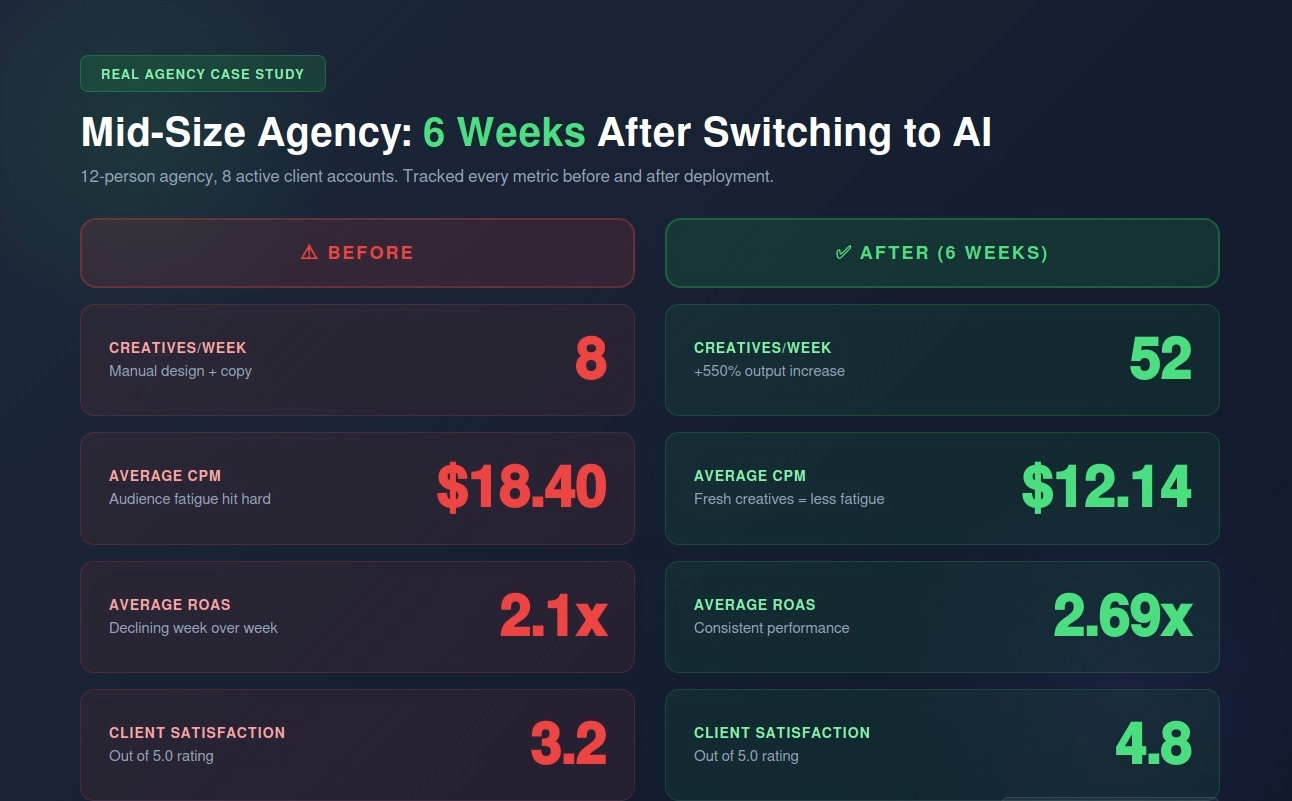
A performance marketing agency managing 12 e-commerce clients. $1.8M in total monthly ad spend under management. Creative team of 2 designers and 1 strategist.
Weekly creative output: 8 ads across all 12 clients. That's less than 1 new creative per client per week.
Average time from brief to live: 9 days.
What was happening: Creative fatigue was hitting every account. CPMs were climbing. Clients were complaining that their ads looked stale. The strategist was spending 60% of their time on research that could have been automated. The designers were underwater.
Monthly creative cost: $18,400 (designer salaries + tools + freelance overflow when they fell behind).
Setup: 2 weeks. Built brand templates for all 12 clients in Nano Banana Pro. Trained the strategist on the Perplexity workflow. Ran one full 4-hour session as a test.
Weekly creative output after go-live: 52 creatives per week. Across all 12 clients.
Time from brief to live: 2 days.
Performance impact across all 12 accounts:
Cost impact: Freelance overflow eliminated — $3,200/month saved. The strategist's research time dropped from 60% to 15%, freeing them up for actual strategy. Perplexity + Nano Banana Pro tools cost $620/month. Net savings of $2,580/month, on top of the performance improvements.
The ROAS lift alone — 28% across $1.8M in spend — translates to $504K in additional revenue per month that the agency is generating for its clients with the same budget.
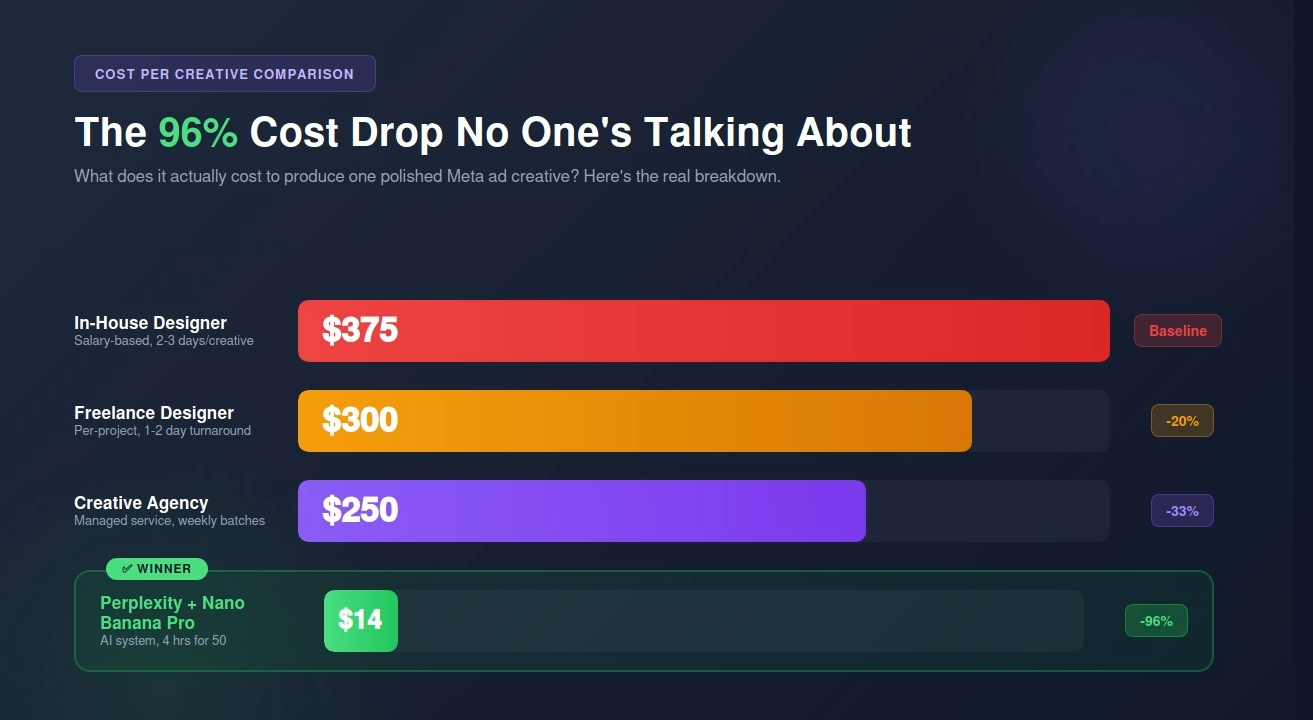
In-house designer: $5,800–$8,200/month salary. Output of 3–5 creatives per week. Turnaround of 5–7 days. That works out to roughly $350–$500 per creative.
Freelance designer: $65–$120/hour. Output of 4–6 creatives per week. Turnaround of 3–5 days. About $220–$380 per creative.
Creative agency: $8,000–$15,000/month retainer. Output of 8–15 creatives per week. Turnaround of 3–5 days. About $150–$350 per creative.
Tool cost: $620/month for Perplexity + Nano Banana Pro. Internal time: 4 hours per week (anyone on the team can run it). Output: 40–50 creatives per week. Turnaround: 2 days.
Cost per creative: $12–$16.
This isn't a replacement for everything. There are situations where manual creative work is still the way to go.
Use manual when: You're launching a brand and the hero creatives need to be pixel-perfect. You're shooting a video with a real person or influencer. You're doing identity work — logo, visual system, brand guidelines.
Use the system when: You need volume — testing 10 angles simultaneously instead of 2. You need speed — new creative every 2–3 days to fight fatigue. You're scaling spend and your creative output isn't keeping up.
The rule is simple: if you're spending more than $10K/month on Meta and your creative output isn't matching your spend growth, you have a problem. This system solves that problem.
The system works best when someone who understands Meta advertising is running it. Writing Perplexity prompts that produce strong creative angles is a skill. Knowing which formats convert vs which just look good is experience. Knowing which of the 50 creatives to scale and which to kill requires judgment.
What RDC's creative automation service includes:
Pricing:
Typical results in the first 30 days:
Ready to see what this would look like for your Meta account?
Book your free creative audit →
We'll audit your current creative performance, show you where fatigue is hitting hardest, and map out exactly how the system would scale your output.
No commitment. No sales pitch. A free audit and a clear plan.
Email: renzo@rdcgroup.co
Website: rdcgroup.co