Google killed call-only ads in February 2026. Here's how local service businesses can migrate to responsive search ads with call assets without losing phone leads or tracking accuracy.
If you run a plumbing company, HVAC business, dental practice, or any local service that depends on phone calls, Google just pulled the rug out from under you.
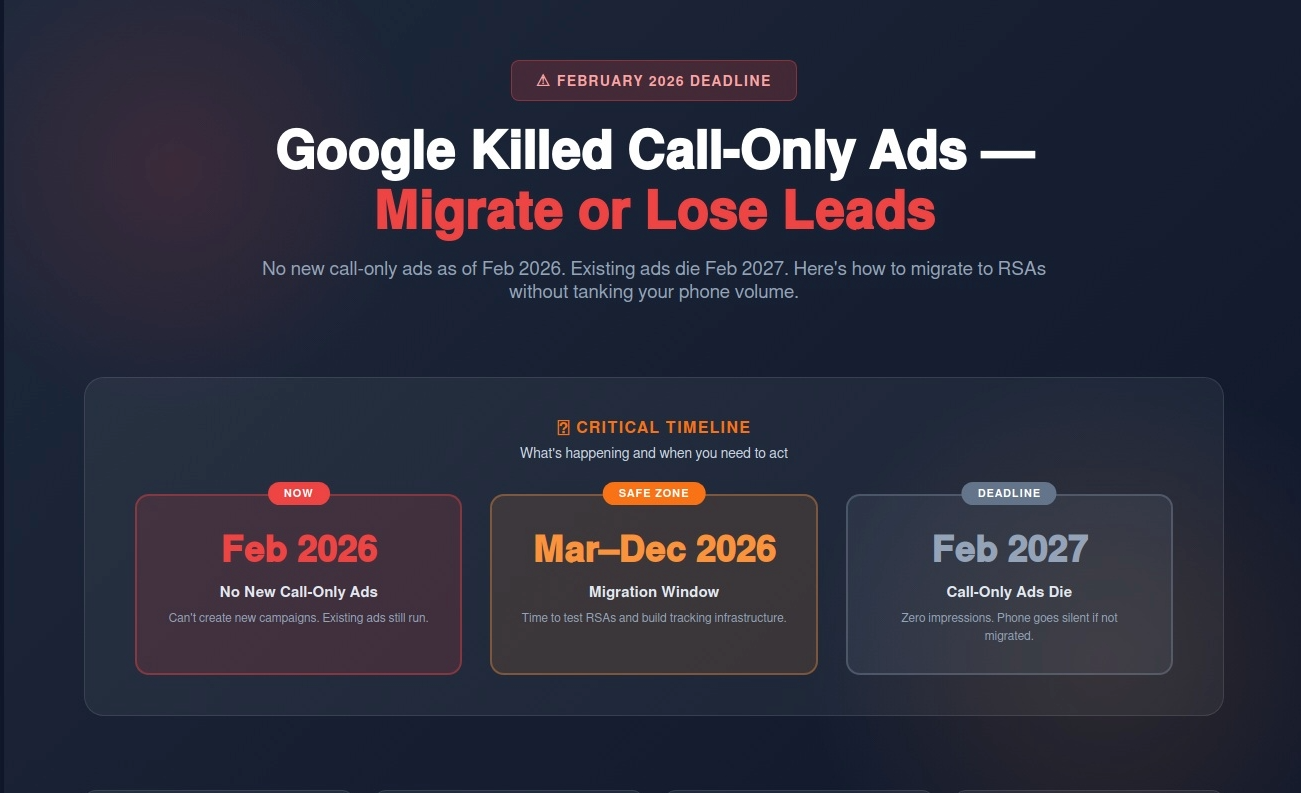
On February 2026, Google quietly deprecated call-only ads. You can no longer create new ones. By February 2027, your existing call-only ads will stop serving entirely.
For businesses that built their entire lead generation strategy around "tap to call" ads, this isn't just an inconvenience—it's an existential threat. A tree service company in Connecticut that generates 80% of leads from call-only ads during storm season doesn't have the luxury of waiting until 2027 to figure this out.
The good news? There's a replacement: Responsive Search Ads (RSAs) with call assets. The bad news? Most businesses will screw up the migration and watch their cost per lead double.
This guide shows you exactly how to migrate without losing phone volume, tracking accuracy, or your mind. We'll cover the technical setup, the call tracking infrastructure you need, and why this might actually be the perfect time to add AI voice agents to your stack.
Call-only ads had one job: get your phone to ring. They were simple, effective, and built specifically for businesses where the phone call IS the conversion.
Google's killing them for the same reason they kill everything: AI optimization requires more inputs.
Here's what Google told advertisers: "Call-only ads limit our ability to optimize across formats. RSAs with call assets give us more flexibility to show the right ad at the right time."
Translation: "We want to control when you get calls vs clicks, and call-only ads don't let us do that."
For Google, this is about maximizing auction participation. For you, this is about maintaining lead flow without tripling your CPA.
The typical agency approach to this migration goes like this:
This is how you tank your phone volume by 40% while increasing your cost per call by 60%.
Here's why that approach fails:
Call-only ads had ONE objective: Drive phone calls. Google's algorithm optimized 100% for that outcome.
RSAs with call assets have TWO objectives: Drive clicks to your website OR drive phone calls. Google's algorithm now splits optimization between both.
If your landing page loads slowly, has poor mobile UX, or doesn't match the ad intent, Google will start favoring the phone call path. But if Google thinks it can get a "conversion" from a website visit (form fill, chat, whatever), it'll send traffic there instead—even if that's not what you want.
The businesses that migrate successfully understand this: you're not just swapping ad formats, you're rebuilding your entire call tracking and optimization infrastructure.
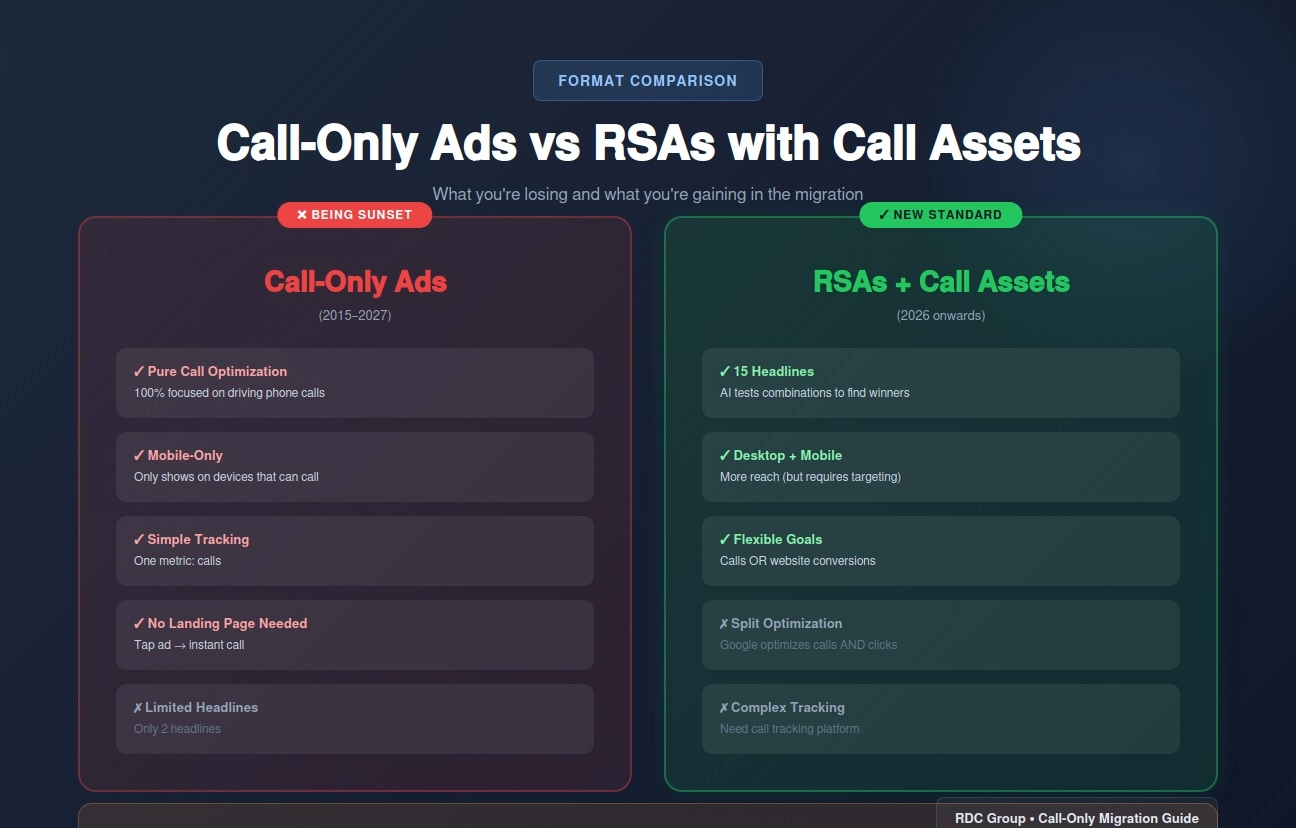
Let me break down exactly what you're losing and what you're gaining:
Pure call optimization: Google no longer optimizes exclusively for phone calls. RSAs optimize for whatever Google thinks will convert—calls, clicks, or form fills.
Simplified tracking: Call-only ads had one metric that mattered: calls. Now you're tracking calls, clicks, click-to-call rate, and website conversions.
Mobile-only targeting: Call-only ads only showed on mobile devices. RSAs show on desktop too, which means you're now paying for clicks from people who can't/won't call.
More headline and description flexibility: RSAs let you test 15 headlines and 4 descriptions (vs 2 headlines in call-only ads).
Desktop visibility: If you actually want website traffic in addition to calls, RSAs give you that option.
AI-driven creative optimization: Google's AI will test headline/description combinations to find what drives the most calls (in theory).
Here's the exact process I used to migrate 17 local service businesses from call-only ads to RSAs without losing lead flow:
Before you touch anything, document your baseline metrics. Pull the last 90 days of data for every call-only campaign:
Most businesses skip this step and then have no idea if the migration worked.
Create a spreadsheet with these columns:
This becomes your migration scorecard. If your new RSA campaigns don't match or beat these numbers within 30 days, something's broken.
Do NOT just convert your existing call-only campaigns into RSAs. The campaign structure that worked for call-only ads won't work for RSAs.
Here's the structure that works:
Campaign Level:
Ad Group Level:
Why separate ad groups? Because emergency searches need different messaging than scheduled service searches. Emergency = "We answer in 30 seconds." Scheduled = "Book online in 2 minutes."
Ad Level (RSAs):
Each RSA needs:
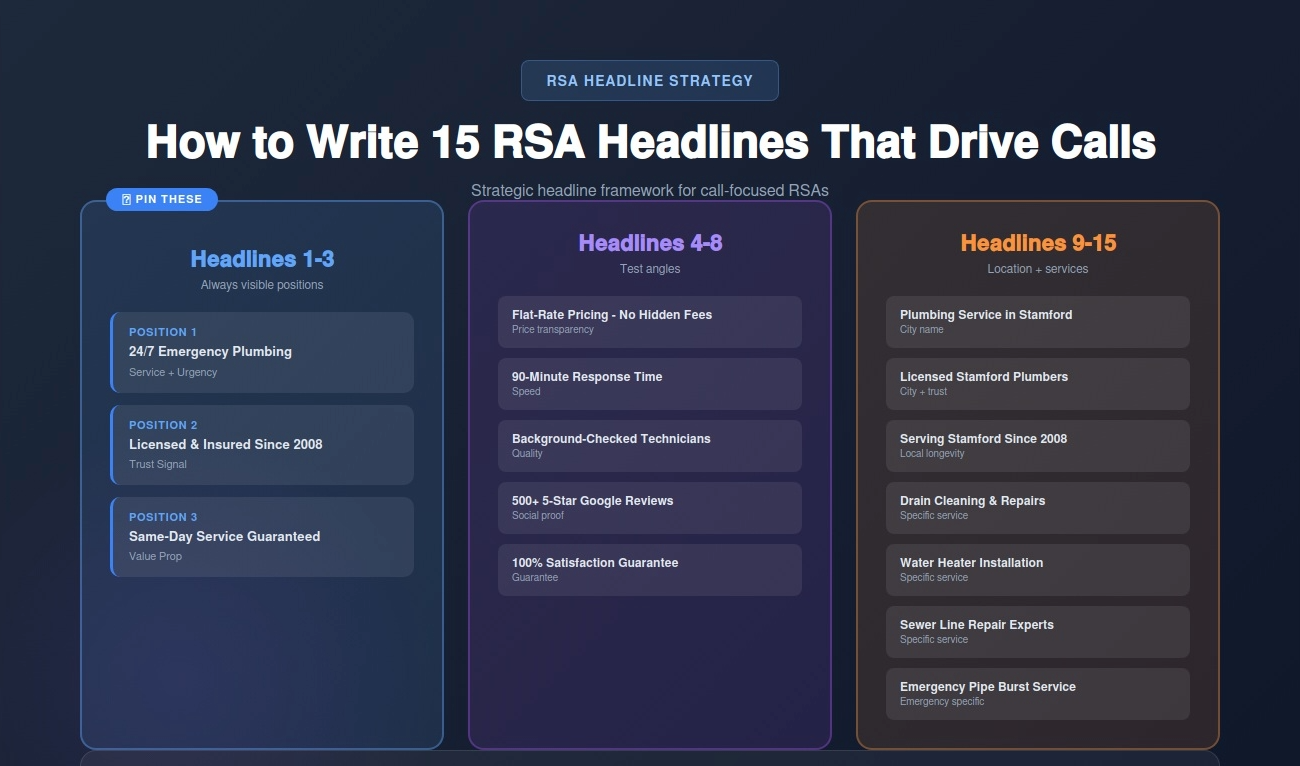
Here's the critical part most businesses miss: Pin headlines strategically.
Pin headline position 1: Your primary value prop ("24/7 Emergency Plumbing") Pin headline position 2: Your differentiation ("Licensed & Insured Since 2008") Let Google rotate positions 3-15: This is where you test messaging
Why pin positions 1-2? Because those are the only headlines mobile users see in collapsed view. If Google puts a weak headline in position 1, your CTR tanks.
This is where 90% of migrations fail. You MUST have proper call tracking or you're flying blind.
Here's what you need:
Call Tracking Platform:
Use CallRail, CallTrackingMetrics, or Invoca. These platforms give you:
Google Ads Call Conversion Setup:
The Call Extension Configuration Most People Screw Up:
In your call asset settings:
Why use a tracking number instead of your business number? Because Google can't track calls to your business number. You need campaign-level attribution.
Do NOT shut off your call-only ads and go all-in on RSAs. That's how you crater your pipeline.
Here's the safe migration timeline:
Week 1-2:
Week 3-4:
Week 5-6:
Week 7-8:
This gradual approach gives you time to catch problems before they destroy your lead flow.
Most businesses just toggle "call extensions" on and think they're done. Wrong.
Here are the specific settings that determine whether your phone rings or doesn't:
Phone number: Use your call tracking number (NOT your business number)
Call reporting: ENABLED (otherwise Google has no idea if anyone called)
Count calls as phone call conversions when they last at least: 60 seconds
When to show: All days, all hours (let Google optimize when to show it)
Google's algorithm doesn't automatically prioritize calls just because you added call assets. You need to tell it to.
Device bid adjustments:
Time of day bid adjustments:
Location bid adjustments:
Why tighten your radius? Because RSAs show on desktop, and desktop users are more likely to click from outside your service area.
Call-only ads let you write headlines like "Call Now - 24/7 Emergency Service." RSAs require a different approach because Google's AI is mixing and matching your headlines.
Here's the framework:
Pin headlines 1-3 in positions 1-3. Let Google test everything else.
Description 1: What makes you different + call to action "Family-owned plumbing company serving [City] for 15 years. Call now for same-day service—we answer in 30 seconds."
Description 2: Services + trust signals "Emergency repairs, installations, inspections. Licensed, insured, and background-checked technicians. Upfront pricing before we start work."
Description 3: Availability + guarantee "Available 24/7 for emergencies. Flat-rate pricing means no surprises. 100% satisfaction guaranteed or your money back."
Description 4: Social proof + urgency "Join 500+ happy customers who chose us for fast, reliable service. Call now—most jobs completed same-day."
Here's the brutal truth: If you migrated from call-only ads to RSAs and your phone stopped ringing, your landing page is probably the problem.
Call-only ads never sent traffic to a landing page. Users tapped the ad and called. Zero friction.
RSAs with call assets give users TWO options:
If your website is slow, confusing, or doesn't make it obvious how to call, Google's algorithm will learn that "website visits don't convert" and stop showing your ads.
Here's what your landing page MUST have:
Above the fold (visible without scrolling):
Below the fold:
Technical requirements:
Test your landing page on a real phone. If you can't call within 3 seconds of landing on the page, fix it.
Here's the part most agencies won't tell you: Migrating to RSAs is the perfect time to add AI voice answering to your call stack.
Why? Because RSAs generate more call volume during off-hours and from less-qualified leads. If you don't have someone answering those calls, you just wasted your ad spend.
Here's what an AI voice agent does:
For qualified calls: Books the appointment, collects customer info, sends confirmation
For off-hour calls: Captures the lead, schedules callback, sends SMS confirmation
For unqualified calls: Filters out wrong service area, competitors, solicitors
Cost: $280-$480/month (vs $3,500+/month for a human receptionist)
The businesses seeing the best results from RSA migration are the ones who set up this stack:
This costs less than hiring one receptionist but handles 10x the call volume.
If you run a local service business and you're doing the RSA migration anyway, this is the time to test AI answering. Your call volume is about to get more unpredictable—AI gives you overflow capacity without hiring.
Here's your complete migration checklist. Save this and work through it step-by-step.
Pre-Migration (Week 1):
Campaign Build (Week 2):
Testing Phase (Week 3-4):
Scale Phase (Week 5-8):
Post-Migration (Week 9+):
Even with perfect execution, some migrations don't work. Here are the 5 most common failure modes and exactly how to fix them:
Diagnosis: Google is sending traffic to your website instead of prioritizing calls.
Fix:
Diagnosis: You're getting unqualified calls from broader match.
Fix:
Diagnosis: RSAs are showing on desktop and attracting different searcher intent.
Fix:
Diagnosis: Your landing page has a form and Google is optimizing for form fills.
Fix:
Diagnosis: Your tracking number got picked up by lead gen databases.
Fix:
February 2027 feels far away. It's not.
If you wait until your call-only ads stop serving to figure out the migration, you'll panic, rush the setup, and watch your cost per lead triple while your phone goes silent.
The businesses that come out ahead are the ones who migrate now, while they still have time to test, optimize, and build the infrastructure needed to make RSAs work.
Here's what to do today:
And if you run a local service business that depends on phone calls, seriously consider adding AI voice answering to your stack. RSAs create more call volume variability—AI gives you the capacity to handle it without hiring.
The call-only ad sunset isn't a disaster. It's an opportunity to build a better, more trackable, more scalable call generation system.
Just don't wait until 2027 to start.
About RDC Group
We help local service businesses migrate from call-only ads to RSA + AI voice agent systems that generate more leads at lower cost. If you need help with the migration or want to test AI answering, book a strategy call.