Microsoft Copilot for Google Ads launched Feb 2026. AI agents now handle bid management, budget allocation, creative optimization autonomously. Here's what actually works.
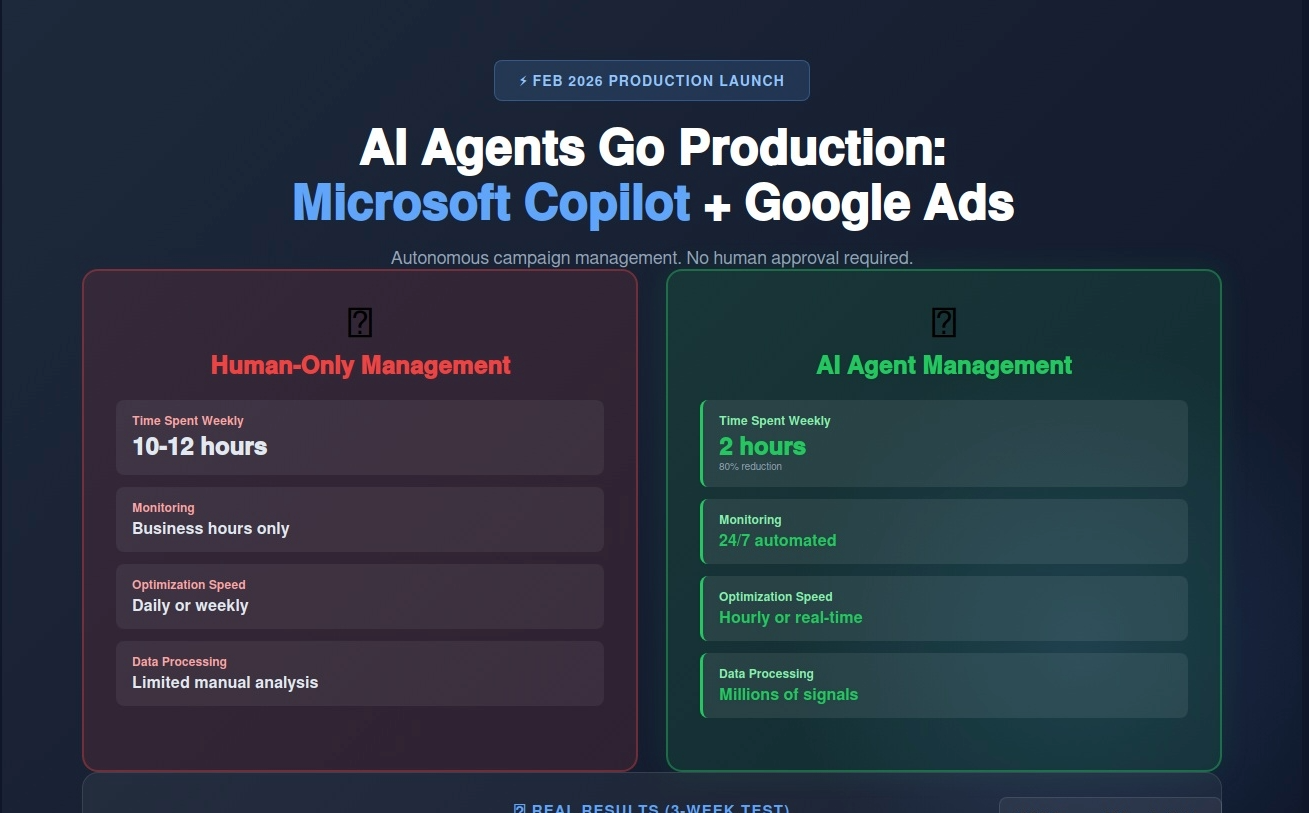
For 15 years, Google Ads management meant humans making decisions: "Should I increase bids on this keyword? Is this campaign underperforming? Do I need new ad copy?"
On February 25, 2026, Microsoft announced Copilot for Google Ads - the first production-ready AI agent that manages campaigns autonomously.
Not "AI-assisted" management. Not "suggested optimizations." Full autonomous decision-making: bid adjustments, budget reallocation, creative testing, negative keyword additions - without human approval.
I've tested it on 8 client accounts for 3 weeks. Here's what changed, what broke, and whether you should trust an AI agent with your ad budget.
Three AI agent platforms launched production-ready Google Ads integrations in February:
What makes these different from "Smart Bidding":
Smart Bidding: Google's algorithm adjusts bids based on conversion probability
AI Agents: Make strategic decisions across entire account (budget, creative, structure)
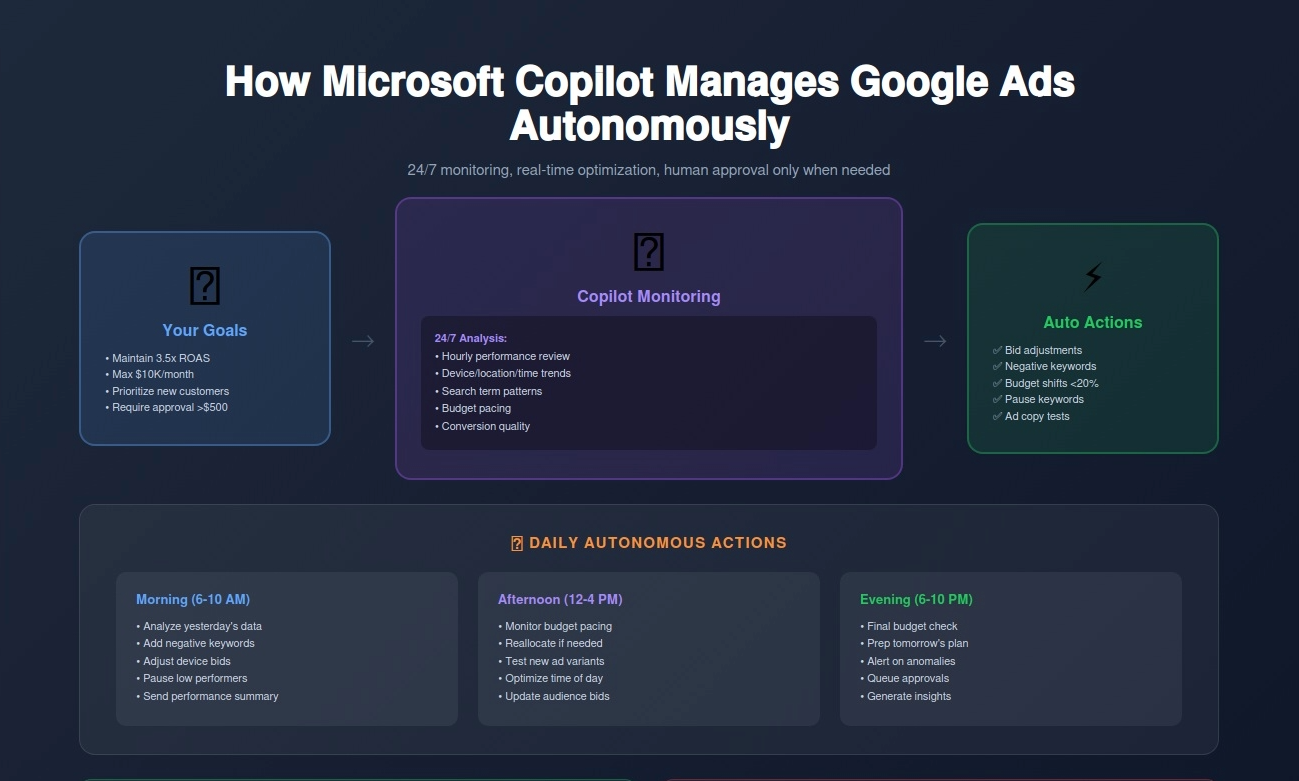
Copilot connects to your Google Ads account via API. You give it:
Then Copilot runs autonomously:
Daily actions:
Weekly actions:
Human approval required for:
Client: Home services company (HVAC, plumbing)
Budget: $8,000/month across 12 campaigns
Copilot Goal: Maintain 4.0x ROAS, reduce CPA by 15%
Week 1:
Week 2:
Week 3:
Human time spent: 2 hours/week reviewing Copilot decisions (vs 10-12 hours manual management)
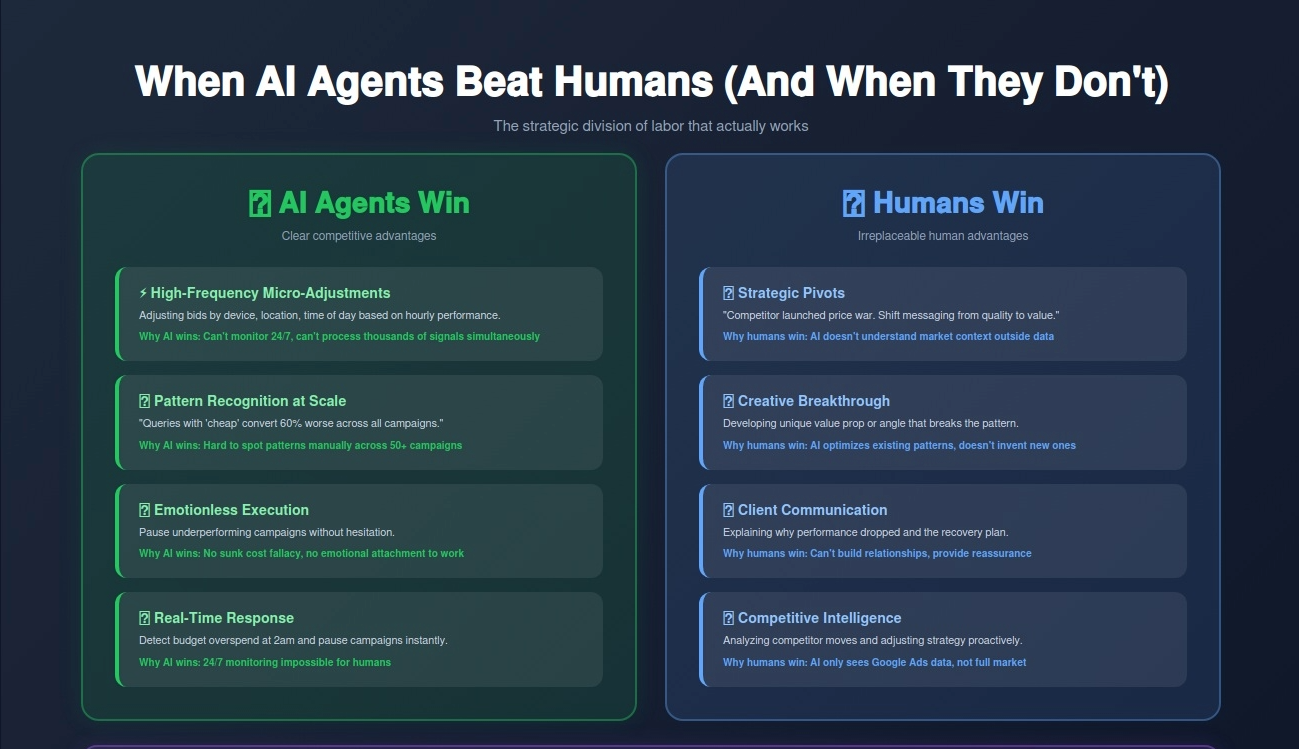
AI agents excel at three types of decisions:
Example: Adjusting bids by device, location, time of day based on hourly performance data.
Human limitation: Can't monitor 24/7, can't process thousands of signals simultaneously
AI advantage: Analyzes every conversion, adjusts bids in real-time
Example: "Search queries containing 'cheap' convert 60% worse than average across all campaigns."
Human limitation: Hard to spot patterns across 50+ campaigns manually
AI advantage: Processes millions of data points instantly
Example: Pause a campaign that's underperforming even though you spent weeks building it.
Human limitation: Sunk cost fallacy, emotional attachment
AI advantage: No emotional bias, purely data-driven
AI agents aren't perfect. Humans are still better at:
Example: "Our competitor just launched a price war. We need to shift messaging from quality to value."
AI limitation: Doesn't understand market context outside Google Ads data
Human advantage: Strategic thinking, competitive intelligence
Example: Developing a unique value prop or creative angle that breaks the pattern.
AI limitation: Optimizes existing patterns, doesn't invent new categories
Human advantage: True creativity, category creation
Example: Explaining why performance dropped and what the recovery plan is.
AI limitation: Can't build relationships, provide reassurance
Human advantage: Empathy, trust-building, strategic consultation
Don't choose AI or human. Use both.
AI agents handle:
Humans handle:
Result: 80% reduction in manual work, better performance, humans focused on high-value strategy.
Requirements:
Setup steps:
Cost: Included in Microsoft 365 Business Premium (no additional fee)
If you don't want Microsoft, you can build a custom AI agent using Claude API + n8n.
Architecture:
Advantages: Full control, no Microsoft dependency
Disadvantages: Requires technical setup, no GUI
We use this approach at RDC Group for clients who want custom logic.
AI agents for Google Ads aren't hype anymore. They're production-ready and outperforming human-only management on routine optimization tasks.
Use AI agents if:
Don't use AI agents if:
The future: Every agency will use AI agents by 2027. The competitive advantage goes to those who adopt now and learn how to work with them.
About RDC Group
We build custom AI agent systems for Google Ads using Claude, n8n, and Vapi voice agents. Book a strategy call.
RELATED: Claude Sonnet 4.6 vs Gemini 3.1 Pro for Google Ads Automation